Beretta A400 L review: a modern classic?
The new Beretta A400 L combines modern engineering with classic styling. Bruce Potts puts it through its paces on clays and in the field.
If you are frustrated by patchy performance, VR offers a high tech way to master line and lead.
I had done all the usual things to improve my hit rate. I pattern tested my shotguns to gauge how flat they were shooting. I identified loads with even and sufficient pellet density.
I took lessons and had a coach identify my errors. I practised weekly at my local clay ground to ingrain muscle memory.
I took decoying opportunities to accustom myself to live quarry. I even acquired a ShotKam to record my shots. I built a comprehensive record of my errors.
Yet I was still routinely exasperated by patchy performance. This was especially true on game days under the gaze of fellow Guns.
A friend confided he had similar issues. He knew when he hit them but not where he missed them. It was driving him crazy.
I think I have found the solution. Unlike most solutions to thorny problems it is convenient and cost effective. The answer is VR.
VR is an immersive three dimensional environment. It precisely tracks your movements and replicates them within the simulation.
It involves wearing a headset with tracking cameras. It includes a high definition display and onboard processing. A mic and speakers handle audio.
Hand held controllers are tracked by the headset. Several systems are available but Meta’s Quest 2 and 3 are popular.
A new Quest 3 is currently £470. You could pay as little as £120 for a used Quest 2. You lose little functionality for shooting training.
Compare that with the cost of cartridges. The penny soon drops on the affordability of this high tech approach.
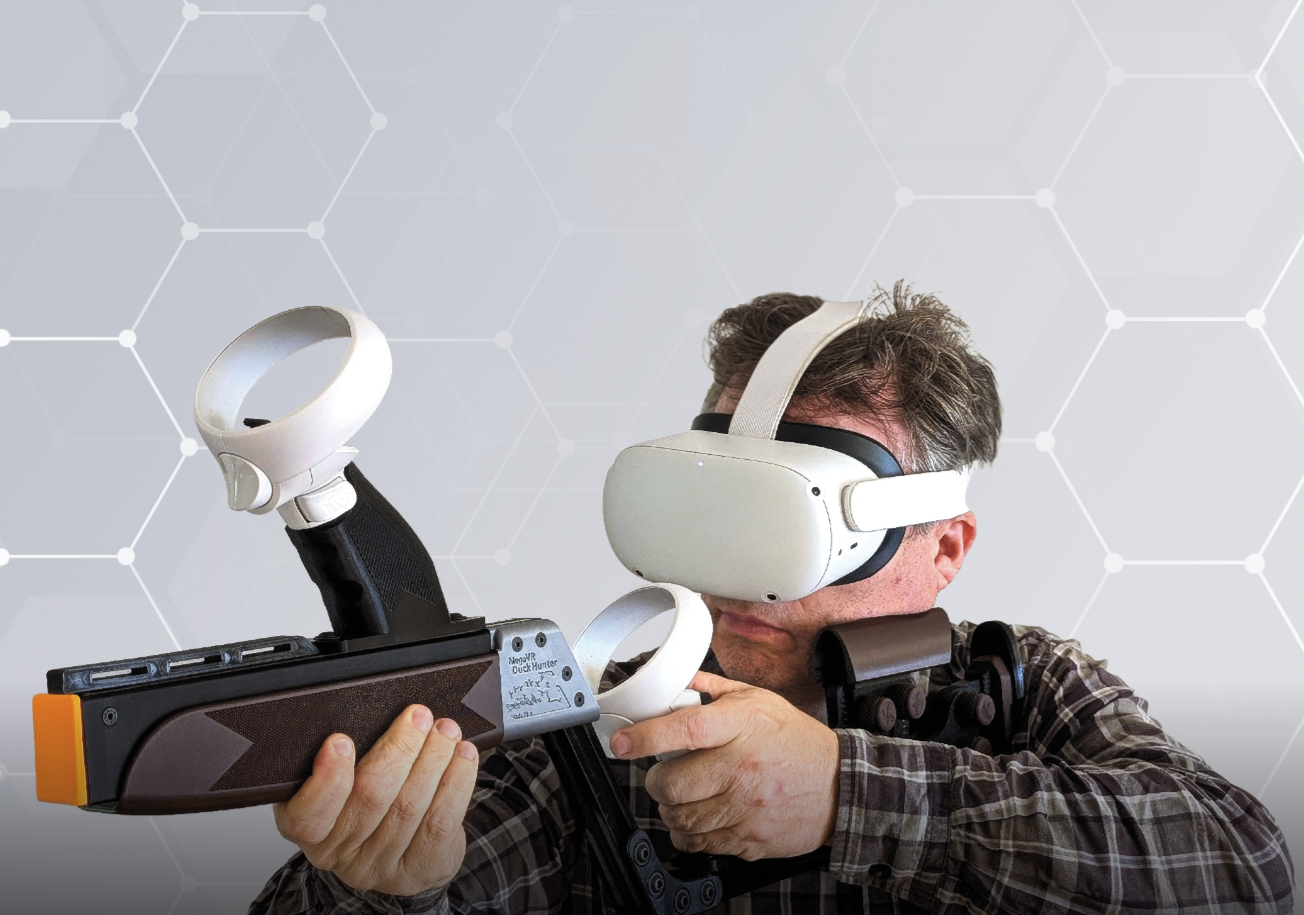
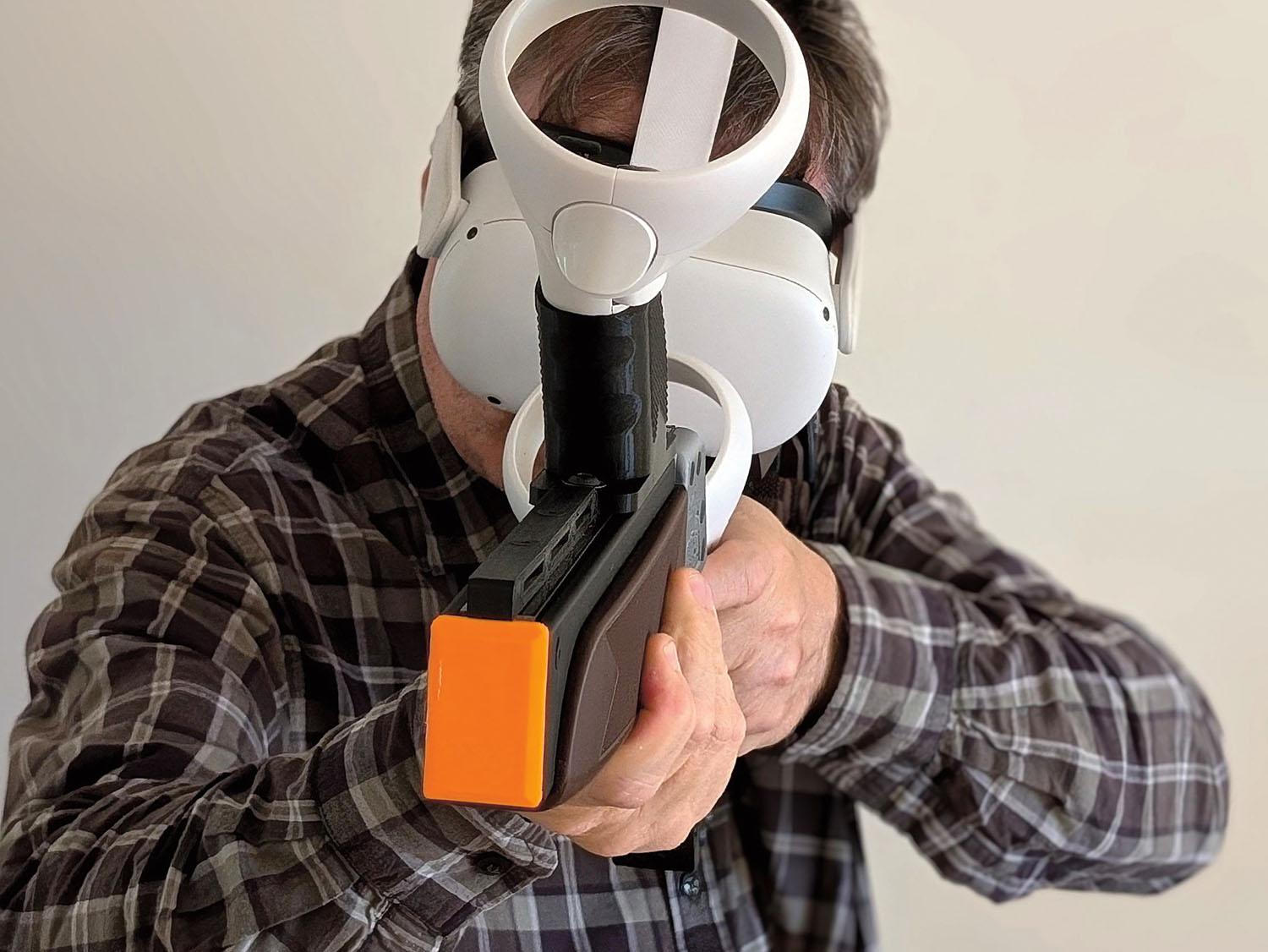
You need a stock to mount the controllers. A good stock is crucial to successful simulated shooting.
This is where the MegaVR Simstock comes in. It was created by the ingenious Nick Royle. It is a highly customisable frame.
It can be adjusted to match your gun dimensions. This includes length of pull, drop, cast, pitch and cant. It also matches weight and balance.
The gun you see in the simulation is generic. However the gun you feel will be a physical twin of your own.
This builds muscle memory of how it moves. It teaches you how much push it needs.

The Simstock is modular in construction. This aids adjustability and makes adding upgrades easy.
It features three extruded aluminium struts. T shaped slots provide attachment points. The forend comprises a hard polymer grip.
A hollow steel box section houses a solid steel weight. There is also a short raised rib for configuring the stock.
The butt assembly centres on a vertical riser. Slots permit a full range of adjustments.
The pistol grip for the controller sits on the same strut. It can be adjusted fore and aft. It can be angled left or right.
The first step is laying out wallpaper to measure your real gun. Mark positions where your body interfaces with the gun.
Measure the degree of cast with a straight rule. Weigh your gun and check the balance point.
The Simstock comes with additional weights. Extra sets can be purchased for hefty guns.
It is easy to adjust the Simstock to fit. A final check along the dummy rib refines the cast. Necessary tools are built into the stock itself.
Settings can be marked with tape. However dedicated stocks are better for multiple shooters. A Junior model is also available.
You need a shooting app once the hardware is ready. MegaVR recommends ClayHuntVR for good reason.
It costs just £24 for the core app. The full suite is £55. It offers sophisticated and realistic scenarios.
You can shoot clays, game and pigeons. Optional modules for wild boar and drones are available.
Select the gun model that matches yours. Adjust digital settings to map the virtual gun to the physical object. Test this on the pattern plate.
The attention to detail is impressive. Layouts are spacious and clays are affected by wind.
Solid hits dust the targets. Clipping the edge just knocks a chip off. Chokes can be changed and make a real difference.
Cartridges can be selected for velocity and shot size. You can even call pull and hear the trap.
VR augments reality by showing your pattern graphic. This enables you to adjust line and lead precisely.
Feedback is less detailed for hunters. Birds react differently when head shot or winged.
Pigs squeal when wounded. Only the driven pheasant scenario shows a pattern representation. It appears as a red or green oval.
This is still immensely useful. It helps with high pheasants where you can become baffled.
You do not get recoil in VR. Only real shooting provides that. However you are relieved of the distraction.
You are free to focus exclusively on hitting the target. You can shoot as much as you like.
Running costs are minimal. You just charge the headset and buy AAA batteries occasionally.
I have been training with VR for four years. I have fired hundreds of thousands of virtual shots.
I crushed most of my bad habits. I gained hugely in confidence. My shooting has definitely improved.
I still miss occasionally. But now I know why so I do not get fazed. I make corrections and recover my form.
Most importantly I enjoy my shooting more than ever.
Hardware megavr.co.uk
Software shotgungaming.com
Price Simstock £269, Simstock JR £199; weight kits £50 and £69; ClayHuntVR from £23.99
Get the latest news delivered direct to your door
Discover the ultimate companion for field sports enthusiasts with Shooting Times & Country Magazine, the UK’s leading weekly publication that has been at the forefront of shooting culture since 1882. Subscribers gain access to expert tips, comprehensive gear reviews, seasonal advice and a vibrant community of like-minded shooters.
Save on shop price when you subscribe with weekly issues featuring in-depth articles on gundog training, exclusive member offers and access to the digital back issue library. A Shooting Times & Country subscription is more than a magazine, don’t just read about the countryside; immerse yourself in its most authoritative and engaging publication.