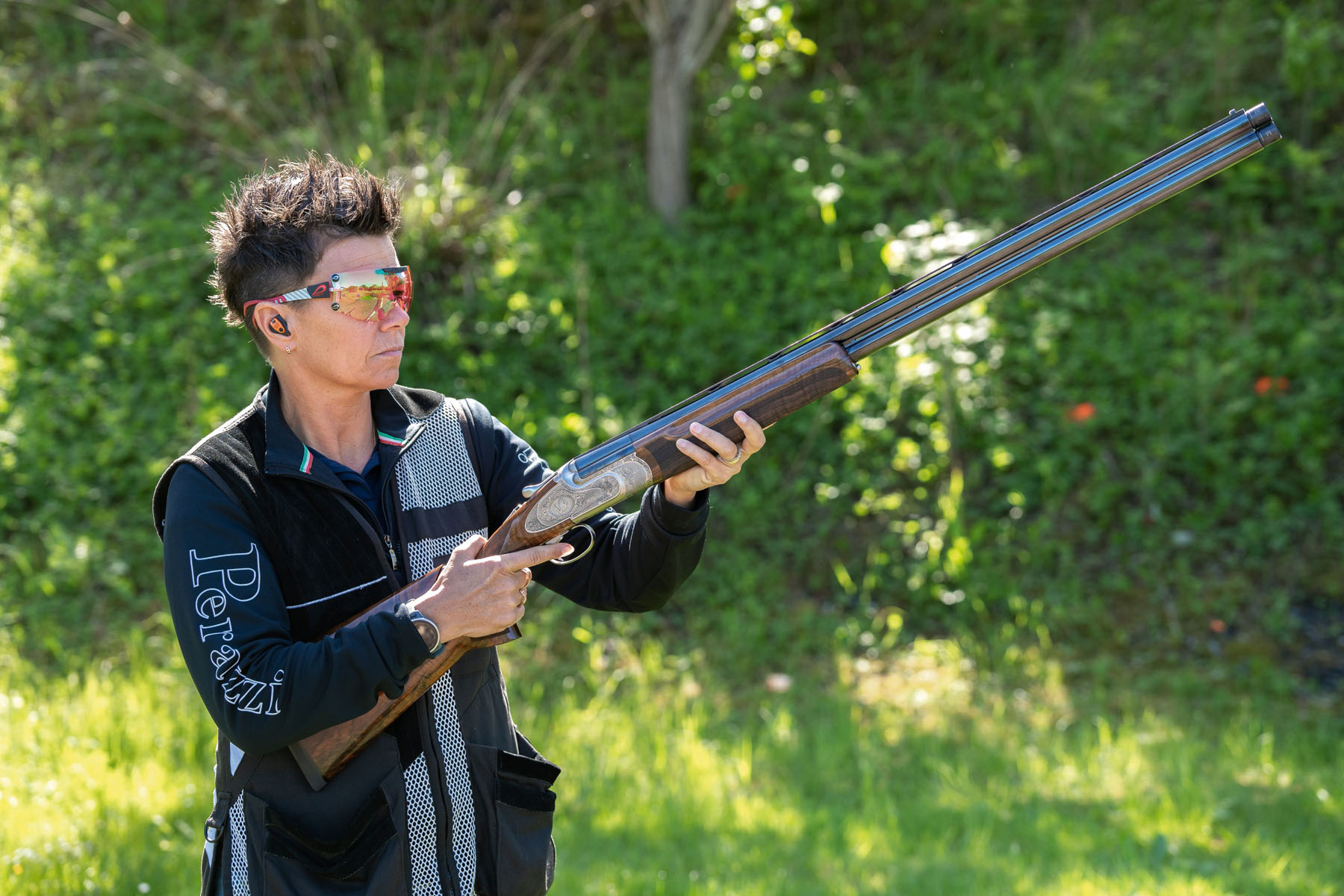
There is a game gun in almost every clayshooter’s past: borrowed or hastily purchased, it was put to work at the clay ground, doing a decent enough job until the shooter became good enough to feel its limitations. At some point – around the time scores began to matter and sessions grew longer – the question surfaced. Is it the gun, or is it me?
Often, it is the gun. Not because a game gun cannot break clays – it clearly can – but because it was never designed to do so consistently, across 100 cartridges, under competitive pressure, with a target flying 60m and less than a second of reading time ahead of the muzzles.
The dedicated Sporter is the answer to a problem that barely existed before the 1980s. Sporting clays grew rapidly in Britain from the late 1970s onwards – the first British Open had been held as far back as 1925, but the sport’s explosion in the following decade forced manufacturers to rethink their catalogues. Shooters who had adapted game guns or pressed Trap guns into service – lowering combs, extending barrels – began demanding something that was purpose-built.
The bespoke evolution of the Sporter
Browning, working with Miroku in Japan, was among the first to respond. The category has evolved, ranging today from sub-£1,200 entry points to five-figure bespoke Perazzis, with a great deal of genuinely excellent engineering sitting between. A Sporter and a game gun are broadly the same object: over-and-under barrels, trigger, stock. The differences are invisible until you pick one up and they are inescapable the moment you shoot a tricky driven teal target at 50m after two hours touring stands.
Weight is the first thing a serious clayshooter notices. A dedicated competition gun – an ATA Pro12, a Perazzi High Tech, a Zoli Z-Sport, a Beretta DT11 – will typically run between 7.8lb and 8.2lb. That additional mass is engineered to absorb recoil over a long session and smooth the swing through the target.
Gary Lamburn of SGC, which imports Perazzi and Benelli, explains: “Field guns are lighter and quicker handling – better for live quarry with less predictable flight patterns. A Sporter is heavier and balanced for a smooth swing and reduced recoil fatigue across longer sessions.”
What makes a gun quick to mount on a driven grouse is exactly what makes it tiring and imprecise on the 80th clay of the day. The rib tells the same story. Sporters have wider, often parallel ventilated ribs that aid target acquisition and help the shooter read speed and angle. Game ribs tend to be narrower, reinforcing a faster, more instinctive style.
Choke follows: a serious clay gun has multichokes – often colour-coded and extended for keyless removal between stands – because target distance changes layout to layout. A game gun typically has fixed or flush-fitting chokes – lighter and less fuss.
Graham Turner of Edgar Brothers, UK distributor for Italian gunmaker Zoli, says stock geometry is important: “Flatter dimensions ensure an upright, repeatable mount – critical when you’re shooting the same presentation dozens of times under pressure.”
Martin Boucquey at Browning takes this point further: on a Sporter, balance can be fine-tuned through recoil pads of varying thickness, stock and barrel weights, and interchangeable chokes. A game gun is fitted once and left alone.
Beretta’s Giulio Theodoli Ciccolini says it relates to a different engineering philosophy: “Increased mass, carefully managed balance, competition-specific barrel architecture and dedicated stock ergonomics are not secondary details – they are central performance factors. The best Sporters are not merely heavier game guns; they are platforms designed to behave consistently under pressure.”
In the DT11, that means a wider action body and Steelium Pro barrels with extended forcing cones reaching 450mm in 30in barrels. Alex Heyes of the Beretta Gallery London puts it succinctly: “A Sporter needs to be agile and versatile to deal with a multitude of target presentations, yet solid enough to reduce recoil and maintain durability.”
Finding a mechanically competent Sporter
The demands are not contradictory – but achieving both requires design choices a game gun never needs to make. At £2,000, a buyer can access a mechanically competent Sporter – correctly weighted, multichoked, adjustable enough for most. The question is what is missing.
Martin at Browning reckons below around £10,000, much of the difference between guns comes down to finish – wood grade, engraving quality and the weight of the name on the receiver. “The core mechanism was invented over a century ago and has remained fundamentally unchanged.” That does not make a £2,000 gun a bad gun. It makes it an honest one, with honest limitations.
Beyond that, the conversation shifts. Giulio Theodoli Ciccolini distinguishes between visible and functional value at the top of the range: “Not every extra pound spent translates directly into more broken targets – wood, engraving and exclusivity all play a role. The meaningful performance value lies in mechanical stability, shootability and the ability of the platform to remain predictable over time.”
In Beretta’s competition guns, this shows in the selective manual refinement of critical mechanical interfaces – tighter tolerances and better durability over thousands of rounds. Alex traces the progression up the range: interchangeable trigger groups at the top of the DT11 and SL2 family are not luxury – they are mechanical insurance for those shooters who cannot afford a gun to fail mid-competition.
Graham Turner places the biggest step change in the £5,000 to £9,000 bracket – territory occupied by guns such as the Zoli XL-Evo, which brings a modular titanium detachable trigger and between-the-hands balance weight system within reach of the serious club shooter.
Matt Panter at Anglo Italian Arms, which imports Caesar Guerini, agrees that engineering upgrades – enhanced barrel technology, detachable trigger systems – start to appear meaningfully above £10,000. Below, buyers are largely paying for aesthetics.
The Sporter has been genuinely shaped by the people who compete with it – but beyond sponsored endorsements. The feedback loop between elite athletes and gun designers has produced specific, traceable engineering outcomes. Barrel technology is the clearest example. Beretta’s athletes have spent years pushing the company to reduce recoil and improve pattern performance. The result – Steelium Pro barrels, extended forcing cones, progressive action refinement – has made the DT11 the dominant platform in Olympic clay disciplines and a multiple world champion in Sporting and FITASC.
At Browning, prototypes go to competing shooters before any new gun reaches the catalogue, with detailed feedback on handling, balance and mechanism feeding directly into the final specification.
The influence surfaces in specific features. Zoli’s between-the-hands balance system exists because elite competitors identified the gun’s balance point as a performance variable worth controlling precisely. The Caesar Guerini Invictus Multisport came about after sponsored shooter Scott Barnett highlighted the competitive advantage of an adjustable comb and Monte Carlo stock for repeatable gunfit. Neither feature emerged from a boardroom.
Walk into any decent gunshop with a budget and an upgrade in mind and the same conversation tends to follow: the buyer asks about wood grade and engraving, and the dealer redirects them towards stock fit and barrel length. The advice from across this feature is unanimous.
Adjustability and gun fit come first
Fit comes first. A gun that does not fit the shooter will not perform, regardless of what the action cost or which championship it has won. Browning’s Martin Boucquey leads with stock adjustability as the single most important criterion, followed by overall balance and weight, and only then discipline-specific options. Alex Heyes adds barrel technology to the top tier – not for its own sake, but because reduced felt recoil builds confidence and consistency over a long session.
The things that do not matter to the score tend to dominate buying decisions. Graham Turner says highly figured walnut and intricate engraving look beautiful but will not break extra targets. Matt Panter makes the same point – a shotgun must feel right in the hands and perform effectively; aesthetics are secondary.
Gary Lamburn, speaking to the qualities that define a Perazzi at any price point, returns to fundamentals: the gun must manage recoil, preserve balance and give the shooter the same reference point from the first target to the last. That is, in the end, what separates a Sporter from a game gun – and what separates a great Sporter from a merely competent one.
Originally cutting her teeth as Shooting Times news editor two decades ago, her career in sporting journalism has taken her all over the world turning field adventures into reports that focus on conservation and sustainability.
This article contains affiliate links. If you click on one of these links and make a purchase, we may earn a small commission at no additional cost to you. Affiliate income helps us maintain the quality of our content and keep it freely accessible.
All recommendations are based on our honest opinions and thorough research.Would you like to speak to our readers? We offer sponsored articles and advertising to put you in front of our audience.
Find out more.
Choosing the right cartridge for Sporting clays and competition shooting is every bit as important as choosing the correct gun and choke combination. This guide covers five of the best competition cla...
Selena Barr quizzes some of Britain’s top gunmakers about the detailed process of building a custom gun and the price tag is just the beginning.
By Selena Barr | 31 January 2026
Get the latest news delivered direct to your door
Subscribe to Shooting Times & Country
Discover the ultimate companion for fieldsports enthusiasts with Shooting Times & Country Magazine, the UK’s leading weekly publication that has been at the forefront of shooting culture since 1882. Subscribers gain access to expert tips, comprehensive gear reviews, seasonal advice and a vibrant community of like-minded shooters.
Save on shop price when you subscribe with weekly issues featuring in-depth articles on gundog training, exclusive member offers and access to the digital back issue library. A Shooting Times & Country subscription is more than a magazine, don’t just read about the countryside; immerse yourself in its most authoritative and engaging publication.
To provide the best experiences, we use technologies like cookies to store and/or access device information. Consenting to these technologies will allow us to process data such as browsing behavior or unique IDs on this site. Not consenting or withdrawing consent, may adversely affect certain features and functions.
Functional
Always active
The technical storage or access is strictly necessary for the legitimate purpose of enabling the use of a specific service explicitly requested by the subscriber or user, or for the sole purpose of carrying out the transmission of a communication over an electronic communications network.
Preferences
The technical storage or access is necessary for the legitimate purpose of storing preferences that are not requested by the subscriber or user.
Statistics
The technical storage or access that is used exclusively for statistical purposes.The technical storage or access that is used exclusively for anonymous statistical purposes. Without a subpoena, voluntary compliance on the part of your Internet Service Provider, or additional records from a third party, information stored or retrieved for this purpose alone cannot usually be used to identify you.
Marketing
The technical storage or access is required to create user profiles to send advertising, or to track the user on a website or across several websites for similar marketing purposes.