Sleet and freezing winds provide the perfect backdrop for Simon Garnham’s memorable end-of-season foray across the marshes of Hamford Water
Shooting Times27 March 2026
Dawn on the foreshore
My last proper outing of the wildfowling season was on 18 February. As usual I was awake before the alarm chirped up at 4.30am, keen to avoid waking Mrs G and equally keen not to miss the dawn. I knew even at that point that it was going to be a day made for the foreshore. Wind lashed the north and east sides of the house, throwing sleet with the same ferocity as the gritter had flung salt across the roads at dusk. It was too good to sleep through.
The thermometer in the garden showed 1.5°C and the north-easterly wind added the sort of damp chill that used to deflate even the toughest of Royal Marines recruits when we trained on Dartmoor – a murderous, demoralising, draining cold that slipped like a Fairbairn Sykes commando dagger into the neck and wrists and bled you fiercely of energy.
Wildfowlers rejoice in the worst of weathers. While others might regard a howling nor-easterly as bleak, we see it as an opportunity. I loaded up with enthusiasm exceeded only by that of the Labradors as they bounded out of the kennel.
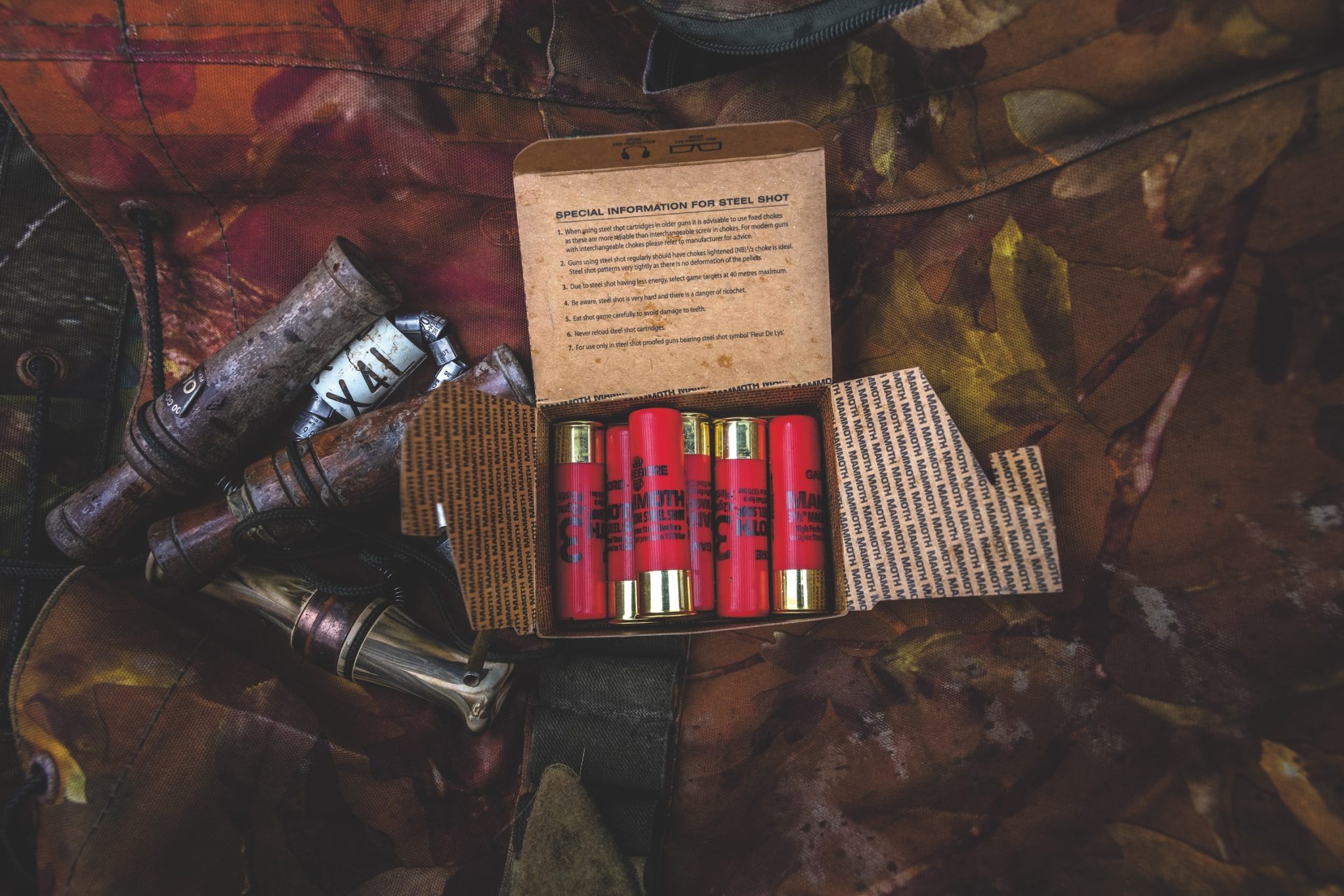
The dogs leapt into my truck to hunker down among scrim nets, hazel poles, decoys, packed lunch and thermos. I was determined to spend the best part of the day on the foreshore and watch the full extent of the tide’s rotation. The Ranger was packed for every eventuality, including RC’s new Blue shot. It’s a lead-replacement alloy of bismuth, aluminium, tin and zinc that wildfowling buddy and RC representative George Leeks had invited me to try.
Exploring new marsh at Hamford Water
Scout, Pip and I were heading for an unfamiliar marsh that I hadn’t shot before. For me, a memorable season needs to include forays to new places alongside old haunts and it was a patch I had been meaning to explore for several years. This particular strip of saltings is a 12-acre block on the western side of a bay set on the vast national nature reserve that makes up Hamford Water National Nature Reserve.
It’s been a great season in my part of north Essex, with numbers of teal and wigeon rivalling any that I can remember and I was hopeful that, despite huge areas of lying water inland, birds would still be holding out on the coast. It’s rare to get a big bag from a new marsh at this point in the season, but reduced numbers are offset by the excitement of learning the ropes on an unknown area. Perhaps I’d be lucky – and at the least I’d know more about this little piece of wilderness.
Incessant conditions test man and dog
After negotiating flooded lanes and downed trees, I nudged the truck into the scrub and muck at the base of the seawall and killed the lights. Harwich and Walton cast a pale glow to the north and south but my focus was into the darkness of the eastern sky. Everywhere I trod the ground slopped and squelched underfoot, heavy with the incessant rain we have had all year so far. The channel markers were visible, blinking green and red at intervals. To my right I could make out the single outside light of a remote house, built squat to withstand storms such as this one.
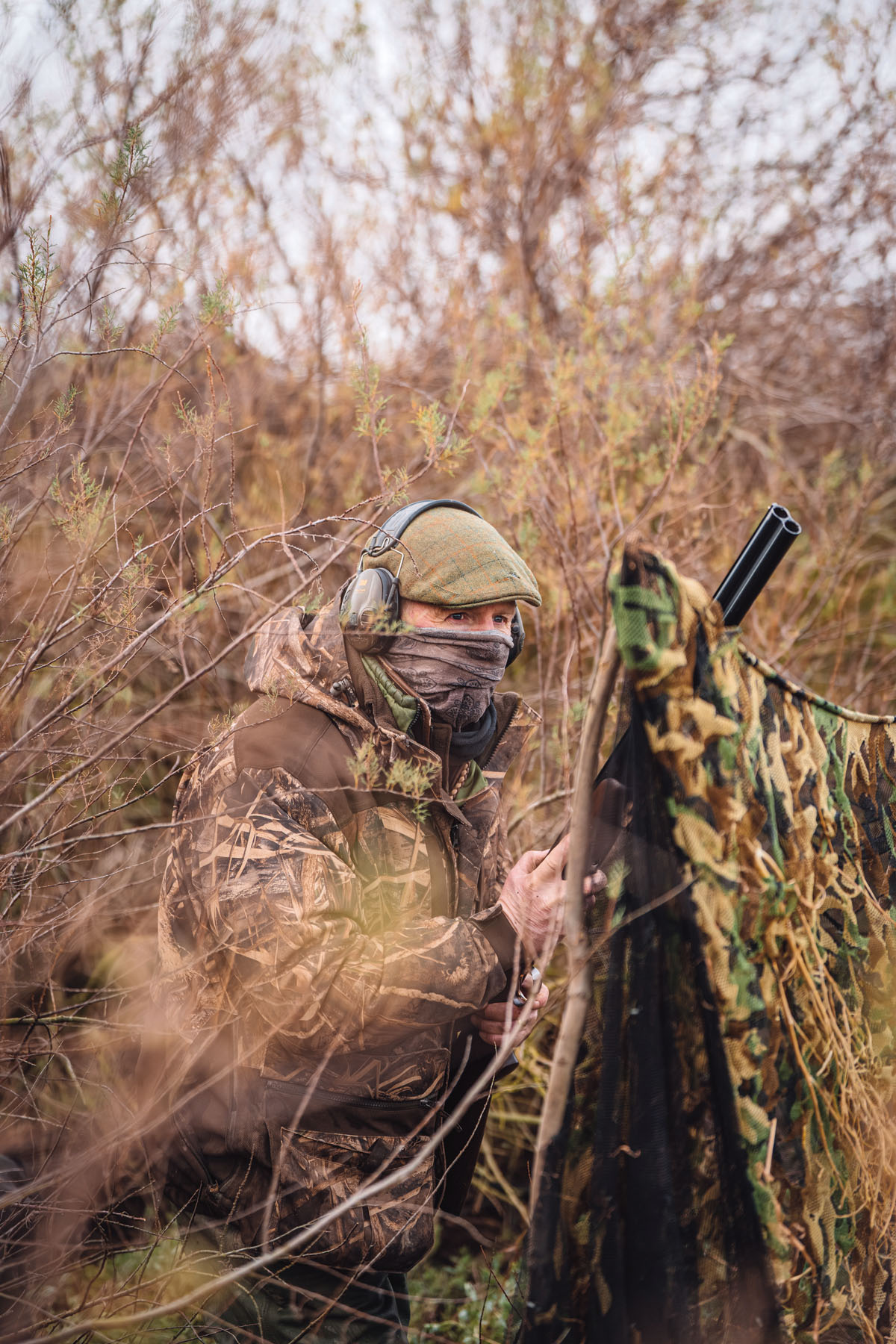
Not really being familiar with the complex maze of creeks and dykes, I slipped off the seawall and settled, facing into the wind with a healthy borrow pit and sluice gate close behind me. I figured that the likely movement of birds might be off the freshwater to my rear, and from there out onto the secluded marshes to lie-up until dusk on the saltings.
An egret stalked the slop in front, showing ghostly through the gloom. A sinuous, winding creek shone silver and black – the tide was at its lowest point and only the faintest of channel waters were visible in the pre-dawn shadows. At my feet the flotsam and jetsam of the winter tides were a reminder that millions of gallons of the North Sea would be flooding inland over the next hours. For now, the place was glutinous, stinking mud.
Reading the marsh and the birds
The first chance of the day was a spring of three mallard that lifted noisily as Pip nosed them out of the reedbeds that ran alongside the seawall. Before I could swing and twist they had disappeared into the darkness. My watch showed nautical twilight – that magical liminal time when the world starts to become visible. But those ducks were apparent only for a second or two and then they were gone into the gloom.
I decided to prod my way out like a blind man, pushing my stick before me, across the sea purslane and into the sparse seagrass. After just a few yards on the thinner cover I sank alarmingly to my knees and had to move fast to reach a second patch of tangled purslane. But now I was nearer to that magical whistling, piping flute of a teal’s pseep pseep coming from somewhere hidden from view in front.
I left Pip tethered, much to her dismay, and Scout and I continued to nudge forward, hoping that a pack might spring and be silhouetted against the lightening sky in the east. Again, the ground was glutinous and cloying underfoot, and again I lost my nerve when the mud reached my knees. I was keen to avoid the embarrassment of a rescue call to the coastguard.
Straining against a high tide
A pair of teal and then a pack of five were visible, dropping into the dead-ground about 80 yards away. From a previous study of Google Earth, I suspected they were coming out of the reservoir on the far side of the bay. But my concern was retaining mobility and I had to strain hard on what remains of my hip and abdominal muscles to retreat back to the high tide mark and my disgruntled black Lab.
An early morning walker and her dog passed, oblivious to our presence in the buffeting easterly. Still more teal emerged. I wondered about a shot to shake them up. However, for me, first outings on marshes are more about working out patterns and spending time in reconnaissance, so the dogs and I patrolled the base of the bank looking for good routes out to the water’s edge.
A satisfying blank and lessons learned
A high pack of mallard swung over, just at the edge of range. I swung, trying to find the line, but they were really too far off and I thought better of it. As far as blanks can be wonderful, it was. And a coffee in the lee of the wind couldn’t have felt more satisfying, supped as it was on the point of a spit of marsh that butts into the channel. Had it not been half-term I would have stayed there, but the dog-walker was obviously following a popular route and we were to meet and greet several other early risers and their hounds. I’d learned a lot about the marsh in the two hours I had spent there. Now it was time for a bacon butty and a more familiar hunting ground.
As we headed back to the farm, I remembered the best of this year’s outings. I’ve explored two other new permissions, one near Mersea Island and one on my home estuary – the River Stour. The patch near Mersea Island turned out to be rather special and I caught it as another easterly ripped through. Wigeon and teal were plentiful and it was a cracking morning. The Stour was quieter, on a clear crisp day with vast choruses of brents and curlew on the move. It’s another marsh that might be great on a cold northerly.
Season highlights from Essex to Norfolk
North Norfolk, as ever, was very special. Skeins of pinkfeet thronged the sky during a long weekend I spent in early November based in Wells-next-the-Sea. But I think that the teal have been this year’s highlight, with huge numbers holding through all five months of the season. The only tricky aspect, which I’ve never noticed so obviously as this year, is that they’ve been content to move all night and not follow the regular patterns of dawn and dusk.
Trail-cams have been very revealing, with big movements of birds even as late as 2am and 3am. Perhaps light pollution is having an effect, which it hasn’t before. Perhaps we should focus less on the moon phase and think more about wind-direction and shooting pressure. There are more unshot areas around me than ever, which perhaps reduces routine traffic but can increase big flocks of birds.
A fitting finale with wigeon on the tide
Back on my home marsh it was teal decoys, coupled with wigeon, that I slung out onto the rising tide to finish the season. Rambling tamarisk shrubs provided ideal cover as the creeks flooded. Mallard lifted and circled, uncomfortable in the gale. A wedge of wigeon whipped high overhead and I swung fast through a leading male to send it falling and curling far out on the marsh. Scout raced away. She’s familiar with the creeks and channels and doesn’t swim if she can avoid it. A long left-handed loop led her to the stricken bird and she returned, filthy, to bring it to hand.
A pair of wigeon beat their way tantalisingly into the wind. Would they come? I whistled, not holding out much hope at this time in the season. But they committed, seemingly hanging in the teeth of the gale. Again, I picked the drake bird and watched it down, restraining myself from the temptation of trying a speculative second shot at the retreating female. This time it was Pip who made a great splash as she dived inelegantly but with enthusiasm into the scudding brine and returned clutching a resplendent male.
It was enough. Both dogs had enjoyed excellent retrieves and I will remember that pair of wigeon committing until September comes around again. It has certainly been a memorable season from the creek. I sincerely hope that all readers have had a chance to enjoy it too.
This article contains affiliate links. If you click on one of these links and make a purchase, we may earn a small commission at no additional cost to you. Affiliate income helps us maintain the quality of our content and keep it freely accessible.
All recommendations are based on our honest opinions and thorough research.Would you like to speak to our readers? We offer sponsored articles and advertising to put you in front of our audience.
Find out more.
We look at five of the best ammunition choices for fox control, ranging from discreet .22 LR subsonic rounds to high-velocity .243 Winchester varmint loads
From agile all-rounders to precision rimfires, we look at five of the best rifles currently helping gamekeepers manage everything from rabbits to red deer
Charles Hartley joins a team of Guns in deepest Wales to pursue the elusive woodcock and snipe across ancient marshes, testing their skill and confidence against these iconic waders
By Shooting Times
Get the latest news delivered direct to your door
Subscribe to Shooting Times & Country
Discover the ultimate companion for fieldsports enthusiasts with Shooting Times & Country Magazine, the UK’s leading weekly publication that has been at the forefront of shooting culture since 1882. Subscribers gain access to expert tips, comprehensive gear reviews, seasonal advice and a vibrant community of like-minded shooters.
Save on shop price when you subscribe with weekly issues featuring in-depth articles on gundog training, exclusive member offers and access to the digital back issue library. A Shooting Times & Country subscription is more than a magazine, don’t just read about the countryside; immerse yourself in its most authoritative and engaging publication.
To provide the best experiences, we use technologies like cookies to store and/or access device information. Consenting to these technologies will allow us to process data such as browsing behavior or unique IDs on this site. Not consenting or withdrawing consent, may adversely affect certain features and functions.
Functional
Always active
The technical storage or access is strictly necessary for the legitimate purpose of enabling the use of a specific service explicitly requested by the subscriber or user, or for the sole purpose of carrying out the transmission of a communication over an electronic communications network.
Preferences
The technical storage or access is necessary for the legitimate purpose of storing preferences that are not requested by the subscriber or user.
Statistics
The technical storage or access that is used exclusively for statistical purposes.The technical storage or access that is used exclusively for anonymous statistical purposes. Without a subpoena, voluntary compliance on the part of your Internet Service Provider, or additional records from a third party, information stored or retrieved for this purpose alone cannot usually be used to identify you.
Marketing
The technical storage or access is required to create user profiles to send advertising, or to track the user on a website or across several websites for similar marketing purposes.