Home/Swarovski AT and ST Balance spotting scope review
Gear
Swarovski AT and ST Balance spotting scope review
Ed Jackson tests the Swarovski AT and ST Balance spotting scopes to see if groundbreaking stabilisation technology can finally eliminate the need for a tripod
Shooting Times20 April 2026
Premium stabilisation technology
I genuinely look forward to reviewing new Swarovski products, as when it comes to hunting, their gear consistently represents the pinnacle of what is available on the market. For me, the premium optics deliver a view where colours are brilliantly vivid and shades are rendered with such clarity and detail that nature truly comes alive.
Consequently, the launch of the AT and ST Balance marks a pioneering milestone for the Austrian company. While integrated image stabilisation has typically been reserved for cameras or binoculars, these spotting scopes are the first to bring such high-level technology to a premium spotting scope. I was sent both versions to test: the AT Balance 18-45×65 and the ST Balance 14-35×50.
Swarovski’s new Swarobalance technology aims to eliminate the need for a tripod by providing a stabilised image even at maximum zoom. It’s a potential game-changer, but does it work?
Ergonomics and design features
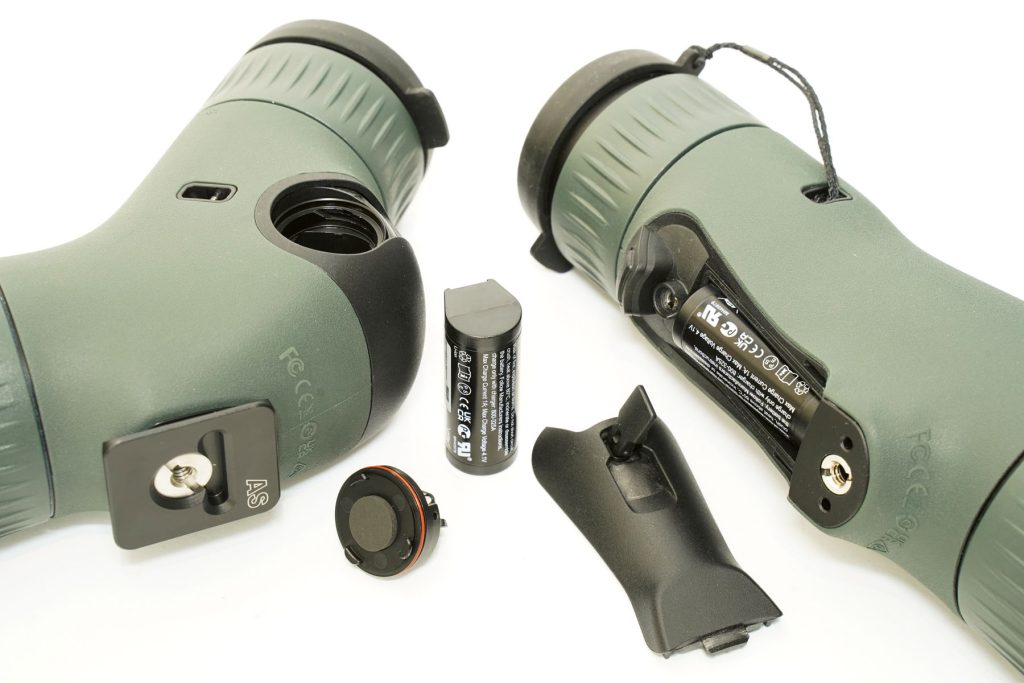
You get instructions, a lens cloth, a carrying strap, an ARCA tripod adapter, a USB-C-compatible charger with a cable, and a 1,860mAh rechargeable battery. Each spotter is fitted with a black captive rubber lens cap for the eyepiece and a solid ‘pinch-to-remove’ cap for the objective lens.
The bodies are wrapped in a robust, green rubberised material for a secure grip, while the twist-to-adjust eyepiece, strap attachment point, tripod adapter plate, and battery housing are all in black. Both AT and ST units share the same intuitive power button positioned at the front of the battery housing, which you press and hold to activate/deactivate the Swarobalance system.
The AT (angled) model is the larger and heavier of the two, weighing in at 1,470g, and features an eyepiece set at a 45-degree angle to the body for comfortable viewing over extended periods. In contrast, the ST (straight) model has the eyepiece in line with the lens to allow for faster, more intuitive target acquisition. It is lighter at 1,300g, and the different shape offers alternative ergonomics depending on your preferences.
On both models, the large magnification collar is ridged for grip and rotates approximately 120 degrees across the full range, with the figures cleanly debossed into the rubber outer. An even larger collar surrounds the main body for fine focus adjustment.
Handheld spotting scope capabilities
Everybody knows that the limiting factor of high-magnification spotting scopes has been the necessity of a tripod or support system. Even the best glass in the world cannot compensate for the human body’s movement when viewing at powers like 35x or 45x. This is where the Swarobalance technology marks a fundamental change in the capabilities of high-end spotting scopes. There is nothing more infuriating than a tripod-mounted image losing its edge because of wind or user-induced vibration.
Swarovski’s optical stabilisation uses sensitive sensors to detect minute movements. This data triggers an electric motor to adjust the lens position, with the system processing over 1,000 measurements per second to compensate.
Out in the field, the experience is surreal, as there is a genuine sense of wonder and excitement as your brain registers a level of handheld stability that it is not used to. It triggers a relentless desire to revisit every familiar landscape or animal you’ve ever seen, just to experience them again through these superior optics, at a much higher magnification. It’s genuinely very exciting.
Given that the technology needs to detect your hand movement and then compensate for it, there is very little, if any, perceivable lag, which is also pretty astonishing given the task at hand.
Known for unparalleled glass, Swarovski delivers brilliant colours and edge-to-edge sharpness in both the AT and ST models. This optical quality allows you to see ‘into’ the landscape rather than just scanning the surface, a feat mid-tier optics simply cannot match. While thermal is superior for pure detection, these scopes master light for those who want to truly observe and appreciate nature.
This glass maintains exceptional edge-to-edge clarity and brightness throughout its zoom range. However, at 45x, the eyebox tightens significantly, requiring precise head alignment that can quickly lead to fatigue. It serves as a reminder that, even with stabilisation, high-power observation remains a demanding task over long periods.
Fields of view are class-leading, ranging from 55–30m on the AT to a wider 70–39m on the lower-magnification ST. This breadth is designed to capitalise on the units’ stabilised handheld capability, transforming the often-restrictive spotting scope experience into a more binocular-like one.
Performance at the shooting range
The week the scopes arrived, I was booked to shoot steels out to 1,132m at Bisley, providing the perfect environment to truly test the limits of the AT Balance, which is the one I took with me. The conditions were tricky, with the sun directly in our eyes, but it was here that the premium Swarovski glass really stamped its authority over the spotting scopes provided at the range.
Handing the AT around, the stabilisation proved an instant hit and drew immediate praise as we spotted impacts freehand at various magnifications. The compactness of the unit was brought up in conversation as well, as the resulting agility allows for swift, intuitive movement when switching between targets at different ranges.
The controls are largely excellent, particularly the perfectly weighted magnification collar. The focus ring, however, feels a bit light. While it functions perfectly once you are on target, offering easy, precise adjustment, it is perhaps too eager to move when the optic is being handled or shared, leading to accidental adjustments. This is a minor gripe, but worth mentioning nonetheless.
I spent most of my time using the 18-27x magnification range. I found this to be the most relaxing ‘sweet spot’ for my eyes, as it provided a generous field of view, a relaxed eyebox, and excellent clarity. While the technology is groundbreaking, it is important to remember that environmental and human limitations still apply at 45x magnification.
After spotting from a standing position for several hours, my limit for precise freehand impact-spotting was 663m. Beyond this, a rest helps maintain clarity and combat fatigue. The battery lasted a freezing morning of constant use, though the unit remains a world-class passive optic even without power.
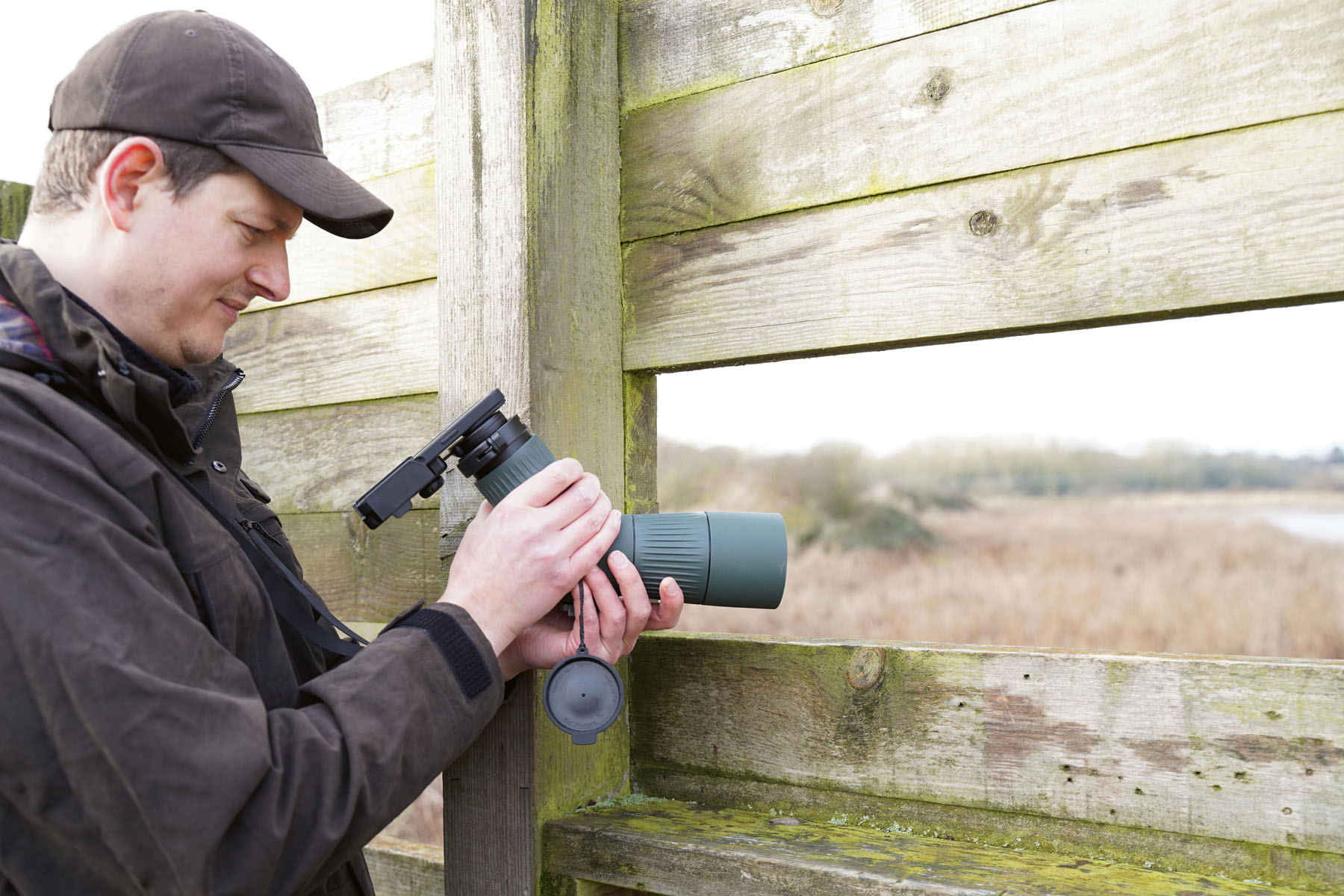
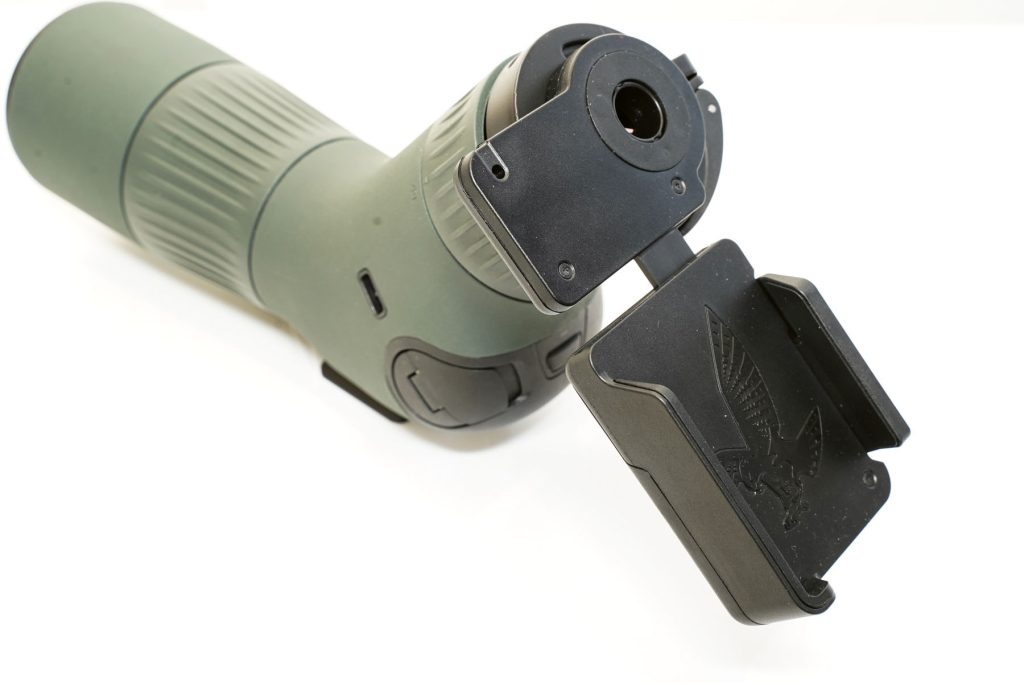
Swarovski’s digiscoping system further extends the scope’s versatility, allowing you to transform the optic into a high-end telephoto lens. You just need a Clamp Adapter (£41.00) and a Variable Phone Adapter (£165.00). Although I did not have the setup available at Bisley, I later tested it with an iPhone 16 while spotting wildlife along the local river, where it worked really well, capturing superb photos and video.
Calibration is critical here: always align your phone’s lens at maximum magnification to prevent the image from shifting as you zoom. It is also important to remember that the phone’s weight alters the centre of gravity, making handheld stability more of a challenge. Finally, while the digital results are impressive, no sensor can quite replicate the ‘MK1 eyeball’ experience. The raw clarity through that premium glass remains superior.
Final verdict and model choice
Choosing between the AT (£2,980) and ST (£2,810) depends on personal preference. While representing a significant investment, you are not just buying world-class glass but a two-in-one tool that bridges the gap between high-power binoculars and a traditional spotting scope. This potentially eliminates the need to carry both a heavy tripod and a separate spotting scope. With a 12-hour battery rating, it easily outlasts a demanding day in the field, ensuring you’re never caught out and by the end of my day at the range, one shooter declared he was going to buy one.
When picking one, the AT model is best for extended glassing and digiscoping. The angled eyepiece offers a relaxed posture when looking uphill and keeps your phone screen facing upwards for easier viewing. Alternatively, the straight ST version provides a larger field of view and faster target acquisition. It is also more comfortable for looking downhill.
Ultimately, these scopes represent a genuine paradigm shift. Given that I was able to use the AT Balance unsupported to spot strikes at long range, it should give you total confidence that the stabilisation will be even more effective at closer ranges, right down to the minimum focus distance of 3.4m. Swarovski has not just added a new feature; they have fundamentally changed the rules of the game. For the hunter or observer who demands the freedom of handheld movement without sacrificing the power of a spotting scope, the Balance series is, quite simply, in a league of its own.
Technical specifications
AT Balance 65
Magnification: 18-45
Field of view: 55-30m / 1,000m
Weight: 1,470g (51.9 oz)
Length: 268mm (10.6”)
Width: 83 mm (3.3”)
Price: £2,980
ST Balance 50
Magnification: 14-35
Field of view: 70-39m / 1,000m
Weight: 1,300g (45.9 oz)
Length: 268mm (10.6”)
Width: 91mm (3.6”)
Price: £2,810
This article contains affiliate links. If you click on one of these links and make a purchase, we may earn a small commission at no additional cost to you. Affiliate income helps us maintain the quality of our content and keep it freely accessible.
All recommendations are based on our honest opinions and thorough research.Would you like to speak to our readers? We offer sponsored articles and advertising to put you in front of our audience.
Find out more.
Modern pest control demands more than skill with a rifle, requiring the right tools for every stage of the job, from scanning a dark hedgerow to placing a precise shot
Built for speed, precision and real-world hunting, the Jaeger NXT Composite impresses Chris Parkin with its practical design and straight-pull performance.
By Shooting Times
Get the latest news delivered direct to your door
Subscribe to Shooting Times & Country
Discover the ultimate companion for fieldsports enthusiasts with Shooting Times & Country Magazine, the UK’s leading weekly publication that has been at the forefront of shooting culture since 1882. Subscribers gain access to expert tips, comprehensive gear reviews, seasonal advice and a vibrant community of like-minded shooters.
Save on shop price when you subscribe with weekly issues featuring in-depth articles on gundog training, exclusive member offers and access to the digital back issue library. A Shooting Times & Country subscription is more than a magazine, don’t just read about the countryside; immerse yourself in its most authoritative and engaging publication.
To provide the best experiences, we use technologies like cookies to store and/or access device information. Consenting to these technologies will allow us to process data such as browsing behavior or unique IDs on this site. Not consenting or withdrawing consent, may adversely affect certain features and functions.
Functional
Always active
The technical storage or access is strictly necessary for the legitimate purpose of enabling the use of a specific service explicitly requested by the subscriber or user, or for the sole purpose of carrying out the transmission of a communication over an electronic communications network.
Preferences
The technical storage or access is necessary for the legitimate purpose of storing preferences that are not requested by the subscriber or user.
Statistics
The technical storage or access that is used exclusively for statistical purposes.The technical storage or access that is used exclusively for anonymous statistical purposes. Without a subpoena, voluntary compliance on the part of your Internet Service Provider, or additional records from a third party, information stored or retrieved for this purpose alone cannot usually be used to identify you.
Marketing
The technical storage or access is required to create user profiles to send advertising, or to track the user on a website or across several websites for similar marketing purposes.