
Simulated game day at Great Tew: 3,000 clays for a syndicate
Ben Palfreyman takes a peg on a syndicate day at the Cotswold estate that has run simulated game since the 1990s. For shoot owners and keepers it shows what a shoot’s drives can earn between seasons, and that the footwork lesson never changes
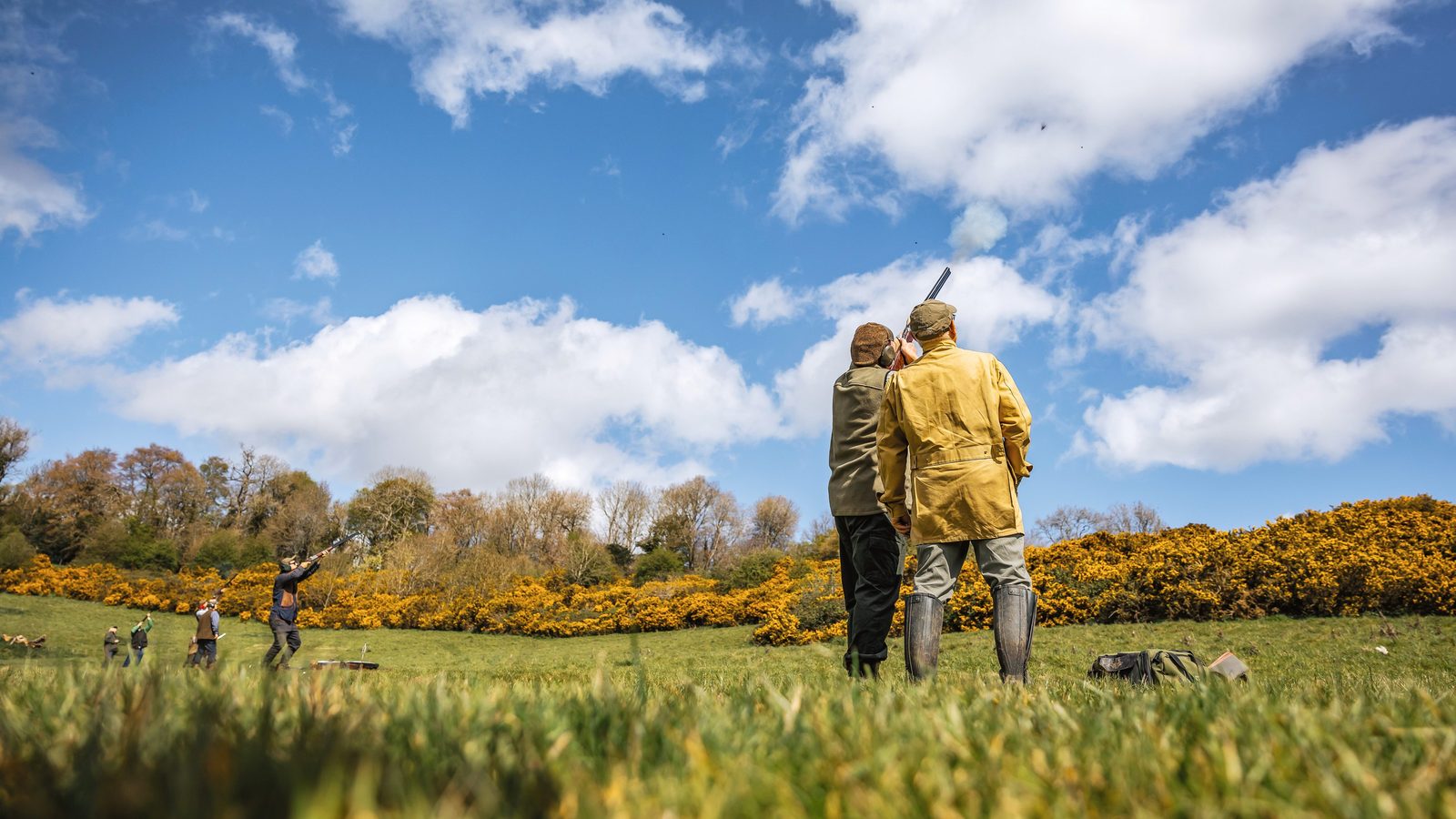

Photographs: Matt Kidd
A flurry of birds bursts out above the bank of gorse in front of me and catches me flat-footed. Even as I start the swing I know my feet have let me down. I never catch up with them – the shot string fills empty sky and the little blighters sail away to my right, untouched.
I pause to curse myself, but a gruff command comes in my ear: “Come on. Reload.” It is exactly what I need. A good friend on the peg will not let you wallow after a bad shot.
Fortunately the ‘birds’ in front of us today carry no feathers. This is a simulated game day, and with more than 3,000 clays promised over the line of Guns before the day is out, there will be plenty of chances to put things right – which is rather the point of the format.
With my friend and colleague Matt Kidd, a fine shoot photographer, I have come to the Great Tew estate in the heart of the Cotswolds for one of its syndicate days. Most of the shooting here is taken by teams of up to 16 Guns; the syndicate days let individuals and small groups buy a peg in the off season, and for a shoot operator they are a model worth studying for what the ground can earn between seasons. Over the obligatory bacon buttie at breakfast we learned that many of our fellow Guns were returning customers – the surest sign that the day would deliver, and that the drives, the hosts and the lodge were doing their job.

On the peg at ‘Gorse Bank’, Matt deftly reloads my Browning B325 while offering unsolicited advice on footwork, which I naturally ignore. I know perfectly well that failing to move the feet into position before addressing the bird is the likeliest route to a miss behind. It is probably the most common fault on a game shoot, and anyone who has watched a line from behind the pegs will recognise it. If the feet are not set for the spot where you mean to kill the bird, the movement of the gun is badly restricted and the shot goes behind, or underneath and behind. I know this.
I hear the whirr of the hidden traps and get ready. I pick a bird like the one before, get my feet into position as early as I can, mount, swing through and fire. Better, I think, as the clay shatters out to my right. “Ah, now you’re smoking them!” comes Matt’s encouragement in my ear.


How Great Tew has run simulated game since the 1990s
Great Tew has run simulated game days since the 1990s and was among the first estates to offer this version of the sport. The idea of using the ground this way came from one of today’s shoot hosts, Roddy Richmond-Watson, who grew up on the farm next door and still hosts many of the shoot days here. Roddy is the third generation of the Richmond-Watson family to run the hugely respected West London Shooting School in Northolt.

“The land at Great Tew Estate is really quite unique,” Roddy says, “and I really just felt that it lent itself to simulated game shooting. The contours of the rolling ironstone hills here are perfect to put on a great variety of drives – and are quite different to most of the downland escarpments you see across most of the Cotswolds.
“I put the notion to Nicholas Johnston, the estate owner, and I was absolutely delighted when he embraced the idea,” he goes on. “Nicholas loves his shooting, and there is a longstanding syndicate game shoot on the estate, so the set-up was already there. He built the grouse butts using the iconic blue and brown ironstone quarried from the estate, which you see in many manor houses and farmhouses in these parts.”
What light-touch farming has left on the ground at Great Tew
The drives are laid on or beside the estate’s existing game drives, and as we move round, Roddy and fellow shoot host Roger Bryan point out the woodlands and cover crops that hold birds in the season. For a keeper it is the most interesting part of the walk, and the ground itself is lovely: a Cotswold stone keeper’s cottage tucked into a grassy valley beside fields full of spring lambs. Roddy describes the estate as one frozen in time, and he means the farming as much as the view. “The owners of Great Tew have historically worked the land here with quite a light touch,” he says. “While many farmers have ploughed the fields, and taken various government grants to remove hedges, these modern practices have largely passed us by here. The result of this means that the estate is home to historic grasslands, magnificent trees, a network of historic hedgerows – and some impressive swathes of brambles. The owners are now embarking on huge efforts to preserve and enhance these habitats. As you can imagine, the result of this is that there is a surprising amount of natural life here, which is supported by the work done by the gamekeepers on the shoot.”
A peg on a sim shoot is not simply an exhilarating day’s sport. For a few hours it also buys access to that natural history, and to the keepering that underpins it.

What are the drives like, from Polly’s to the grouse butts?
As Roddy recognised all those years ago, the landscape at Great Tew offers a superb variety of drives, which is exactly what a simulated day needs. A short walk from the lodge where breakfast is served is ‘Polly’s’, a line of native hedging and cherry trees where the clays mimic a typical partridge drive. The birds here were not especially high, but they could be fast, and they were the ideal chance to get your eye in before the trickier drives to come. Next door is ‘Spike’, overlooked by the lodge terrace: more of a pheasant drive, with the targets appearing out of the gorse.

After elevenses we head to ‘Cottenham Bank’, where Matt produces his side-by-side – an old gun from an estate sale that draws a bit of attention along the line. One of our fellow Guns shot exclusively with side-by-sides until a couple of years ago, when a change in his eye dominance forced the switch to an over-and-under, and he regards Matt’s gun the way one might a photograph of an old friend. Under what is now a sunny sky the barrels get hot quickly; there are a great many cartridges going through them.

The final drive here is always ‘Grouse’, a line of stone butts built with a team of grouse experts so that the experience is as authentic as it can be. The grouse explode like tiny missiles from the horizon in front. I miss one behind. I overcorrect and miss in front. In the space of a single drive I manage to demonstrate almost every way there is to miss a driven bird. But the great thing about a simulated day is repetition. In the season you might miss a bird and then not see a similar one for weeks; on a sim day you can practise one presentation again and again until the technique is in your muscle memory. For a syndicate whose Guns arrive on the first day having not lifted a gun since the end of last season, that is the practical case for the format.

As the day closes, with a very good lunch back at the lodge, the team of Guns reflects on it. We enjoy the last of the sun, open a cold beer and swap notes on the small details that made the day. I pat the head of a cocker puppy just starting its training as a peg dog for one of the Guns. So many days in the field await that pup. They wait for us too.

Enquiries about simulated or game shooting at Great Tew Estate go to the team at the West London Shooting School.
Frequently asked questions
What happens on a simulated game day?
The day recreates driven game shooting with clays thrown from hidden traps, so the targets mimic partridges, pheasants and grouse over a line of Guns on pegs, drive by drive. At Great Tew more than 3,000 clays can go over the line in a day, and the drives are set on or beside the estate’s real game drives.
Why does a simulated day improve your game shooting?
Repetition. In the season you might miss a bird and not see a similar one for weeks; on a sim day the same presentation comes again and again, so the fault can be worked on until the technique is in the muscle memory.
Why do Guns miss driven birds behind?
Footwork, more often than not. If the feet are not moved into the correct position for where you plan to kill the bird before you address it, the movement of the gun is restricted and the usual result is a miss behind, or underneath and behind.

About the author
Ben Palfreyman
Former managing editor of Fieldsports Journal, Ben ran the bi-monthly through a period of growth for the title, working across game shooting, fishing and big game features, and wrote for ShootingUK during his time with the group.
 Closes 15 JanuaryWorth £129.90Win a pair of tickets to the British Shooting Show 2027Enter nowFree to enter
Related Articles

Sporting Life: from gunpowder to keepers’ lore, the history of answering the call of nature in the field
Jeremy Hobson on why ‘spending a penny’ on the end peg has a richer history than most Guns realise, from saltpetre beds and keepers’ tricks to the Law of Urination
By Jeremy Hobson | 4 November 2026
Country Diary: a car-boot haul of 1970s sporting books, a Saturday stick and the white pheasant
Giles Catchpole finds late shoot-day starts and fuel rationing in a car-boot haul of old sporting books, then buys a handsome staghorn-topped stick from a friend’s shed
By Giles Catchpole | 4 November 2026
Get the latest news delivered direct to your door
Subscribe to Shooting Times & Country
Discover the ultimate companion for fieldsports enthusiasts with Shooting Times & Country Magazine, the UK’s leading weekly publication that has been at the forefront of shooting culture since 1882. Subscribers gain access to expert tips, comprehensive gear reviews, seasonal advice and a vibrant community of like-minded shooters.
Save on shop price when you subscribe with weekly issues featuring in-depth articles on gundog training, exclusive member offers and access to the digital back issue library. A Shooting Times & Country subscription is more than a magazine, don’t just read about the countryside; immerse yourself in its most authoritative and engaging publication.