★ Your magazine. Your say. Complete our reader survey with a chance to win Jack Pyke kit worth £500! ★


Browning Grand Prix shotgun review
The Browning Grand Prix shotgun has a hidden surprise in store.
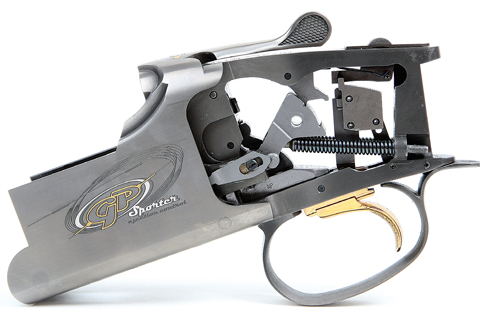

In terms of exterior livery, it certainly looks a little different to its many other brothers and sisters in the range.
But take a closer look and you’ll see it shares pretty much the same features as its slightly more expensive sibling, the XS.
In this respect the price differential alone should make the Grand Prix a good value buy.
But the GP has another ace up its sleeve, a feature that helps set it apart from the crowd, in fact from most other guns that I can think of.
Its ejectors can be turned on and off at the flick of a switch.
Unique feature
In short, the gun can be easily converted to a non ejector. This is achieved by using a small tool, supplied with the gun – to push back the ejector hammers in the fore-end. Under spring pressure these simply go back to a point over centre, where they can no longer make contact with the ejector trips.
Why, you might ask, should anyone want to buy an ejector gun then turn it into a non-ejector?
Well, the reasoning behind this is most clay grounds now prefer shooters to put spent cartridges cases in the bins at each stand to keep the place nice and tidy.
Someone at Browning evidently thinks shooters might find the job easier if their gun was a non-ejector. The reality is that few of us will probably ever make use of this facility.
Nevertheless, Browning has now given us a choice in the matter. Ejector or not, the Grand Prix has been designed purely as a gun for sporting clays. You could, at a pinch, use it for game and pigeon shooting but its weight and handling characteristics make it more suitable for the role intended of it.
Barrels and proofing
The gun is available in 12-bore only and its monoblock barrels have been fitted with 3in (76mm) chambers. You might have no choice in bore size but the makers do give the option of barrel length and you can take your pick of 28in, 30in or 32in.
The barrels have been back-bored to reduce recoil, chrome lined for easy cleaning and fitted with vented side ribs to aid barrel cooling and reduce weight. The neat top rib is matted to kill glare, 10mm wide and milled with a central channel to draw the eye to the line of sight.
The barrel set is finished with a small white fore and mid-sight bead.
Barrel blacking on this gun takes the form of a high gloss and it has been done extremely well.
The GP is proofed for Special steel shot cartridges – as are all guns in the 525 range – and it is supplied with 5 Midas choke tubes made by none other than Briley. Those who know such things will instantly spot Briley’s distinctive gold
ring at the end of the extended section of each tube when the gun is out of its slip.
As I said earlier, the action frame is mechanically the same as the 525 and it shares the same carving and detonating to the fences as other guns in the stable.
Browning’s Grand Prix comes with their proven trigger mechanism, complete with intercepting safety sears.
The action body on this model is finished in light satin silver with a unique and distinctive GP logo in the centre of the frame on both sides. Turn the gun upside down and you will find a similar legend with the maker’s name highlighted in white on the belly of the action.
The gun, as expected, has a single selective, and adjustable, trigger and a manual safety catch that also doubles as a barrel selector.
Stock dimensions follow the same pattern as other Browning Sporters with a 14.3/4in length of pull and drops at comb and heel of 1.1/2in and 2.1/4in respectively.
The stock is quite straight at the comb and heel but does show a slight bias for the right handed shot with a little bit of cast off at toe.
The stock is finished with a thin polymer butt plate and has been furnished with a full pistol grip that’s nicely shaped to give a comfortable hold. Again, the chequering pattern follows the design of other 525s in that it gives a very full wrap around the grip. It works very well, but I am not fully convinced of the look; call me a stick in the mud if you like but I much prefer the more traditional chequering found on previous Browning guns.
Overall weight depends on the length of barrel you choose and wood density but, as a general guide, you’re looking at should range around 3.4 to 3.5 kilos depending on barrel length and wood density.
As well as the tool to disconnect the ejectors, and Midas tubes, each gun comes supplied with a useful ABS travelling case.
JASON’S VERDICT:
The Grand Prix more than meets Browning’s usual build standards and will no doubt
prove to be a reliable performer like all the others.
Apart from the non-ejector facility it’s a 525 through and through.
This gun represents good value and will be able to compete at the highest level of competition.
Build Quality: 9
Styling: 7
Value for money: 8
PRICE:
£1500
More information available from BWM.
Telephone: 01235 514550.
Read a Browning Heritage shotgun review
Read a Browning B525 Game shotgun review
Read a Browning Custom B25 shotgun review
Read a Browning B525 Hunter shotgun review
Read a Browning Medallist shotgun review
Read a Browning Cynergy shotgun review
Read a Browning Elite Shotgun review
Read a Browning 525 shotgun review
Related Articles

Cameron and Blunkett back Countryside Alliance's Rural Reset campaign
A former Conservative Prime Minister and a former Labour Home Secretary told the Westminster launch that the trail hunting ban and the family farm tax are mistakes, as ORB polling for the Countryside ...
By News Desk | 17 September 2026

Beaver report: 84 removed under licence and 22 killed in a year
NatureScot's annual Beaver Management Report shows trapping and translocation carrying the load, with lethal control holding at 22 animals
By News Desk | 16 September 2026
Get the latest news delivered direct to your door
Subscribe to Shooting Times & Country
Discover the ultimate companion for fieldsports enthusiasts with Shooting Times & Country Magazine, the UK’s leading weekly publication that has been at the forefront of shooting culture since 1882. Subscribers gain access to expert tips, comprehensive gear reviews, seasonal advice and a vibrant community of like-minded shooters.
Save on shop price when you subscribe with weekly issues featuring in-depth articles on gundog training, exclusive member offers and access to the digital back issue library. A Shooting Times & Country subscription is more than a magazine, don’t just read about the countryside; immerse yourself in its most authoritative and engaging publication.