★ Your magazine. Your say. Complete our reader survey with a chance to win Jack Pyke kit worth £500! ★

Carrying rifles and shotguns legally and safely on an ATV
Quad bikes and side-by-sides have transformed how keepers and stalkers get about the ground, but the moment a rifle or shotgun goes on the back, a set of obligations comes with it


There is no section of the Firearms Act 1968 headed “ATVs”. Nothing tells you which rack to use, how to strap a rifle down, or whether a slip will do. That absence catches people out, because it is easy to assume that if nothing specifically forbids something, nothing applies to it.
A great deal applies. The law governing a rifle on the back of a quad is the same law that governs it in the boot of a car or on your shoulder in a wood: the conditions on your certificate, the public place provisions of the 1968 Act, and the ordinary duty not to endanger anyone. What changes is the setting. An ATV crosses roads, tips on banks, throws you about and offers nowhere lockable to put anything. That combination turns familiar rules into unfamiliar problems.

Is there a law about carrying firearms on a quad bike?
No, and grasping that is the useful starting point. The relevant provisions were written long before anyone thought to put a rifle on a quad, so they apply by their general terms rather than by naming the vehicle.
Three things do most of the work. The first is section 19 of the Firearms Act 1968, which makes it an offence to have a firearm with you in a public place without lawful authority or reasonable excuse. The second is condition 4 of your firearm or shotgun certificate, which requires reasonable precautions for safe custody whenever a gun is in transit. The third is section 20, which makes it an offence to be on land as a trespasser with a firearm.
Get those three right and most of the practical questions answer themselves. Get them wrong and the penalty is rarely a quiet word, because firearms offences and breaches of certificate conditions are dealt with by licensing departments that have very little appetite for discretion.
When your ATV is in a public place
This is where the confusion usually sits. A public place is defined in section 57(4) of the Act as any highway and any other premises or place to which, at the material time, the public have or are permitted to have access, whether on payment or otherwise.
Note what that does not say. It does not turn on who owns the land. It turns entirely on public access. A metalled road is plainly a highway, but so are bridleways and footpaths, and an estate track the public are permitted to use can be a public place even though the ground is privately owned. Cross a road between blocks and you are in a public place for as long as you are on it.
Under section 19 it is an offence to have with you in a public place a loaded shotgun, a loaded air weapon, or any other firearm, loaded or not, together with ammunition suitable for use in it. The burden of showing lawful authority or reasonable excuse falls on you, not on the prosecution.
Shotguns are treated a shade more strictly than rifles here. Section 19 catches a loaded shotgun outright, with no need for ammunition to be carried separately, so a gun left closed on a full chamber while you move between drives becomes an offence the moment the machine touches a road or a right of way. Breaking the gun and slipping it before you move off is the simple discipline, and it is the one most often skipped when the day is running late.
Two practical consequences follow. Unload well before you reach a road or a right of way, and keep rifle and ammunition apart where you can, because an unloaded rifle carried without suitable ammunition falls outside the wording of that subsection. Second, expect that you may be stopped: section 47 allows a constable who has reasonable cause to suspect there is a firearm in a vehicle in a public place to search that vehicle and require the driver to stop.
What your certificate requires in transit
Condition 4(b) is the one that bites on an ATV. It provides that where a firearm or ammunition is in use, or is in transit to or from a place in connection with its use, reasonable precautions must be taken for its safe custody.
“Reasonable” is deliberately elastic, and it is judged after the event, usually once something has already gone wrong. The Home Office Firearms Security Handbook and the British Association for Shooting and Conservation (BASC) point the same way: keep the firearm out of sight, secure it to the machine rather than balancing it on top, and separate the bolt and the ammunition where practical. A cable lock through the action and around a rack tube costs very little and answers the question well on open machines.
On a vehicle with no boot, no lock and no glass, the honest answer is often that reasonable precautions mean not leaving the gun on the machine at all.


Cases, slips, racks and packs: what actually works
Sporting Gun’s Paul Austin spent 250km testing carriage options on a quad in hill country, and his conclusions are worth borrowing.
A drag bag straps easily to front or rear racks with bungees or ratchet straps and is fine for getting from A to B before laying an ambush. Paul found it close to useless when he needed the rifle in a hurry.
A hard case solves both security and stability. His Plano 54in case, ratchet-strapped to the rack, locked everything down firmly and doubled as a shooting platform for a bipod. The cost is that it becomes a semi-permanent fixture, slow to mount and slow to remove, which is a nuisance if the quad has other work to do.
A backpack was his eventual choice. The ripcord release on the Vorn put the rifle in hand almost instantly, it sat high enough not to push him forward over the bars, and it leaves nothing behind on the machine when you dismount to stalk.
Dedicated racks are the fourth option. Kolpin’s Ratcheting Rhino Grips, a pair of rubber-lined claws that clamp to rack mounts, hold a rifle securely and swivel to make a rest. They are quick and cheap, but they carry a gun in the open, which is acceptable on your own ground and wrong anywhere the public might see you.
Muzzle control on rough ground
Two habits cover most of the risk. Nothing is loaded while the machine is moving, and the muzzle never points anywhere a person, a dog or a passenger could be.
The second is harder than it sounds. A quad pitches violently, and a barrel pointing safely at the start of a rut is not necessarily pointing safely at the end of it. Muzzle up is not automatically safe either, particularly under a rollbar or low branches. Think about the whole arc the barrel sweeps as the vehicle moves, rather than the direction it happens to face when you set off.
If you carry slung across your back, avoid a bolt or lever-action rifle. Air Gunner made the point years ago and it still holds: over rough ground the action bounces against your spine and does real damage.
One more provision is worth carrying in your head. Under section 161(2) of the Highways Act 1980 it is an offence to discharge a firearm within 50 feet of the centre of a carriageway if a user of the highway is thereby injured, interrupted or endangered. It is easily forgotten when a fox shows itself near a road.
Never leave a firearm on an unattended machine
An ATV has no boot, no lock and nothing to break into. A rifle in a slip on the rack of a parked quad is not secured, it is displayed, and quads are stolen from farmyards and field gateways with depressing regularity.
The consequence is not only the loss of the gun. A theft attributable to poor security is a direct route to the revocation of a certificate and to prosecution for breach of condition 4. If you are getting off to walk in, the firearm goes with you. If it truly cannot, then the machine does not get left.
Dogs, passengers and shared space
A shoot-day ATV rarely carries a gun and nothing else. Once dogs, beaters or a passenger are aboard, the calculation changes again.
A dog that leaps from a moving vehicle alongside a rifle strapped down the rack is a serious accident waiting to happen, and a secured dog box solves it. Anyone getting on should be told where the firearm is and which way it points. Where a machine carries more than one gun, both belong in cases rather than loose against each other.
The habits that matter
None of this is onerous, and none of it is new. Unloaded well before the road. Secured to the machine rather than balanced on it. Muzzle controlled through the whole arc of the ride. Never left behind on an empty quad.
Get those four right and an ATV does exactly what it should, which is to put you and your rifle on ground you could not otherwise reach.
Frequently asked questions
Can I carry a loaded gun on a quad bike on my own land?
There is no offence under section 19 of the Firearms Act 1968 on private land with no public access, but the practical answer is still no. A quad pitches hard over rough ground and the muzzle cannot be controlled reliably while the machine is moving, so nothing should be loaded until you have stopped and dismounted.
Is an estate track a public place for firearms purposes?
It can be. Section 57(4) defines a public place by public access rather than by ownership, so a privately owned track the public are permitted to use counts as a public place, as do highways, bridleways and footpaths. Crossing a road between blocks puts you in a public place for as long as you are on it.
What counts as reasonable precautions for a gun in transit on an ATV?
Condition 4(b) is not prescriptive, but the Home Office Firearms Security Handbook and BASC point the same way: keep the firearm out of sight, secure it to the machine rather than balancing it on top, and separate the bolt and the ammunition where practical. A cable lock through the action and around a rack tube meets the point cheaply on an open machine.
What is the best way to carry a rifle on a quad bike?
It depends on how quickly you need the rifle. A hard case ratchet-strapped to the rack is the most secure and stable, and doubles as a bipod rest, but it is slow to fit and remove. A backpack with a ripcord release is the fastest into the hand and leaves nothing on the machine when you dismount. A drag bag is easy to strap on but slow to get into, and open rack grips are quick and cheap but carry the gun in plain sight.
Can I leave a rifle on a parked quad while I walk in?
No. An ATV has no boot, no lock and nothing to break into, so a gun left on the rack is displayed rather than secured, and quads are stolen from farmyards and gateways regularly. A theft attributable to poor security is a direct route to revocation of a certificate and prosecution for breach of condition 4. If the firearm cannot go with you, the machine does not get left.
How close to a road can I shoot from an ATV?
Under section 161(2) of the Highways Act 1980 it is an offence to discharge a firearm within 50 feet of the centre of a carriageway if a user of the highway is injured, interrupted or endangered as a result. It is easily forgotten when a fox shows itself near a road.
 Closes 15 JanuaryWorth £129.90Win a pair of tickets to the British Shooting Show 2027Enter nowFree to enter
Related Articles

Gamekeeper's storm ATV death could have been avoided, inquiry finds
A fatal accident inquiry into the death of Aberdeenshire gamekeeper Matthew Burden has found the tragedy could have been avoided had the day's shoot been called off in the storm
By News Desk | 25 June 2026
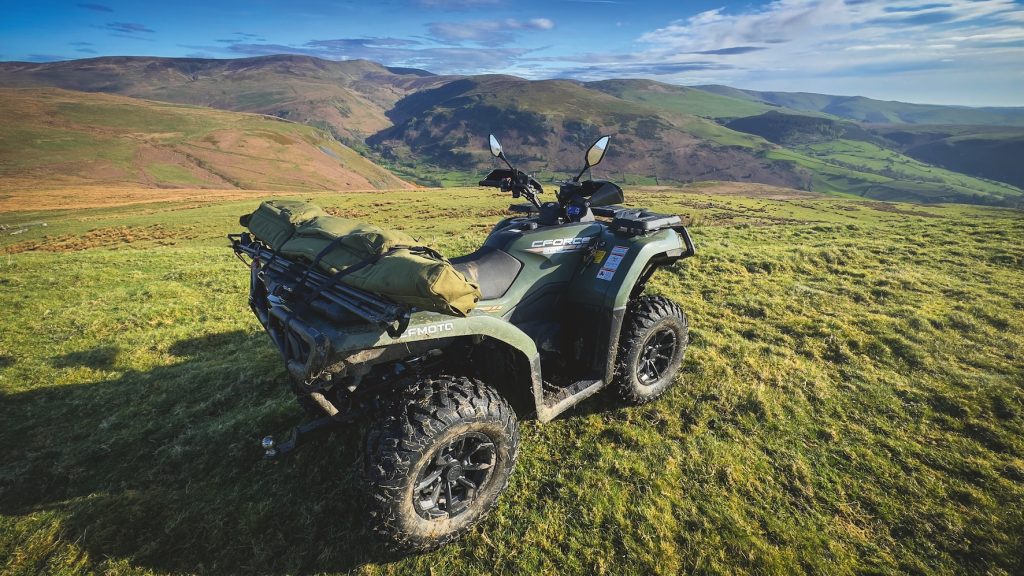
CFMOTO CFORCE 520 EPS review: is this budget-friendly ATV the ultimate hunting workhorse?
Looking for a reliable ATV for deer extraction and stalking? The CFMOTO CFORCE 520 EPS delivers full-spec utility, impressive off-road capability and serious value for money.
By Shooting Times | 1 August 2025
Get the latest news delivered direct to your door
Subscribe to Shooting Times & Country
Discover the ultimate companion for fieldsports enthusiasts with Shooting Times & Country Magazine, the UK’s leading weekly publication that has been at the forefront of shooting culture since 1882. Subscribers gain access to expert tips, comprehensive gear reviews, seasonal advice and a vibrant community of like-minded shooters.
Save on shop price when you subscribe with weekly issues featuring in-depth articles on gundog training, exclusive member offers and access to the digital back issue library. A Shooting Times & Country subscription is more than a magazine, don’t just read about the countryside; immerse yourself in its most authoritative and engaging publication.
 New competitionWin a pair of tickets to the British Shooting Show 2027Worth £129.90Closes 15 JanuaryEnter now ›