★ Win a pair of Brandecosse Capriolo boots worth £219! Click here to enter ★


Merlin survey: more than meets the eye?
Moorland estates are being urged to refuse access to a national merlin survey run by Natural England and the RSPB amid concerns over what's really being recorded.
 Credit: Helen Davies via Getty Images.

Merlin survey under scrutiny
Moorland estate owners across England have been advised by the Moorland Association (MA) not to participate in a national merlin survey after it was revealed that RSPB fieldworkers would be recording “known or suspected persecution incidents” and whether the ground is managed for grouse shooting.
The survey, conducted by the RSPB in partnership with Natural England and other UK statutory conservation bodies, is the first since 2008 and aims to provide a picture of how the red-listed merlin is faring. The RSPB said replicating the methodology of the previous national count was essential to measuring change.
Natural England has been seeking access to private moorland estates for RSPB research assistants to carry out the survey. However, instructions issued to those research assistants, seen by Shooting Times, reveal the survey extends beyond simply counting birds.
Surveyors are required to classify moorland as managed for grouse shooting or not. They must also record the extent of heather burning. And in the “additional comments” section of the recording form, surveyors are directed to note any “known or suspected persecution incidents”, without any definition of the term or explanation of what will be done with the information collected.
.
Concerns over scope and transparency
Andrew Gilruth, chief executive of the MA, was unsparing in his criticism. “Suspected by whom, on what basis and to what standard?” he asked. “Recorded for what purpose, shared with whom, retained where and used how? Those are not trivial questions. They go to the heart of what this exercise really is.”
The RSPB has campaigned for the licensing of driven grouse shooting on the grounds of alleged raptor persecution by keepers, a charge the industry strenuously disputes. For moorland estates already wary of that scrutiny, the prospect of RSPB staff walking over their ground and noting “known or suspected persecution incidents” is not a neutral proposition.
.
Estates urged to refuse access
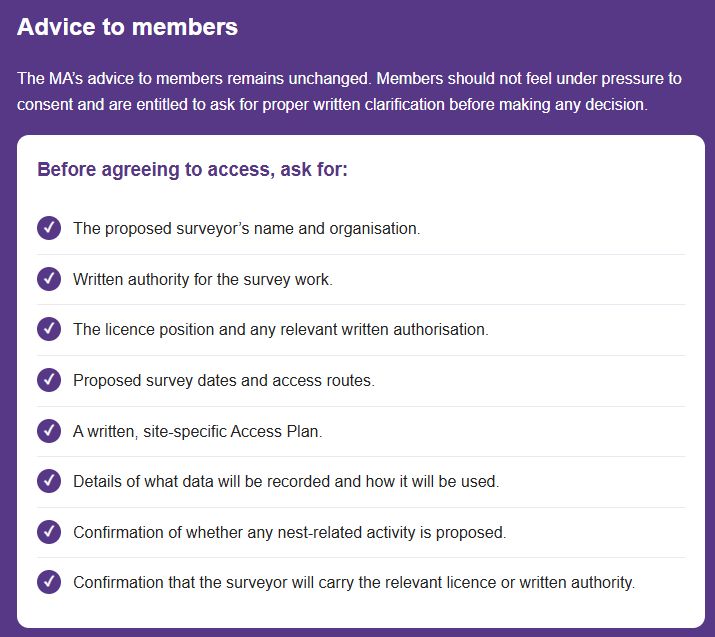
On 7 April the Moorland Association published a template letter for members to send to Natural England, refusing RSPB contractors access until eight detailed questions were answered, covering everything from the scope of the survey to the use of RSPB staff.
Natural England replied on 20 April, offering assurances that access was sought by consent only, with no statutory powers of entry invoked; that RSPB contractors would agree dates and routes with landowners beforehand; that no contact details or results would be passed on without consent; and that landowners would receive copies of all survey records promptly after each visit.
Contrary to what Mr Gilruth said estates had previously been told, Natural England disclosed that in England surveyors would also assess the condition of Sites of Special Scientific Interest (SSSIs) where breeding merlin are notified features. Nonetheless, Natural England said unequivocally that there would be “no other habitat inspection, wider monitoring, or data gathering for any other regulatory purpose”.
.
Trust remains a sticking point
Mr Gilruth remained unconvinced, questioning why estates had not first been asked to share their own merlin records and why gamekeepers and estate staff – who often have the most detailed knowledge of the ground and nest locations – had not been consulted before outside contractors requested entry.
“Where Raptor Study Group workers or other individuals outside Natural England are being drawn into sensitive observations of this kind, members are entitled to ask whether opinion, prejudice or speculation is being given an official-looking route into the system,” said Mr Gilruth.
“If Natural England wants confidence, it needs to say plainly who is involved, in what capacity, under what authority, with what safeguards and to what evidential standard. Vague references to collaboration are not enough.”
Natural England told Shooting Times that the survey “focuses solely on the endangered merlin to give us vital information about population numbers” and that surveyors were asked to note anything that could harm the birds they were monitoring, “such as habitat changes or signs of illegal persecution”. It added that “no surveys have taken place without landowner consent and data that is collected will not be shared beyond Natural England, the RSPB and the relevant landowner”.
At the time of writing, the MA was writing formally to Natural England and the RSPB and had told members to refuse access to merlin surveyors until both bodies had responded.
Do you have a news story to share?
Contact our group news editor Hollis Butler at hollis.butler@twsgroup.com. We aim to respond to all genuine news tips and respect source confidentiality.
Stay in the loop with the latest fieldsports news
Don’t miss a story – get shooting news straight to your inbox or phone. Join our newsletter and WhatsApp channel.
Related Articles

Shooting community urged to complete 2026 Game Shooting Census
The deadline for the 2026 Game Shooting Census and Shoot Owner Census, run by GunsOnPegs and Lycetts with the backing of BASC, the Countryside Alliance and the GWCT, closes at 12 noon tomorrow (Tuesda...
By News Desk
Gamekeepers refuse to endorse Scotland's new muirburn code
Scotland's gamekeepers say they will not endorse the revised Muirburn Code when NatureScot publishes it on 1 July, warning that it strips out the tools they rely on to fight wildfire and puts public s...
By News Desk
Get the latest news delivered direct to your door
Subscribe to Shooting Times & Country
Discover the ultimate companion for fieldsports enthusiasts with Shooting Times & Country Magazine, the UK’s leading weekly publication that has been at the forefront of shooting culture since 1882. Subscribers gain access to expert tips, comprehensive gear reviews, seasonal advice and a vibrant community of like-minded shooters.
Save on shop price when you subscribe with weekly issues featuring in-depth articles on gundog training, exclusive member offers and access to the digital back issue library. A Shooting Times & Country subscription is more than a magazine, don’t just read about the countryside; immerse yourself in its most authoritative and engaging publication.