For the working pest controller, the question is rarely which tool is best in isolation – it is which tool is best for the job at hand
Shooting Times7 May 2026
For the working pest controller, the question is rarely which tool is best in isolation – it is which tool is best for the job at hand. Airguns and rimfire rifles each occupy a distinct place in the pest controller’s armoury, and understanding where one excels and the other falls short is the difference between an effective setup and a compromised one.
In England and Wales, air rifles that produce up to 12ft/lb of muzzle energy do not require a firearms certificate. That single fact shapes much of the airgun’s appeal. Walk into a gunshop, pass a basic age check, and you can leave the same day with a capable pest control tool and no paperwork. For a farmer who wants to keep rats out of a grain store, or a smallholder managing pigeons in a Dutch barn, that accessibility matters enormously.
Tony Belas at Daystate puts the modern airgun’s evolution into sharp relief: “Do you remember the airguns of your childhood? Perhaps you borrowed a friend’s rifle or owned one yourself. Hitting a tin can from 20 paces while standing was often the challenge. Now imagine reliving that experience with a modern airgun.”
The contrast with those childhood memories is striking. “Today’s shooter is likely to use a pre-charged pneumatic [PCP] rifle with multishot capability: an airgun able to place pellets accurately at 50m while remaining light, refined and easy to handle. Many have triggers that outperform those on rimfires and full-bore rifles. High-end models may even feature electronic triggers and built-in chronographs, technology very rare or unseen on firearms but increasingly common on airguns.”
Accessibility and the modern airgun
Tony’s closing point is perhaps the most persuasive of all: “In an age of tightening firearms regulation, this accessibility remains one of the airgun market’s greatest strengths, giving ordinary enthusiasts the chance to buy, own and collect them with ease.”
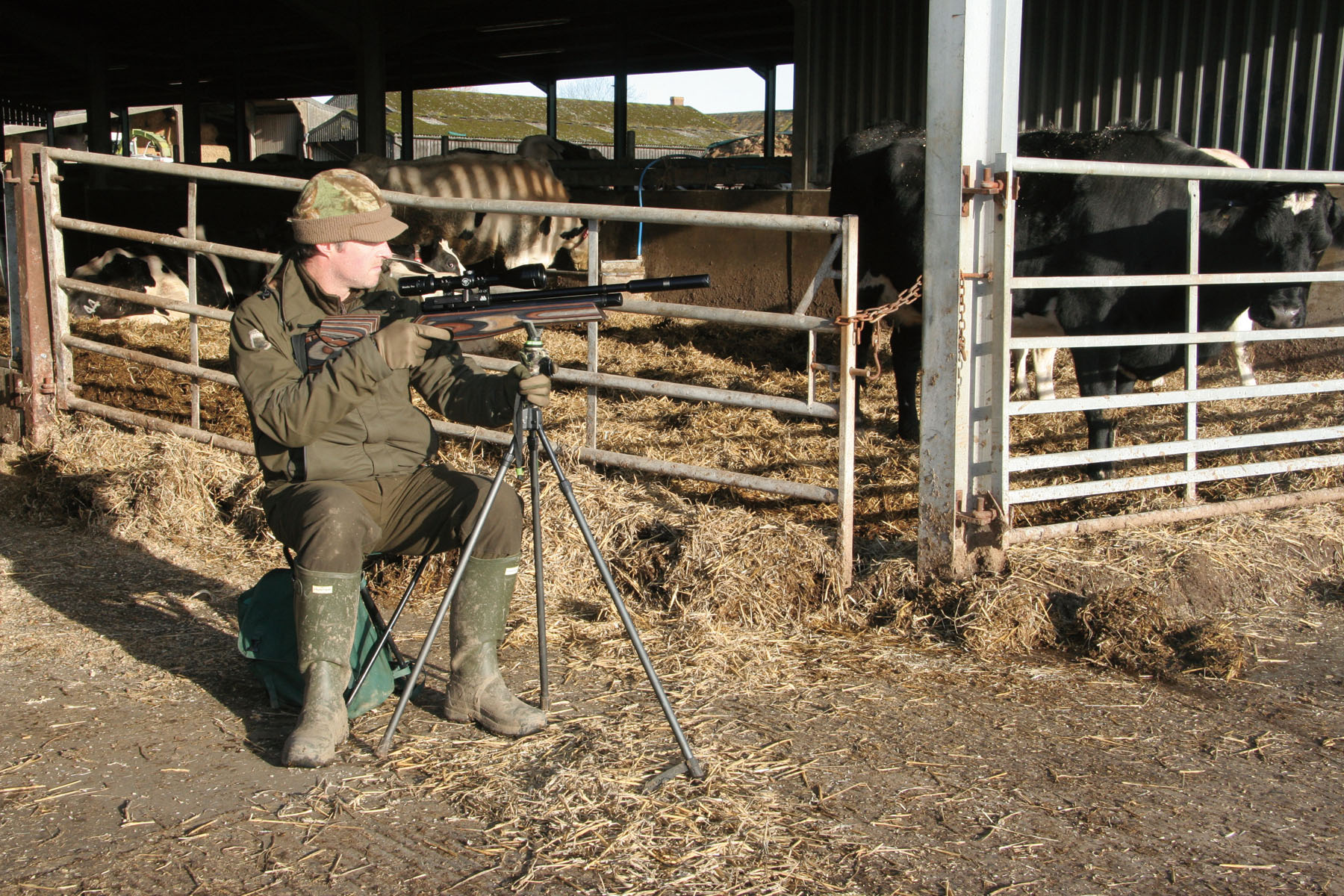
For close-range, confined-space work – the kind of pest control that makes up a significant proportion of everyday jobs – the sub-12ft/lb airgun is genuinely hard to beat. Graham Turner of distributor Edgar Brothers, which imports Airgun Technology to sell alongside its own EBA brand, is direct on the point: “PCP airguns are the masters of stealth and precision in confined spaces. For nighttime ratting or clearing feral pigeons inside barns, a sub-12ft/lb air rifle is ideal. Its low report and minimal ricochet risk protect livestock and infrastructure.
“Furthermore, the lack of an FAC requirement for standard airguns makes them more accessible for immediate, close-range tasks.”
That low report is worth dwelling on. Moderators for sub-12ft/lb airguns require no licensing, making a genuinely quiet setup straightforward to achieve. In and around farm buildings, where livestock, dogs and people may be present, that matters – both for safety and for not repeatedly flushing quarry with noise.
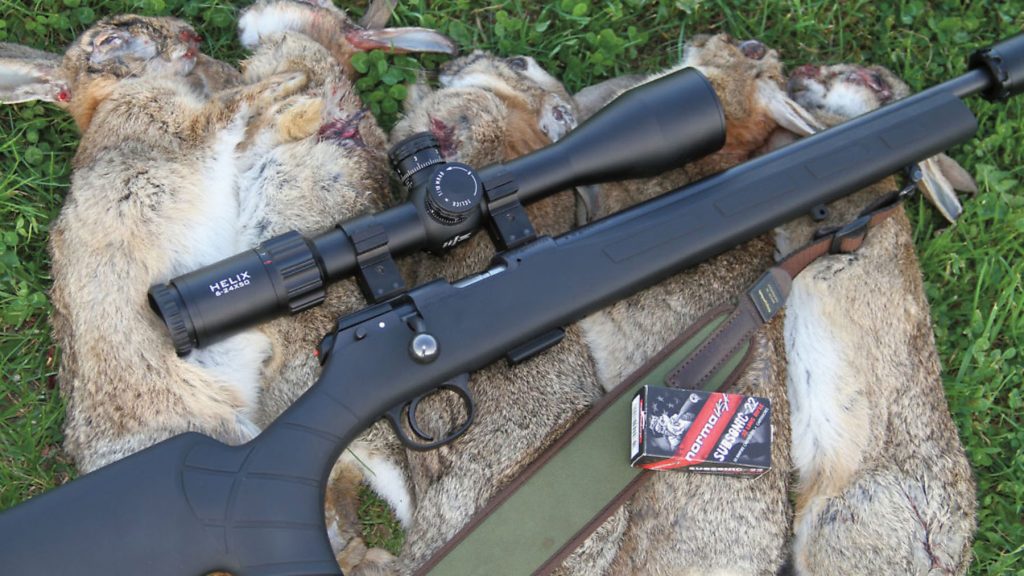
Where the sub-12ft/lb airgun reaches its limits is in open country. Effective range against rabbits drops away, and the combination of pellet weight and velocity available within the legal limit simply cannot deliver reliable, humane results at the distances a rimfire handles with ease. This is where the case for .22 LR and .17 HMR firearms becomes compelling.
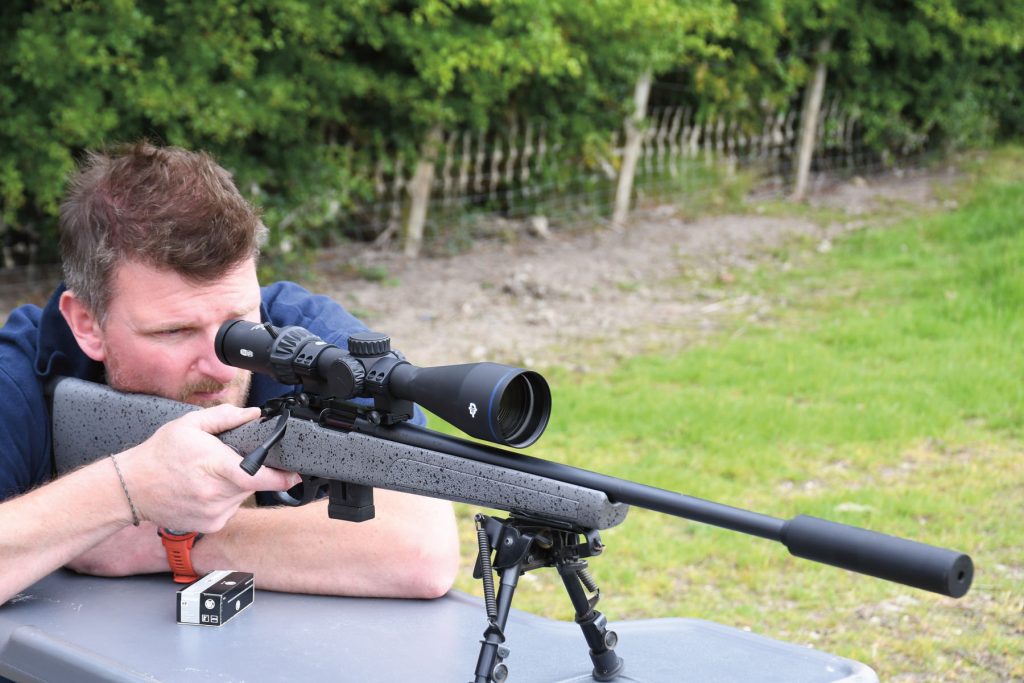
James Cook from SGC, which distributes CZ, frames the distinction clearly: “For suitable approved ground, rimfire rifles remain the natural choice. Calibres such as .22 LR and .17 HMR deliver the range, accuracy and trajectory needed for the most humane results on vermin.”
Graham agrees: “Rimfire rifles provide the range and stopping power required for woodland, moors and open fields. When managing rabbits at 50 to 100 yards or picking off wary corvids from a distance, the flatter trajectory and higher kinetic energy of a rimfire rifle ensure humane, one-shot kills that sub-12ft/lb airguns simply cannot match.”
Then there is the FAC air rifle – a category that increasingly straddles the two worlds. Simon Moore of BSA points to several advantages: “With development of higher powered air rifles, and heavier weighted pellets and slugs, higher foot/pound energy can be achieved, delivering greater stopping power. More accepted by FEOs [firearms enquiry officers] in the granting of licences as air rifle ballistics dictate less travel and more drop-off of projectile, so less risk. And cost – once the investment is made in the PCP, lead pellets are much lower cost than .22 LR or .17 HMR cartridges.”
Stealth advantages of FAC air rifles
Simon also highlights stealth: “Airguns are much quieter than rimfire and need no licence for moderators.” This is a point that holds at sub-12ft/lb and remains a relative advantage even in the FAC category when set against the report of a rimfire.
Graham takes the FAC argument further: “A modern high-powered PCP air rifle, when professionally tuned and paired with the correct slugs, will outperform any rimfire. My answer would actually be two air rifles.”
It is a bold claim, but the underlying logic is sound for many scenarios. James at SGC, which also distributes FX Airguns, puts the broader case neatly: “FAC-rated air rifles extend these capabilities, offering greater power, improved wind resistance and increased effective range through the use of heavier pellets and slugs.
“When used with safe and responsible consideration, particularly in environments where rimfire rifles may be unsuitable due to the lie of the land, high-performance platforms effectively bridge the gap between traditional airgun work and rimfire rifles, proving highly efficient against rabbits and corvids where additional reach is required.”
Safety and matching the tool to the task
The consensus across all four contributors, however, points not to one solution but to several working in combination. As Graham puts it: “Using a rimfire for rats in a barn is overkill and dangerous, while using a sub-FAC airgun for long-range rabbits is ineffective. By carrying both, you can adapt to the environment, ensure humane despatch, and maintain farm safety regardless of the target or terrain.”
James echoes that pragmatism: “In practice, many pest controllers use both systems: airguns for quiet precision in confined areas and rimfires for longer-range work. Matching the tool to the task ultimately delivers safer, more efficient and more humane pest control.”
For the serious pest controller, the question is not airgun or rimfire. It is having the right tool ready for wherever the job takes you next.
Pest control options to consider
Browning T-Bolt Sporter Composite
This straight-pull rimfire rifle in .22 LR is very affordable and fast-cycling for quick shots.
BSA R12 Take Down PCP
The latest utility version of BSA’s popular R12 PCP family comes with everything you need.
Daystate Alpha Wolf Carbon PCP
Said to be Daystate’s most advanced PCP airgun to date, the Alpha Wolf delivers up to 15% more muzzle energy.
Airgun Technology Vixen 2
Now distributed via Edgar Brothers, Airgun Technology’s firearms come with a three-year warranty.
This article contains affiliate links. If you click on one of these links and make a purchase, we may earn a small commission at no additional cost to you. Affiliate income helps us maintain the quality of our content and keep it freely accessible.
All recommendations are based on our honest opinions and thorough research.Would you like to speak to our readers? We offer sponsored articles and advertising to put you in front of our audience.
Find out more.
We look at five of the best ammunition choices for fox control, ranging from discreet .22 LR subsonic rounds to high-velocity .243 Winchester varmint loads
By Shooting Times
Get the latest news delivered direct to your door
Subscribe to Shooting Times & Country
Discover the ultimate companion for fieldsports enthusiasts with Shooting Times & Country Magazine, the UK’s leading weekly publication that has been at the forefront of shooting culture since 1882. Subscribers gain access to expert tips, comprehensive gear reviews, seasonal advice and a vibrant community of like-minded shooters.
Save on shop price when you subscribe with weekly issues featuring in-depth articles on gundog training, exclusive member offers and access to the digital back issue library. A Shooting Times & Country subscription is more than a magazine, don’t just read about the countryside; immerse yourself in its most authoritative and engaging publication.
To provide the best experiences, we use technologies like cookies to store and/or access device information. Consenting to these technologies will allow us to process data such as browsing behavior or unique IDs on this site. Not consenting or withdrawing consent, may adversely affect certain features and functions.
Functional
Always active
The technical storage or access is strictly necessary for the legitimate purpose of enabling the use of a specific service explicitly requested by the subscriber or user, or for the sole purpose of carrying out the transmission of a communication over an electronic communications network.
Preferences
The technical storage or access is necessary for the legitimate purpose of storing preferences that are not requested by the subscriber or user.
Statistics
The technical storage or access that is used exclusively for statistical purposes.The technical storage or access that is used exclusively for anonymous statistical purposes. Without a subpoena, voluntary compliance on the part of your Internet Service Provider, or additional records from a third party, information stored or retrieved for this purpose alone cannot usually be used to identify you.
Marketing
The technical storage or access is required to create user profiles to send advertising, or to track the user on a website or across several websites for similar marketing purposes.