★ Your magazine. Your say. Complete our reader survey with a chance to win Jack Pyke kit worth £500! ★


A bird worth waiting for: Squire Connop, Miss Glasscocke and the finest spoonbill in Norfolk
Sea-Pie rides along in a dog cart as Norfolk bird collector EM Connop finally gets his hands on the spoonbill he had coveted for years – and still thinks it cheap. First published in Shooting Times in December 1955


In the days of the old-time bird collectors and gentlemen gunners, a stuffed spoonbill was regarded as a kind of hallmark of a successful naturalist. High prices ruled for rare birds 50 years ago or so, and on one occasion I was present when a spoonbill changed hands at £40. Today, the buyer would find himself mulcted of £25, with the possible addition of a month’s change of air and surroundings at Her Majesty’s expense.
My old friend, the late EM Connop, the noted Norfolk bird collector of Rollesby, offered me one day a seat in his dog cart to drive over to Morston to call upon a certain elderly lady with a view to picking up a stuffed spoonbill, which Squire Connop had agreed to purchase from her at the above extortionate sum – possibly the highest price ever paid for a ‘spoonie’.
The lady was a Miss Glasscocke who resided in a small white house, since pulled down, on the road known as Morston Chase between the village of that name and the town of Wells.
Bird skins and a bottle of whisky
There cannot be many people alive today to whom the name of her father, the late Captain Richard Glasscocke, is familiar, but it may be encountered in some of the ancient catalogues and bygone bills of sale of old-fashioned private bird collections and museums. He was a retired East India captain who had been a traveller in many lands and often brought home skins of birds of paradise for which there was a constant demand during the 1870s and 1880s.
When Mr Connop was amassing his huge collection, he could seldom resist acquiring any brightly plumaged tropical specimens that came his way. Connop must have been a wealthy man, but ruined himself by extravagant expenditure on his favourite hobby. His method of driving a bargain was to sit down at a table with the specimen and a bottle of whisky, between himself and the vendor, and not to rise until agreement had been reached.
This kind of business exactly suited Captain Glasscocke, who was an antagonist well able to cope with the famous naturalist, and it is believed that more than one bottle would occasionally be in request before some particularly desirable specimen passed into Mr Connop’s possession. In fact, Captain Glasscocke was in the habit, as soon as his ship dropped anchor in the port of London, to visit Jamrach, the East End dealer, to ascertain the approximate cash value of his bird skins. Small wonder that Mr Connop constantly affirmed that “Glasscocke was a devil to drive a bargain with.”
The old sea captain died in the early 1880s, and after her father was deceased, his daughter had parted with most of his remaining bird skins to Mr Connop.
A treasured spoonbill in the drawing-room window
I am not suggesting that the latter had ever broached a bottle in any attempt to influence the homely-looking little lady who greeted us on our arrival at her house, but I do know that Mr Connop had tried for years to induce her to part with the treasured spoonbill, which Captain Glasscocke himself had shot.
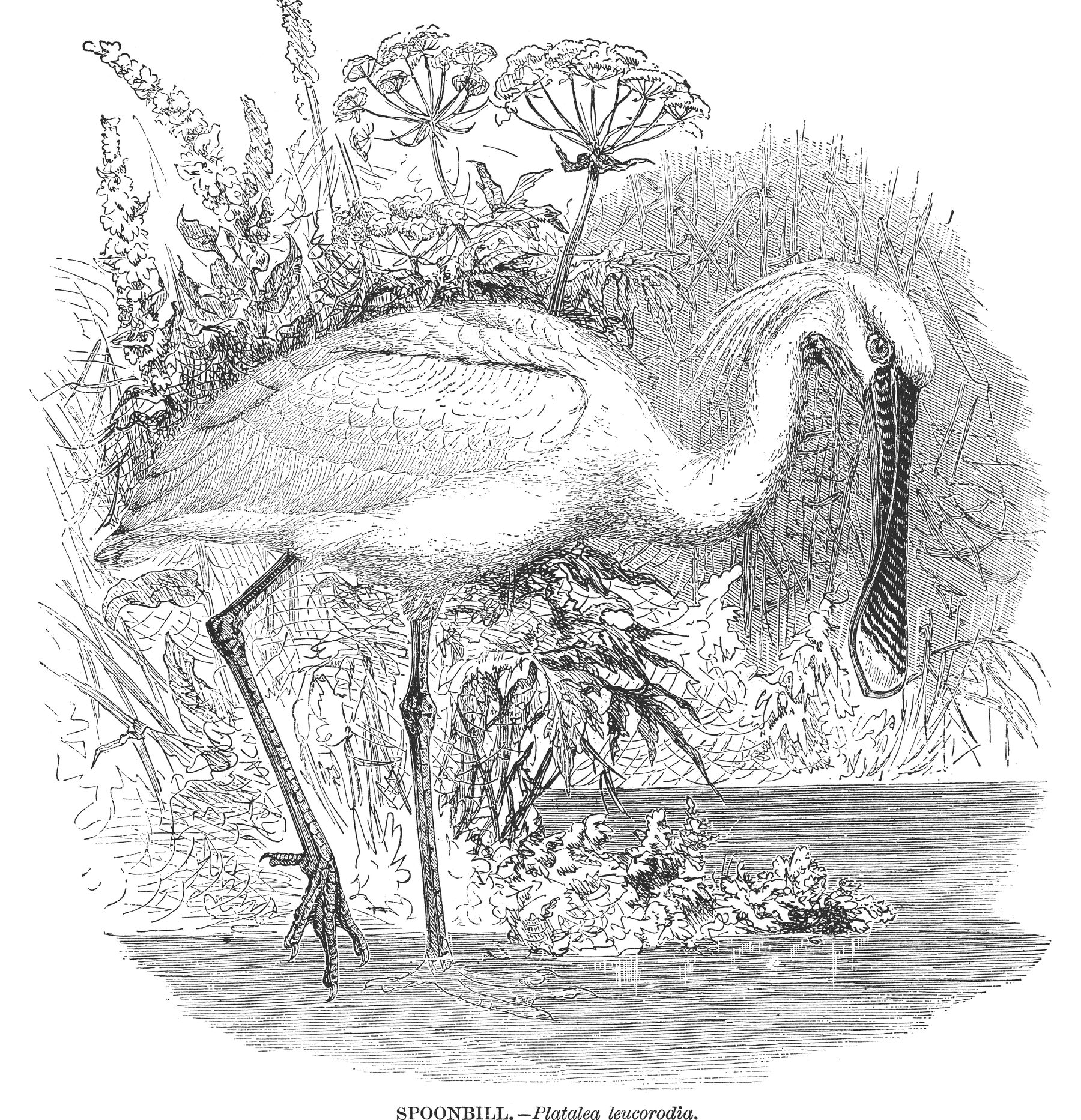
This bird, which stood in a large case in one of the windows of the drawing room, was certainly an impressive creature with a long flowing crest of a tawny-orange hue. To acquire this noble specimen had become almost an obsession with the squire of Rollesby Hall, for though he already possessed at least half-a-dozen spoonbills, there was not one to approach Miss Glasscocke’s bird for richness of colour, and the glory of its plumes.
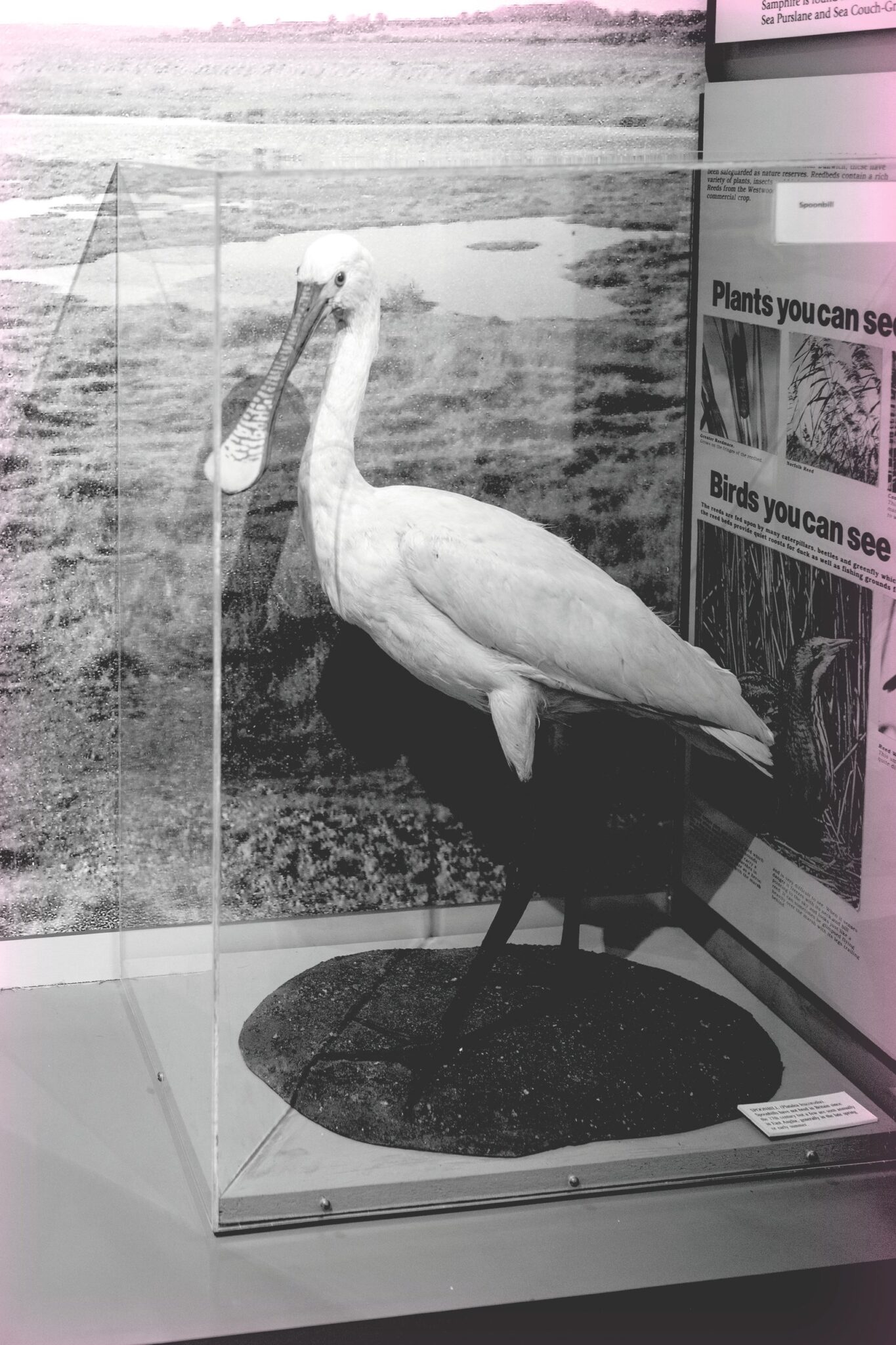
As soon as we entered the parlour, Mr Connop stepped back in admiration of his purchase and began fumbling with his chequebook. The lady herself, delighted to recount her bird’s history to a newcomer, at once started her spoonbill story, which Connop no doubt had heard a score of times.
A shy bird on the Morston marshes
“It was a very shy bird,” she began. “Spoonbills are, I am told, always shy, but this one was excessively so, for it had been on the flats for some days, and several local men had shot at it till at last nobody could approach the bird within 500 yards. It was after my father’s return from his last voyage, and one particular May morning I happened to be up rather earlier than usual, and noticed from my bedroom window a great white bird with outstretched neck and legs flying across the marshes. I knew it must be the spoonbill.
“After circling over the marsh for some time, as if seeking a safe spot on which to alight, the bird gradually descended and pitched in a deep drain beside the old sheep bridge in the middle of the saltmarsh. I hurriedly knocked on my father’s door and told him what I had observed. He was not long in throwing an old mackintosh over his pyjamas, pulling on his thigh boots and picking up his gun. And I can assure you, Captain Glasscocke looked a strange object as he made his way thus attired across the marsh.
“As he got near the wooden bridge, I saw him go down on his hands and knees and creep towards the edge of the drain. My father told me afterwards he had crawled almost on top of the spoonbill so that he could see its red eyes, and would have blown it to bits if he had not put it up before firing. When he came back carrying the bird by its legs, he remarked it was the finest specimen ever taken in Norfolk, and added ‘my friend Squire Connop will never rest till he gets this bird’.”
“By Jove!” chimed in Mr Connop, as the lady finished. “By Jove, old Dick Glasscocke was right. Here is the cheque, and we’ll load the bird up right away on the back seat.”
As we were lashing the case in position on the dog cart, I heard the old naturalist remark to himself with one of his inimitable chuckles, “That’s the first bargain I ever got out of Glasscocke. I’d have given her £50. Luckily, it was not the old chap I had to deal with.”
This article was first published in the 16 December 1955 issue of Shooting Times.
Frequently asked questions
Why were stuffed spoonbills prized by Victorian collectors?
In the days of the old-time bird collectors and gentlemen gunners, a stuffed spoonbill was regarded as a kind of hallmark of a successful naturalist, and rare birds commanded high prices – Sea-Pie saw one change hands for £40.
Who was EM Connop?
EM Connop was a noted Norfolk bird collector of Rollesby Hall who amassed a huge collection, including at least half-a-dozen spoonbills, and is said to have ruined himself through spending on his hobby.
 Closes 15 JanuaryWorth £129.90Win a pair of tickets to the British Shooting Show 2027Enter nowFree to enter
Related Articles

Lend at your peril: two true tales of a borrowed gun on the foreshore
When a fowler takes another man's gun to the foreshore, strange things follow, warns AL Jarrett in this piece from the Shooting Times archive, first published in October 1979
By Shooting Times | 15 October 2026

Off the back of a lorry: a house move with a labrador, five terriers and eight ferrets
A house move with a labrador, five terriers and eight ferrets was never going to be simple, as Petrel discovered on the road west in this piece from 1979
By Shooting Times | 10 October 2026
Get the latest news delivered direct to your door
Subscribe to Shooting Times & Country
Discover the ultimate companion for fieldsports enthusiasts with Shooting Times & Country Magazine, the UK’s leading weekly publication that has been at the forefront of shooting culture since 1882. Subscribers gain access to expert tips, comprehensive gear reviews, seasonal advice and a vibrant community of like-minded shooters.
Save on shop price when you subscribe with weekly issues featuring in-depth articles on gundog training, exclusive member offers and access to the digital back issue library. A Shooting Times & Country subscription is more than a magazine, don’t just read about the countryside; immerse yourself in its most authoritative and engaging publication.

