★ Win a pair of Brandecosse Capriolo boots worth £219! Click here to enter ★


Learning to shoot and cook game in Somerset
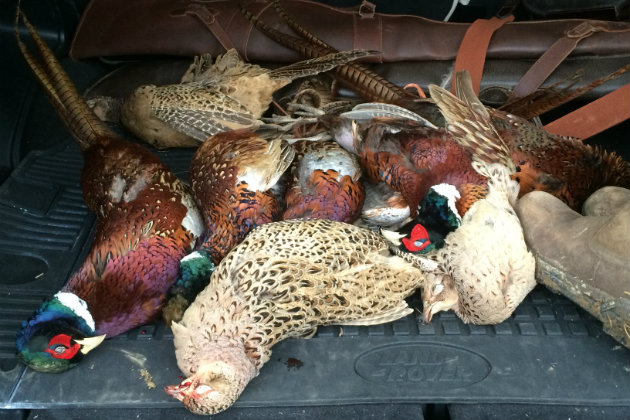

My experience of clay pigeon shooting has largely been limited to team-building days. And I found them immensely frustrating.
For whilst some of my colleagues picked up their shotguns and were away, hitting clays with just about every shot, I was a complete amateur and a quick 10 minute lesson taught me nothing useful – and I didn’t hit a single clay. And in any case, after about an hour on the clay ground, we were off to hit another target – golf balls on the driving range.
Learning to shoot
Rather than put me off, I was intrigued and resolved to learn to shoot with the help of a patient and knowledgeable instructor. I was also keen to learn how to cook whatever game I eventually managed to shoot out in the field – following the “field to fork” philosophy.
The ideal course
After a bit of research I came across just what I was looking for. A two-day shooting experience course at Vale House Kitchen in the pretty village of Timsbury just south of Bath.
I didn’t need a gun, cartridge or a shotgun licence. Just a waterproof coat, wellies, enthusiasm and a willingness to listen – which I certainly had.
Would I really shoot a pheasant?
Apparently so. On the first day I’d be taught to shoot in the morning (a morning?) and then go out for two pheasant drives in the afternoon. On the second day I’d be taught how to cook said pheasants by none other than Tim Maddams, who has recently written The Game Cookery Book for River Cottage with Hugh Fearnley Whittingstall.
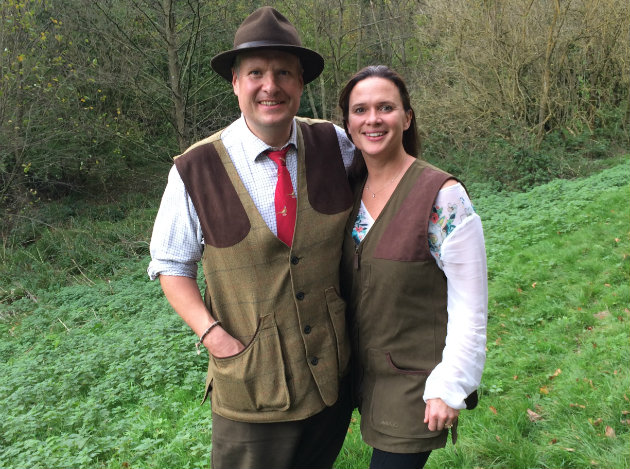
Bod and Annie Griffiths
The “Shooting Experience” course was set up by Bod and Annie Griffiths four years ago. Bod has been fishing and shooting since childhood and after a spell in the City, he moved back to his native countryside and the couple set up Vale House Kitchen – with a ‘field to fork philosophy’. That is you eat what you shoot, preparing it in the most delicious way possible.
Day one
Following instructions, I arrived by 9.30pm at the Shellard Shoot, in the idyllic village of Wellow just outside Bath. Parking by the stables, my fellow shooters and I were greeted by Bod Griffiths, who took us inside for a briefing, introductions and coffee.
Bod Griffiths is just the sort of person you want to introduce you to shooting. He is personable, knowledgeable, enthusiastic and not in the slightest bit condescending, He told us what the format of the next two days would be and what we would get out of it.
My fellow shooters – one other woman, three other men – were a mix of beginners, a couple coming back to shooting after a break and a young chap who’d done a bit of pest control but wanted to brush up on pheasant shooting and clayshooting. I talked to Stuart who’d been gameshooting once before and done some beating but wanted to learn more, particularly about cooking what he had shot.
One of the reasons Bod and and wife Annie had set up the course, with the help of Frank Shellard, is that they felt a lot of people wanted to get into shooting but didn’t know how. They knew that many people had a preconceived idea of shooting that was far off the mark, considering it cliquey.
Enter Frank Shellard
Frank is a true character, a true countryman, right down to sporting a bow tie made from pheasant feathers – given to him by the aforementioned Tim Maddams of whom more later.
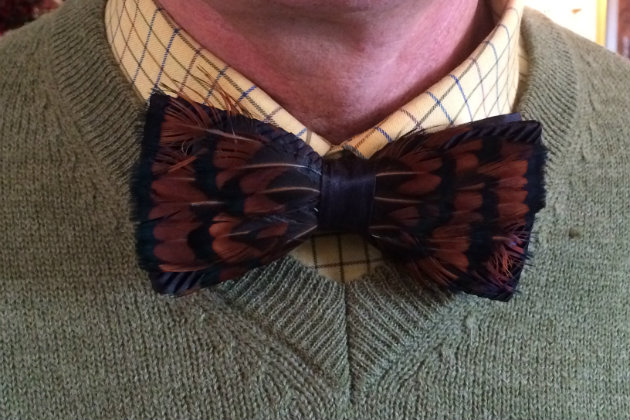
I’d never seen a pheasant bow tie before
And Frank has been known to run the beating line from the back of his horse, Dragon.
Frank set up the Shellard shoot and it was on his clayshooting ground we were going to brush up on our clay skills in the morning, learning about gun mount, technique, stance and lead. Then a trip out into the the field in the afternoon for a couple of drives.
He began by bringing in a selection of stuffed gamebirds – pheasant, partridge, woodcock – and telling us about each of their characteristics.
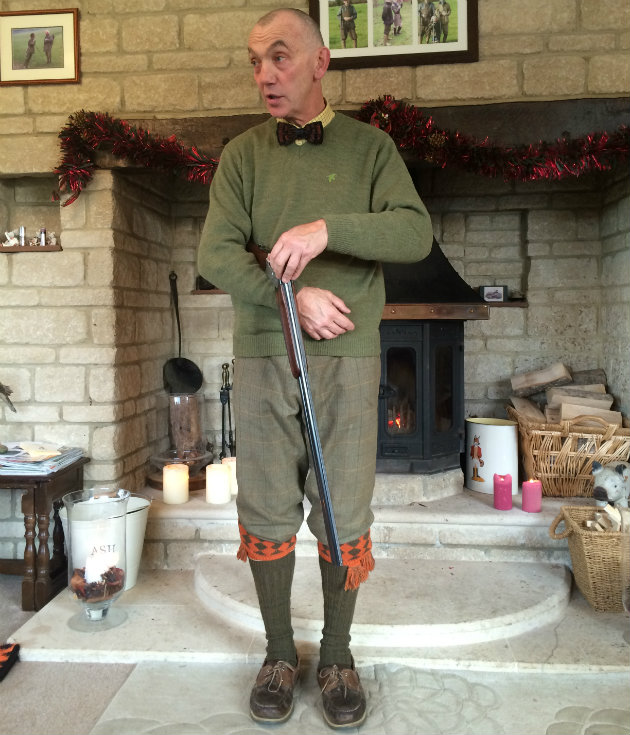
Frank Shellard was an entertaining and informative instructor
Staying safe
Next up was a thorough safety briefing and I felt very reassured that I knew the correct way to do things. Frank showed us how to take a gun out of a gun slip and how to put it back, and the right order and routine for everything.
He talked to us about ‘The Method’ – which is not acting but the correct way of carrying and holding your gun so you’re safe, why breaking the gun between shots is crucial, the importance of pointing it upwards and carrying the gun inside a gunslip.
Country conservation and shooting are in Frank’s blood. Having taken up game shooting from an early age, Frank is now a qualified CPSA instructor and has shot over many estates throughout the UK. He employs a full-time gamekeeper who rears the majority of the birds released on the Manor Farm Estate where he farms 110 acres (of which 100 are organic). The property focuses on conservation, hedgerows are left relatively untouched and crops like kale are left to run to seed as food for finches.
Off to the clay ground
Bod’s wife Annie drove me to the clayshooting ground and on the way we chatted. If you had preconceptions about the sort of women who shoot, then she’ll change them. Before she married Bod she worked as an acupuncturist in a trendy part of London. I asked her about what she thought of it all – she is now a keen gameshooter herself.
“The idea for this course crystallised slowly in my mind – I decided that the best way of honouring the game I shot was to lovingly prepare and cook it before eating. Also people don’t know how to get into gameshooting and we wanted them to have the whole experience from learning through to serving game at the table.”
Frank had also told me that he’d bumped into Bod four years ago, chatted and they’d all “put two and two together” – with the course being launched three years ago (and it’s popular).
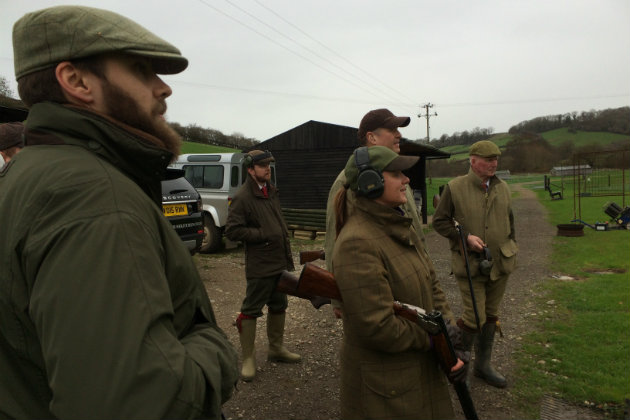
Listening to our briefing at the clayshooting ground
Starting to shoot
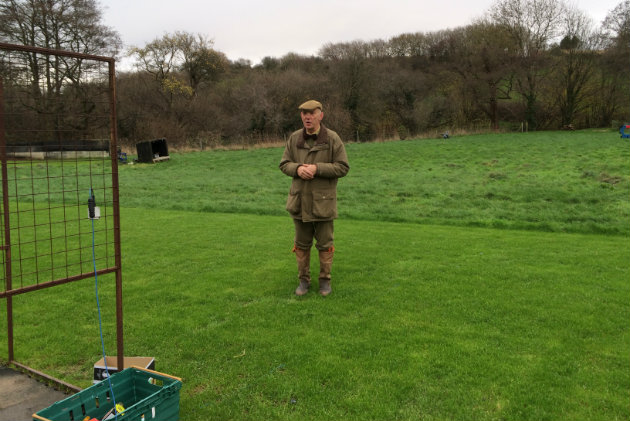
Another briefing on safety
At the clayground, Frank talked us through gun mount and stance again and how to lead. I was then handed ear protectors, safety goggles, and a 20-bore Beretta Silver Pigeon (which I found straightforward to use, with minimal recoil).
One of the instructors stayed by my shoulder talking me through and acted as my loader.
Squeezing the gunstock closely I took my first shot at a high incoming clay, squeezed the trigger … and missed.
The good thing was that the Beretta was a very comfortable shotgun for a beginner like me and so over the next few minutes I relaxed and about five minutes later smashed my first clay.
Then there was no stopping me and in fact I found the ‘rabbits’ rather easier than the high incoming and going away clays.
With every shot my instructor told me what I was doing right – and more often wrong – and giving solid advice that was endlessly patient and encouraging.
Then it was time to step away from the cage and shoot in front – which felt entirely different. Much more exposed so it immediately gave me for a feel what it was going to be like out in the field later on. More clays were launched and after some initial hesitation I managed to hit two or three.
All too soon it was time to go back to Frank’s house for a friendly lunch and discuss the finer points of shooting clays around the farmhouse kitchen table.
Off to the shooting line
After lunch we were all driven to the first of our drives. Frank explained to us how each peg was allocated and gave me my very first game card, which I’ll treasure.
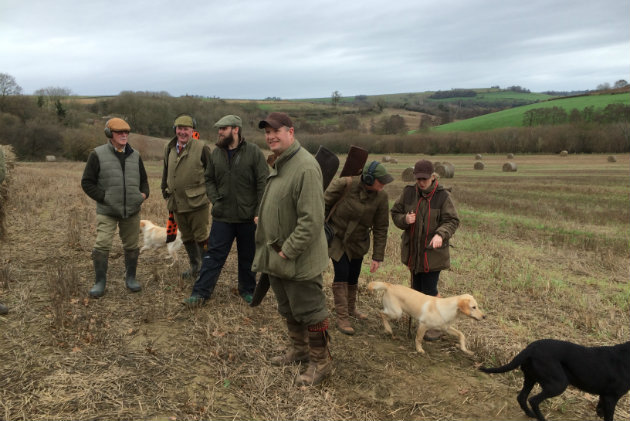
Waiting for our pegs
I was on the edge of a maize field and Frank stayed by my side as I listened to the beaters doing their work. Suddenly the game was quite literally up and in the next 15 minutes I bagged my first brace of pheasant. All the time Frank was at my ear with words of advice and encouragement, which did wonders for my confidence.
I was handed the pheasants and put them in the boot of a Land Rover. A first for me, I really felt I’d learned something useful. I don’t think I am a natural shooter so it is indicative of how good the teaching had been that I achieved success so early on.
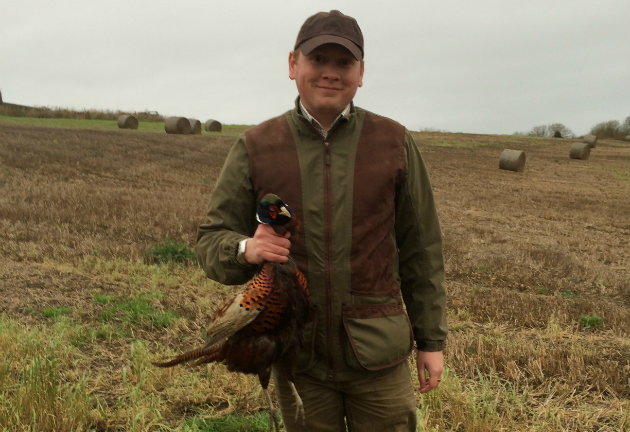
One of my fellow students holding his first-ever pheasant
Then we were off to the next drive, a short distance away in Phillips Meadow and waited on our assigned pegs on some stubble by a small copse.
This time I didn’t managed to get anything, although my neighbour bagged three birds.
The light started to fade and we were done for the day and walked back to the 4 x 4s.
Working dogs
Something I particularly enjoyed about the day was watching the gundogs working. All were beautifully trained and it was a pleasure to see the enjoyment and concentration with which they went about their work.
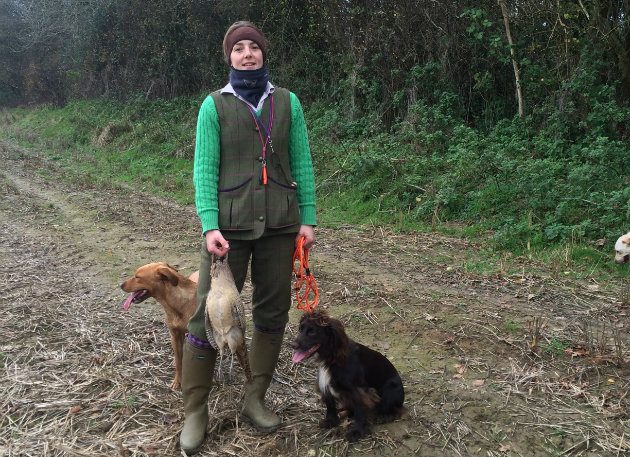
Frank’s daugher was an expert handler
Back at my car I realised how tired I was. Being outside all day, concentrating and adrenalin surging had been exhausting in the best possible way. I slept better than I had for months, proud of my day’s bag and all I had learned. I was looking forward to the next day – a cookery course with the great Tim Maddams where I would prepare the pheasants I’d shot.
Sounds like the course would be useful to you? You can read more about The Shooting Experience at Vale House here. Read all about the second day of the course, a game cookery day with Tim Maddams here.
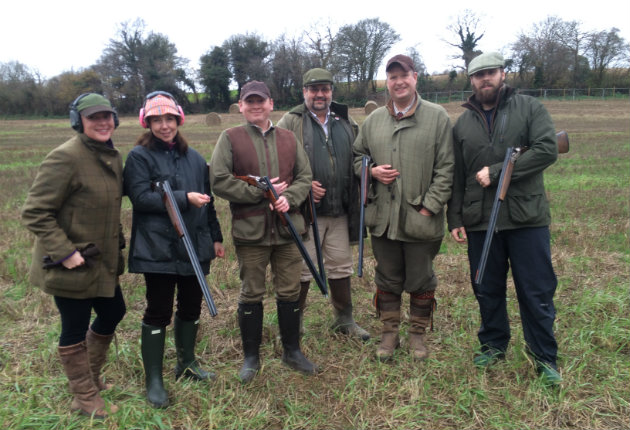
Happy and glorious. Learner Guns at the end of the day
Related Articles
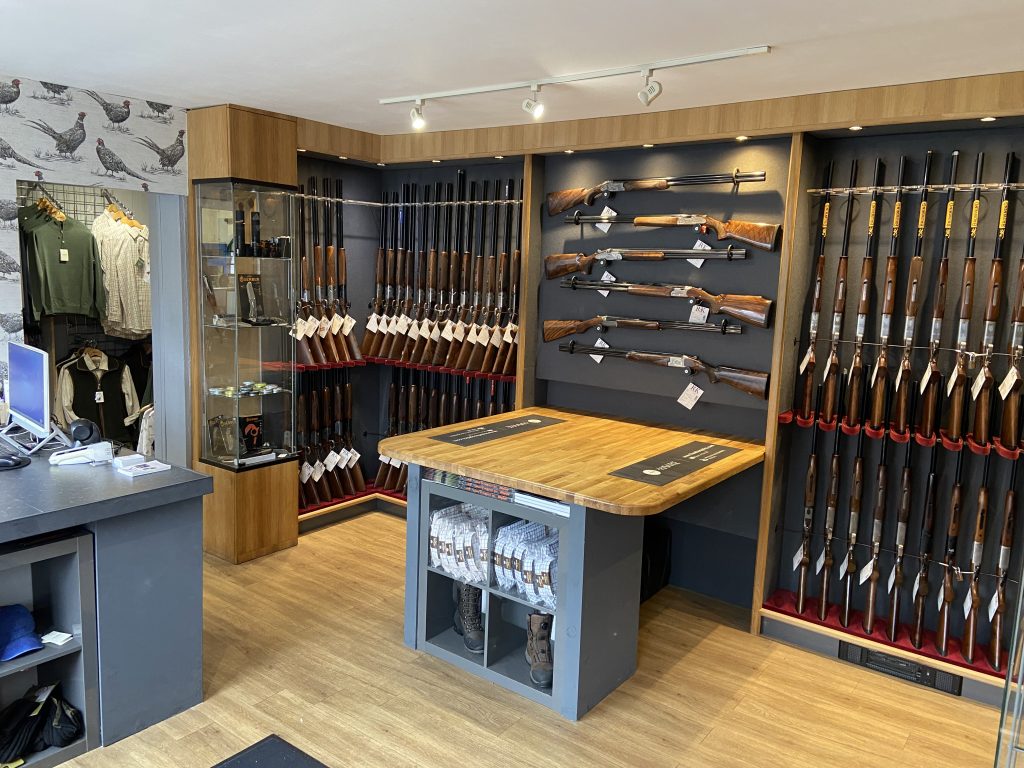
The Gun Shop Directory
A pick of some of the best gun shops for fieldsports enthusiasts
By Shooting Times
Get the latest news delivered direct to your door
Subscribe to Shooting Times & Country
Discover the ultimate companion for fieldsports enthusiasts with Shooting Times & Country Magazine, the UK’s leading weekly publication that has been at the forefront of shooting culture since 1882. Subscribers gain access to expert tips, comprehensive gear reviews, seasonal advice and a vibrant community of like-minded shooters.
Save on shop price when you subscribe with weekly issues featuring in-depth articles on gundog training, exclusive member offers and access to the digital back issue library. A Shooting Times & Country subscription is more than a magazine, don’t just read about the countryside; immerse yourself in its most authoritative and engaging publication.