★ Your magazine. Your say. Complete our reader survey with a chance to win Jack Pyke kit worth £500! ★
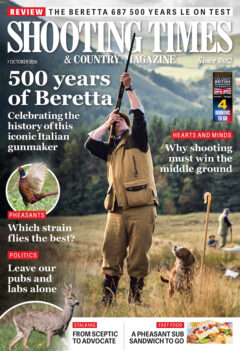

Young shots: becoming a gamekeeper, where to study and the red-legged partridge
With the new school year under way, this edition is all about what comes next, with expert advice on starting a career in keepering and where to study. Plus the red-legged partridge, a GCSE in Natural History, memory retrieves and a partridge casserole


The new school year is well under way, and for most of you the summer holidays already feel like a distant memory. So, this month we’ve turned our attention to what comes next. We ask whether you’d take a GCSE in Natural History, find out how to get a gamekeeper into your classroom and share expert advice on starting a career in keepering – including where to study. Plus, the red-legged partridge takes centre stage, and there’s a recipe to try.
Martin Puddifer, managing editor
Are you our next star? Please send your letters and photos to shootingtimes@twsgroup.com
In this edition
- Quarry in question: the dashing redleg
- How to become a gamekeeper
- Going off to college: where to study gamekeeping
- Cookery corner: partridge and bacon casserole
- Welcome to BASC: would you take a GCSE in Natural History?
- Gundog guidance: memory retrieves
- Take part: get a gamekeeper into your classroom
- Book corner: The Messenger
Quarry in question: the dashing redleg
The red-legged partridge is one of the most important birds in British shooting, especially at the start of the season in September. It’s striking, tough and very quick, and it has lived in Britain for more than 250 years. Read on to find out what makes the redleg so special.

What is it?
The red-legged partridge (Alectoris rufa) is also called the redleg or French partridge. It isn’t originally from Britain. It comes from France, Spain, Portugal and north-west Italy, and was brought to Suffolk around 1770. It’s a little bigger than our native grey partridge and weighs 400-550g. Look out for its red beak and legs, its white throat with a black border and its stripy sides. Here’s something unusual: a hen can lay two lots of eggs, and the cock bird sits on one of them.
Where to find it
Redlegs like dry, open countryside, especially farmland with chalky or sandy soil. They shelter in hedges, field edges and specially planted crops called cover crops. East Anglia is their stronghold, but released birds live across much of Britain, from flat farmland to the steep valleys of the West Country and Wales. They cope with hot, dry weather better than grey partridges, and they would rather run than fly.
How it flies
Left alone, a redleg flies low, whirring just above the ground before gliding back to cover. On hilly shoots they can fly over at 40 yards or more. With the wind behind them they can reach around 40mph – faster than a car driving through town!
Rearing and release
Most redlegs shot in the UK are raised on game farms, and around nine to 10 million are released every year. The chicks hatch from eggs and are kept warm under heaters. From July, at 10 to 12 weeks old, the young birds (poults) move into release pens. Lots of eggs and birds used to come from France, but bird flu and new rules since Brexit have made that harder in recent years.
Season
1 September to 1 February (in England, Wales and Scotland); 1 September to 31 January (in Northern Ireland).
Did you know?
Why the redleg is called the ‘Frenchman’
The redleg is sometimes called the ‘Frenchman’. That’s because back in the 1770s, eggs were brought over from France and hatched under farmyard hens! And when a covey (a family group of partridges) is flushed, the birds often scatter in all directions.
How to become a gamekeeper
The National Gamekeepers’ Organisation offers some practical advice.
Gamekeeping is an amazing career. It’s hands-on, varied and rewarding work, and if you love the countryside and being outdoors, it could be the job for you. You’ll work with wildlife, habitats, dogs, livestock and people, and no two days are ever the same. It’s certainly not a 9-5 desk job.
So how do you get started? The best advice is simple: get out there and get involved. Go beating, meet gamekeepers and offer to help at weekends or in the evenings. Be prepared to work hard, get cold, wet and muddy, and learn from experienced people who can teach you the skills that you need.

You don’t necessarily need a string of qualifications either. If your GCSE results weren’t what you hoped for, don’t let that hold you back. In gamekeeping, practical experience, enthusiasm, reliability and a good attitude can sometimes be worth more than exam results.
Many jobs are actually found through word of mouth and recommendations, so make a good impression wherever you go.
Get involved, learn as much as you can and build a good reputation. Your first opportunity could be just around the corner!
Going off to college: where to study gamekeeping
Where to study gamekeeping in England, Scotland and Northern Ireland.
Sparsholt College, near Winchester, Hampshire
Gamekeepers have trained here since the 1970s. The main course is equal to A-levels and takes one or two years. You’ll need four or five good GCSEs (grade 4 or above). You could even earn a deerstalking certificate. Want to earn while you learn? Try the underkeeper apprenticeship. sparsholt.ac.uk
Askham Bryan College, York
Its Level 3 gamekeeping course covers lowland and upland keepering, with work placements and trips to the coast, moorland and forest. You’ll need GCSEs at grade 4 or above in two of English, maths and science, and at least a 3 in the other. askham-bryan.ac.uk
Hartpury College, near Gloucester
Learn to rear gamebirds and go beating on shoots, on a 360-hectare campus. You can also gain quad bike, chainsaw and shooting safety certificates. Do well and you can stay a further year for the Level 3 Diploma. For that you’ll need a merit and grade 4 in GCSE English and maths. hartpury.ac.uk
Plumpton College, near Lewes, East Sussex
On this two-year course you’ll help run the college’s own shoot. You’ll need four GCSEs at grade 4 or above, including English, maths and a science. You’ll also spend 50 days on a work placement – a great way to meet future employers. One former student landed a job at Sandringham! plumpton.ac.uk
Myerscough College, near Preston, Lancashire
School leavers can take Level 2 and 3 courses in land and wildlife management. Facilities include a gamebird hatchery, an armoury and an off-road driving course. You can also study gamekeeping at its Blackburn centre. Check the website for entry requirements. myerscough.ac.uk
Wiltshire College, Lackham, near Chippenham
The course here is built around running a real shoot, from producing gamebirds to working with dogs and beating. Every year ends with a beaters’ day to celebrate. Check the course is still running before you apply. wiltshire.ac.uk
SRUC Elmwood, Cupar, Fife
Scotland’s main gamekeeping college. The one-year course needs three National 4s, including English. You’ll help manage a real estate in Fife and stay on upland estates to learn about red deer and grouse. If you qualify for a bursary, you pay no fees. A higher-level HNC follows. sruc.ac.uk
Borders College, Newtown St Boswells
On the NC Gamekeeping you spend three weeks in college, then three weeks working on an estate, and repeat. It’s a great way to learn on the job. You’ll need some hands-on experience, an interview and a reference. Afterwards, you can move up to the HNC. borderscollege.ac.uk
UHI North, West and Hebrides, Thurso
In the far north of Scotland, this one-year course mixes online lessons with real work on an estate. You’ll need to find your own placement, but the college will help. You’ll need to be 16 or over, fit and have three National 4s. You’ll also work towards a deer management qualification. nwh.uhi.ac.uk
CAFRE, Glenwherry, Co Antrim
A short taster course over six days, mostly Fridays, started in September. You had to be 18 or over. You got BASC student membership plus certificates in safe shotgun and rifle use, and grey squirrel control. Keep an eye on this provider. cafre.ac.uk
If we’ve missed a college near you that offers gamekeeping courses, let us know at shootingtimes@twsgroup.com.
Cookery corner: partridge and bacon casserole
Autumn’s here, so why not cook a warming casserole for the family?

Ingredients
- 4 skinned partridge breasts
- 1 tbsp plain flour
- 1 tbsp olive oil
- 100g smoked bacon lardons
- 1 onion, chopped
- 2 carrots, peeled and sliced
- 250g small new potatoes, halved
- 100g button mushrooms, halved
- 1 garlic clove, crushed
- 1 tbsp tomato purée
- 400ml chicken stock (a stock cube is fine)
- 1 tsp dried thyme
- Salt and pepper
- Crusty bread or mash, to serve
How to make partridge and bacon casserole step by step
- Step 1. Wash your hands. Ask an adult to preheat the oven to 180°C/Gas Mark 4.
- Step 2. Cut each partridge breast in half. Check for any shot (small pellets) and remove it. Toss the pieces in the flour, then wash your hands, the board and the knife.
- Step 3. Heat the oil in a flameproof casserole dish over a medium heat. Brown the partridge for 1-2 minutes on each side, then lift it out onto a plate.
- Step 4. Add the bacon and onion to the dish and cook for 5 minutes, until golden. Stir in the carrots, potatoes, mushrooms and garlic, and cook for 2 minutes more.
- Step 5. Stir in the tomato purée, stock and thyme, and bring to a simmer. Put the partridge back in the dish, cover with the lid and ask an adult to put it in the oven.
- Step 6. Cook for 30 minutes, until the potatoes are tender and the partridge is cooked right through with no pink showing. Season with a pinch of salt and pepper and serve with crusty bread or mash.
Welcome to BASC: would you take a GCSE in Natural History?
BASC’s head of outreach and education Curtis Mossop explains more…
Good news if you love being outdoors: from September 2028, teenagers in England could take a brand-new GCSE called Natural History!
The idea took years to happen – it was first suggested back in 2011. Now it’s finally becoming real.
If you choose this GCSE, you won’t just be stuck in a classroom. You’ll spend at least 20 hours doing fieldwork – getting outside to study plants, birds, insects and animals in their natural habitats.

That matters more than ever. One study found that people in Sheffield spend, on average, less than five minutes outdoors in nature each day!
Events like our Let’s Learn Moor initiative already show what’s possible. Since it began in 2017, it has introduced more than 16,000 young people to the UK’s wild uplands.
Fieldsports have always been about understanding nature. Maybe it’s time more of that knowledge was shared with the next generation.
Curtis Mossop, BASC’s head of outreach and education
Gundog guidance: memory retrieves
These simple training steps will help you feel confident, build trust with your dog and set the right foundations for success in the field. This is stage 13: memory retrieves.

Why this stage matters
Memory retrieves teach your dog to trust you and to run out with confidence even when they cannot see the dummy.
Setting up the exercise
Start with one simple memory. Walk out with your dog at heel and place a dummy on the ground. Walk back to your starting point and sit your dog. You want them to understand that the retrieve is there even though they cannot see it.
Building the straight line
Send your dog straight out. If they hesitate, stay calm and give the cue once. When they return, take the dummy cleanly and praise them. Repeat this until your dog is running out with purpose.
Progressing the exercise
Once your dog understands one memory, add a second. Place one dummy, walk back, then place another in a different spot. Send for one, then quietly turn your dog and send for the second. This teaches them to hold two memories at once. As you progress, increase the distance and vary the ground.
If your dog is not retrieving yet
If your dog is unsure about picking up a dummy, use a food bowl instead. The exercise stays the same and helps them understand the idea.
Supplied by Jennifer Thomas, JT Dog Training and Muntjac Trading ambassador
Take part: get a gamekeeper into your classroom
By Ruth Kerr, learning and engagement co-ordinator at the NGO Educational Trust
Have you ever seen a gamekeeper in a school? Most people haven’t, and that’s where the NGO Educational Trust comes in. We help young people find out what gamekeepers do and why their work matters for the countryside. At schools and at country shows, our hands-on activities and interactive displays let you explore real habitats, see how food chains work and learn how predators and prey live alongside each other. Everything links to what you’re studying in class, so it brings lessons to life. We want you to discover how wildlife and land are looked after, get closer to the natural world and maybe even become one of the people who care for the countryside in the future.

If you’d like a gamekeeper to come to your school, visit gamekeeperstrust.org.uk.
Book corner: The Messenger
The Messenger by Lyndsay Roberts Rayne (Bloomsbury, from £9.99)
New this month, the book tells the story of brave farm dog Nell, who is sent to the First World War to carry messages to the front line. Told only in pictures, this moving story celebrates the bond between people and animals, with real wartime animal stories.
Frequently asked questions
Where can you study gamekeeping in the UK?
Colleges offering gamekeeping courses include Sparsholt, Askham Bryan, Hartpury, Plumpton, Myerscough and Wiltshire College Lackham in England, SRUC Elmwood, Borders College and UHI North, West and Hebrides in Scotland, and CAFRE in Northern Ireland.
Do you need qualifications to become a gamekeeper?
Not necessarily. The National Gamekeepers’ Organisation says practical experience, enthusiasm, reliability and a good attitude can sometimes be worth more than exam results, and the best start is to go beating and help experienced keepers.
When is the red-legged partridge season?
1 September to 1 February in England, Wales and Scotland, and 1 September to 31 January in Northern Ireland.
When could the Natural History GCSE start?
From September 2028, teenagers in England could take the new GCSE in Natural History, which includes at least 20 hours of fieldwork.
 Closes 15 JanuaryWorth £129.90Win a pair of tickets to the British Shooting Show 2027Enter nowFree to enter
Related Articles

Young shots: red deer, riflescopes and venison burgers
The last week of the summer holidays, and red deer take centre stage: what makes them Britain's largest wild land mammal and when their seasons run. There is also clay shooting with BASC, the parts of...
By Shooting Times | 30 August 2026

Young shots: ferrets, purse-nets and rabbit nuggets
Everything for the school holidays, from your first pair of ferrets to tying a purse-net of your own. There is a rabbit nuggets recipe to cook, three junior training vests to look at and a gundog less...
By Shooting Times | 5 August 2026
Get the latest news delivered direct to your door
Subscribe to Shooting Times & Country
Discover the ultimate companion for fieldsports enthusiasts with Shooting Times & Country Magazine, the UK’s leading weekly publication that has been at the forefront of shooting culture since 1882. Subscribers gain access to expert tips, comprehensive gear reviews, seasonal advice and a vibrant community of like-minded shooters.
Save on shop price when you subscribe with weekly issues featuring in-depth articles on gundog training, exclusive member offers and access to the digital back issue library. A Shooting Times & Country subscription is more than a magazine, don’t just read about the countryside; immerse yourself in its most authoritative and engaging publication.
 New competitionWin a pair of tickets to the British Shooting Show 2027Worth £129.90Closes 15 JanuaryEnter now ›