Home / Shooting eyewear explained
Optics

Shooting eyewear explained

The tech behind modern eyewear is more sophisticated than many shooters realise, in terms of both vision and protection

Shooting Times
Shooting Times 29 May 2026
Shooting eyewear explained

Why vision is a shooter’s most important tool

Ask most Shots what they consider to be essential kit and they’ll list gun, cartridges, hearing protection – and perhaps, as an afterthought, shooting glasses. Yet the eyes are arguably the most important tool a shooter brings to the stand. According to Edward Lyons – a SportsVision optometrist who has examined the eyes of more than 3,500 shotgun shooters, from amateurs to Olympic medallists and world champions – the relationship between vision and performance is not incidental.

“Without exception, all of the highest performing individuals have superlative visual skills,” he says. “The accuracy with which you see the target dictates how you make the move to shoot it.”

The link between eyewear and shooting performance

This reframes shooting eyewear from a box-ticking safety measure into a genuine performance tool. The science behind it is compelling. When a clay breaks from a trap, the visual system has fractions of a second to acquire it, calculate its trajectory and relay that information to the motor system. The challenge is not simply one of speed: it is one of contrast. A clay spinning against a flat grey sky, or a bird crossing a dark tree line, is visually indistinct. Ambient light levels, background colour and target colour all compound the difficulty.

“The coordination and synchronicity of the visual system is directly linked to how repeatable that first dead pair becomes,” Edward explains. This is why the right lens is not merely a comfort choice. It is part of the technical toolkit – as much as choke selection or stock fit.

At X Sight Sport, founder and CEO Jack Harris frames the challenge in similar terms. “The eye is constantly trying to separate a target from a complex, often inconsistent background,” he points out. “The right eyewear reduces visual noise, allowing faster and more consistent target acquisition.”

Why eye protection matters

Before exploring performance, it is worth establishing the non-negotiables. At most registered clay shoots and many commercial grounds, wearing impact-resistant eyewear is mandatory. But the case for protection extends beyond the rule book.

Denzil Lee of Evolution Eyewear says polycarbonate lenses – the material of choice for quality shooting glasses – offer up to 10 times the impact resistance of standard plastic and 50 times that of glass. “A 2mm polycarbonate lens provides a very high degree of protection, whether from a shard of clay or a pellet,” he says.

Choosing the right lens material

Two common lens materials fall short of this standard and are worth knowing. TAC, used in most off-the-shelf polarised sunglasses, lacks the impact resistance required for shooting. CR39, the material used in the vast majority of standard prescription spectacles, is equally inadequate – it will shatter on impact, and shooters who assume their everyday glasses are safe because the lenses are plastic are mistaken.

Eyewear that is intended for shooting should have polycarbonate or Trivex lenses. Specialist prescription shooting glasses are made to a greater thickness in these materials precisely to meet the demands found in the shooting field.

UV protection is equally important. Good-quality shooting eyewear should carry UKCA or CE markings and a UV400 rating, meaning it blocks the full spectrum of harmful solar ultraviolet radiation, including the more damaging UVB rays.

Game shooters are notably resistant to the habit of wearing safety glasses. “While grouse shooters sensibly use eyewear, it’s still uncommon for game shooters to do so,” Denzil observes. Given the risk from stray pellets alone, that is a gap worth closing.

Understanding lens tints and colours

Decoding lens colours is where it becomes genuinely technical – and where many shooters feel overwhelmed. The range of tints available has expanded considerably, with brands offering dozens of colour variants, each engineered for specific conditions. The principles, however, are logical.

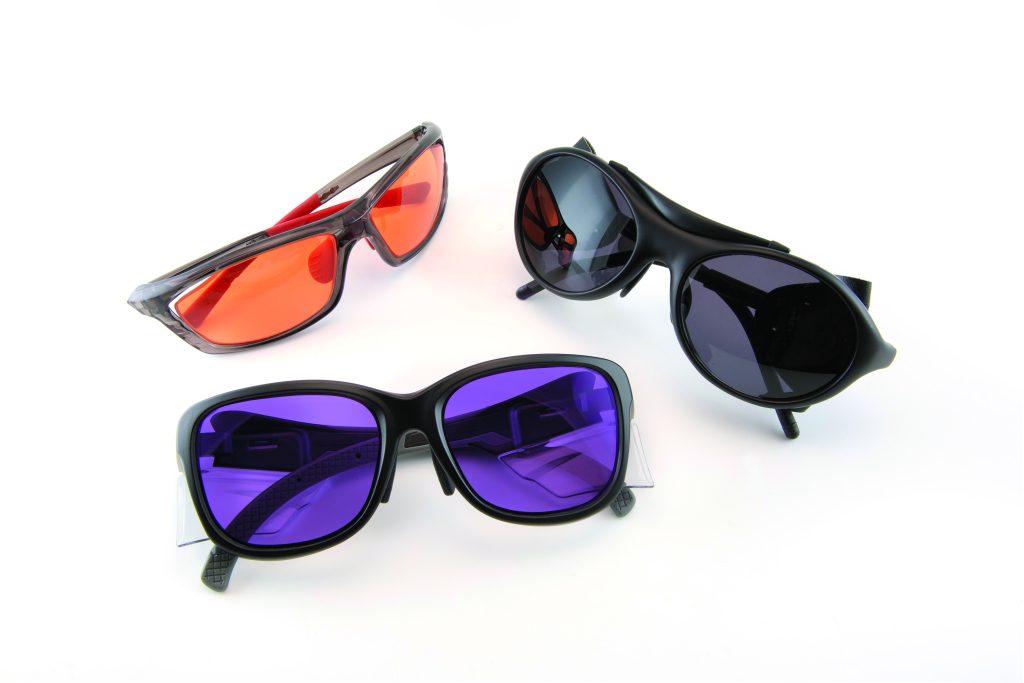
Lenses work by selectively filtering parts of the visible spectrum to increase contrast between target and background. As Jack says: “Yellow lenses can enhance visibility in low light by boosting brightness, while purples suppress greens and blues, helping orange clays or darker, less defined quarry stand out more clearly in variable terrain.”

Best lens colours for different light conditions

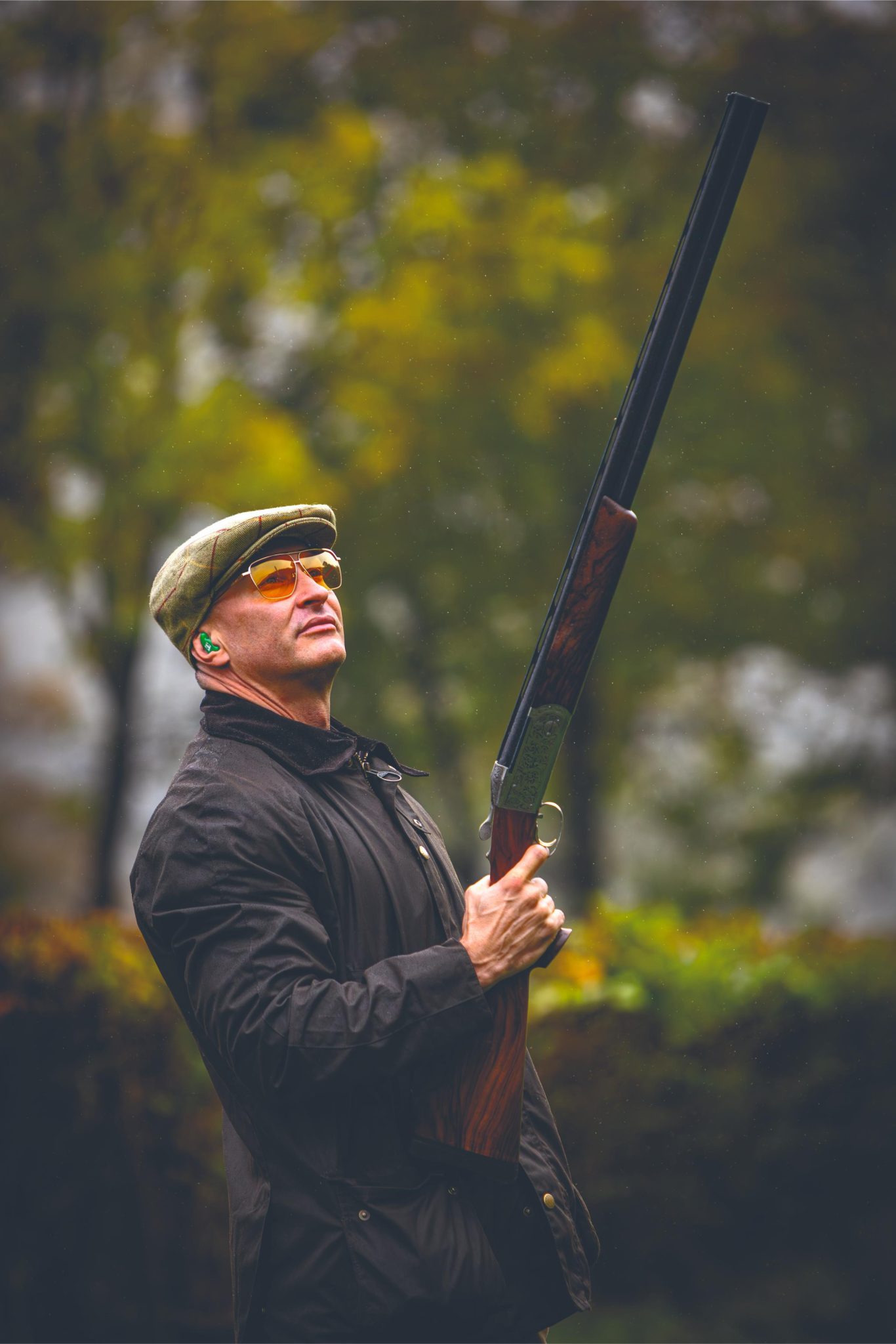
Yellow and pale amber lenses lift perceived brightness in dull, flat or overcast light – the go-to choice for gloomy winter days. Grey and brown lenses manage glare in strong sunshine without distorting colour. Orange and light brown perform well in mixed, changeable conditions.

Best lens colours for target visibility

Red and rose lenses enhance orange and pink clays against a sky background. Orange lenses help distinguish black and orange targets against blue sky.

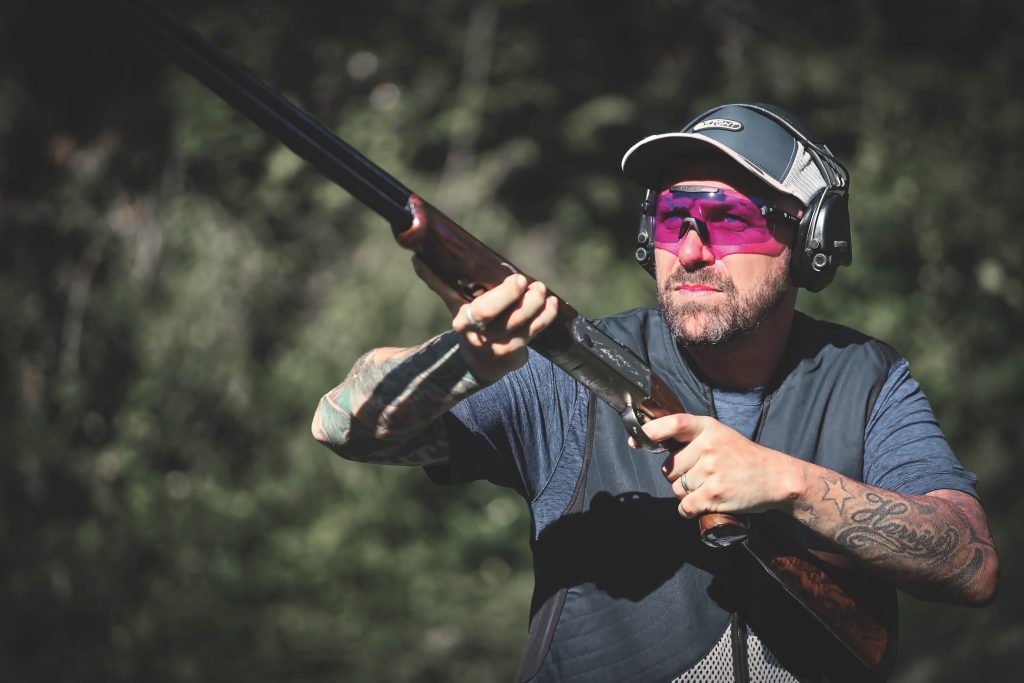
Purple is consistently effective at separating all clay colours from dark, green-heavy backgrounds. Tony Kerr of Optilabs, which has been producing shooting glasses with bespoke prescription lenses for more than 30 years, echoes this: “For clay shooters, purple or vermilion tints are especially effective, helping to neutralise busy backgrounds and make clays stand out more clearly.”

For game and field shooting, conditions are the primary guide. Yellow and pale amber lenses perform best on the overcast winter days that dominate the UK shooting calendar, while brown polarised suits brighter conditions where glare is a factor.

As with all lens choices, personal preference plays a significant role – trying different tints in the conditions you shoot most regularly is the most reliable way to find what works for you.

Light transmission explained

Tom Starkey of Starkey Outdoors retails Pilla. Its lenses are made in partnership with Zeiss and engineered using the brand’s proprietary VIVX colour science, which adds another dimension – light transmission percentage.

All lens colours are available across a broad range, from 7% transmission (the darkest) up to 98%, which is essentially clear. Tint and transmission are therefore independent variables and understanding both allows far more precise kit selection.

Avoiding overcomplicated lens choices

Edward urges a note of caution about over-engineering the choice.

“There is no ‘best lens for…’ because everyone is different and there is a huge degree of subjectivity when it comes to lens preference,” he says, adding that the commonly repeated advice to always use the palest lens available is a mistake.

His recommendation for most shooters is pragmatic: a product for low light, a lens for bright sunny days and a good all-rounder.

Tom agrees, suggesting a starter kit built around a 50% transmission lens as the everyday option, supported by a sun lens in the 7% to 30% range and a low-light lens at 60% or above.

Prescription shooting glasses: what to consider

For the significant proportion of shooters who require corrective lenses, the stakes are higher. Standard prescription glasses present real practical problems – limited field of view, frame designs that can obstruct gun-mount and the absence of protective coatings.

“In competitive shooting, clear vision is paramount,” says Tony. “If you require prescription lenses, your choice of eyewear becomes even more important.”

Optilabs specialises in direct-glazed shooting glasses – lenses ground to prescription within the shooting frame itself, rather than using optical inserts. This delivers a wide, uninterrupted field of vision that inserts simply cannot match.

Popular models, including the Edge, FleXit, Flow and Onyx, all feature adjustable nose pads for precise positioning across different shooting disciplines. Every lens is precision-made in Optilabs’ own laboratory and a home trial service ensures customers find the right fit before committing.

Advances in shooting eyewear technology

Simon Goldsmith of JHS Eyewear takes a complementary approach, offering photochromic lenses that adapt automatically as light changes.

Available in yellow, orange or light purple for low to medium conditions, they darken to a sun-brown in bright light.

“This gives a lens that will perform in changing light conditions without the need for constantly changing frames and tints,” he says.

Shooting eyewear has changed markedly in recent years and one of the most significant shifts is the democratisation of performance technology.

Affordable performance options

Christopher Stutley of Edge Eyewear points to the Kabru as a case in point – a model that delivers high-end features for around £25. It carries UKCA certification and, in its tactical variants, MIL-PRF-32432 ballistic ratings, meaning it can withstand a projectile fired at it.

The Kabru has a flexible nylon frame and thermoplastic rubber on the nosepiece and temples, which becomes tackier with moisture to resist slippage. Its anti-fog technology uses an impregnated formula within the lens to prevent moisture build-up.

“The Kabru stands out as a practical, affordable safety solution – robust enough for demanding use, yet accessible enough to replace without hesitation when it has done its job protecting your vision,” Christopher says.

Brands such as Evolution similarly offer Class 1 optical-grade polycarbonate eyewear from £20 to £40, putting technically competent kit well within reach of club shooters.

Premium materials and the future of eyewear

At the premium end, the materials are transforming.

Edward, who in 2019 co-founded Edwards Eyewear with former World FITASC champion Ed Solomons, describes the shift: “Higher-level products use titanium and carbon fibre, paired with Trivex lenses. These are even lighter, stronger and have far superior optical properties.”

His Hiroki II glasses, made from pure Japanese titanium, weigh 15g and are available with prescription lenses alongside a curated range of eight tints.

The move towards adaptable shooting systems

The broader direction of travel is towards adaptability.

Jack at X Sight points to a growing shift away from single-lens solutions: “Increasingly, shooters are moving towards adaptable systems that allow them to respond to changing light and backgrounds throughout the day.”

Frame adjustability – the ability to fine-tune fit for consistent visual alignment – is receiving increased attention, as small distortions can introduce subtle inconsistencies that compound over a long competitive day.

Why shooting eyewear deserves more attention

There is no magic lens that suits every shooter, every target or every sky. What the evidence does support is that treating eyewear as an active performance variable – rather than a passive safety requirement – has measurable benefits.

Know your conditions, understand what each tint is engineered to do, invest in impact-resistant, UV-rated lenses and resist the temptation to chase complexity where simplicity will serve.


This article contains affiliate links. If you click on one of these links and make a purchase, we may earn a small commission at no additional cost to you. Affiliate income helps us maintain the quality of our content and keep it freely accessible. All recommendations are based on our honest opinions and thorough research. Would you like to speak to our readers? We offer sponsored articles and advertising to put you in front of our audience.  Find out more.

Related Product Reviews