★ Your magazine. Your say. Complete our reader survey with a chance to win Jack Pyke kit worth £500! ★

Krieghoff K-80 Custom shotgun review: made to measure in Ulm
Lloyd Pattison follows his own Krieghoff K-80 Custom from a walnut blank on the bench in Ulm to a full day on the layouts at Bywell, at £14,730 plus £1,825 for the custom fitting. His verdict: a competition workhorse that holds its money and wears its age better than anything else at the price
The Krieghoff factory is an unassuming, medium-sized industrial unit in a business park on the outskirts of Ulm in Baden-Württemberg, with a row of flags and the company name emblazoned across the frontage. For those not in the know, anything could be made here. Yet, once inside it becomes obvious, as an impressive array of mounted trophies surrounds the atrium stairway that leads to the upper floor, where customers are greeted and briefed on the custom process.
| Specification | Detail |
|---|---|
| Name | Krieghoff K-80 Custom |
| Calibre | 12-bore |
| Barrel length | 32in |
| Weight | 9lb as reviewed |
| Length of pull | 15in |
| Price | From £14,730; custom fitting £1,825. As reviewed – not telling |
| Contact | Alan Rhone, sales@alanrhone.com |
Prices are RRP at the time of publication and may since have changed.
Having selected the action and barrels months earlier, they were ready for me on arrival. So after a brief look at the action – which is one of the nicest, most unusual I have seen – we moved on to the woodwork.
In the workshop Ralf, the stocker, assesses gun fit and takes some initial measurements. Cast, drop, comb, pad and forend styles are discussed. I had thought prior to arrival that I would be going for a hybrid stock with a Monte Carlo comb, but after looking at me and talking over my style of shooting, Ralf advised a much prettier, classic-style Sporter stock, essentially meaning I was looking at Parcours woodwork mated to Super Sport barrels.
Choosing the walnut blank for a custom stock
After a brief chat about grade and preference for figure and colour, Ralf disappeared into the bowels of the factory to select some blanks in the grade I selected that he thought would work for me. A nicely figured blank was selected and further measurements taken to finalise the stock dimensions and ensure that the planned stock would work with the selected blank. I have large hands, so an extended grip was planned, which meant that the blank had to be able to accommodate it.
How a Krieghoff stock is shaped by hand
Under normal circumstances, at this point the customer can take off and enjoy an afternoon in Ulm, but as I was filming the process for my channel I was allowed to stick around and follow the process in great detail.
The stock is first “headed up”, a process that involves milling the blank so that it can be fitted to a slave action that forms the anchor around which the stock is shaped. Using a bandsaw and a multi-axis milling machine, the headwork is cut to reveal the interior of the blank.
The stock is then drilled for the stock bolt, which marks the point at which hand tools take over. The milling machine and the bandsaw for roughing out the shape are the only power tools used in the process (unless an adjustable comb is to be fitted, but more on that later) and are only used to get the stock perhaps 80% of the way before rasp, file, chisel and spoke shave are used to refine, and refine the shape of the wood into its final form.

Ralf is definitively old school. The stock measuring machine sits in a corner, dusty and unused. Ralf works by eye – and it’s a pleasure to watch. After filing the rough interior of the head to fit the slave action and bolting the blank in place, he measures and marks up the wood to give a centre, then calculates the cast, drop, pitch and a load of other data points before setting to work shaping. Over the course of the day I was fascinated to see the stock emerge from the wood and the many tools and techniques used.
The grain guides the tool selection and the direction that cuts are made. Sometimes the wood doesn’t want to be cut in a certain way and the stocker must adapt to that as he works the material. A poorly judged chisel blow or cut with the draw knife can pull the blade in an unintended direction. Ralf doesn’t use any forms or models; he shapes solely through pure skill and careful measurement.
The following morning things really start to take shape as more material is removed and the final form takes shape. The comb, belly and grip are shaped most of the way (leaving room to finalise the grip once the customer arrives) and if requested an adjustable comb kit is fitted. Using a custom set of tooling, the cuts are made and the metalwork fitted, then all the surfaces are filed to perfection and the edges chamfered by hand.
At this point in the process the customer normally arrives back at the factory to work with the stocker to refine the final details. Working together, shooter and stocker arrive at a final shape for the neck, palm swell and grip. Once the shaping is finalised, Ralf sprays the stock with a little water to reveal the grain. It also raises it, which makes the shooter’s grip secure for the next part of the process.
An action and barrels that match the customer’s metalwork are mated to the stock and off we go to MSZU shooting complex, because at Krieghoff there are no pattern boards or tunnels. The testing is done with clays in what I believe is the largest indoor shooting facility in Europe at 8,000m².
Testing the gun in Krieghoff’s indoor shooting complex
The facility has a huge store and shooting lanes for rifle and pistol as well as a shooting cinema for driven game training, but we are headed to the vast clay shooting hall. Time in the range is at a premium, so we get on with attacking every bird on the menu to work out the fit and feel of the gun in a real-world scenario. I can tell you that your mettle will be tested not only by the targets but by the fact that you are literally shooting with the guy who just made your gun. After dusting the first few dolly targets I settle down and refine any final points of fit with Ralf’s guidance. All too soon the ride is over and it’s time to take the gun back to the factory and head off to fly home.
Back in the UK: the K-80 on the layouts at Bywell
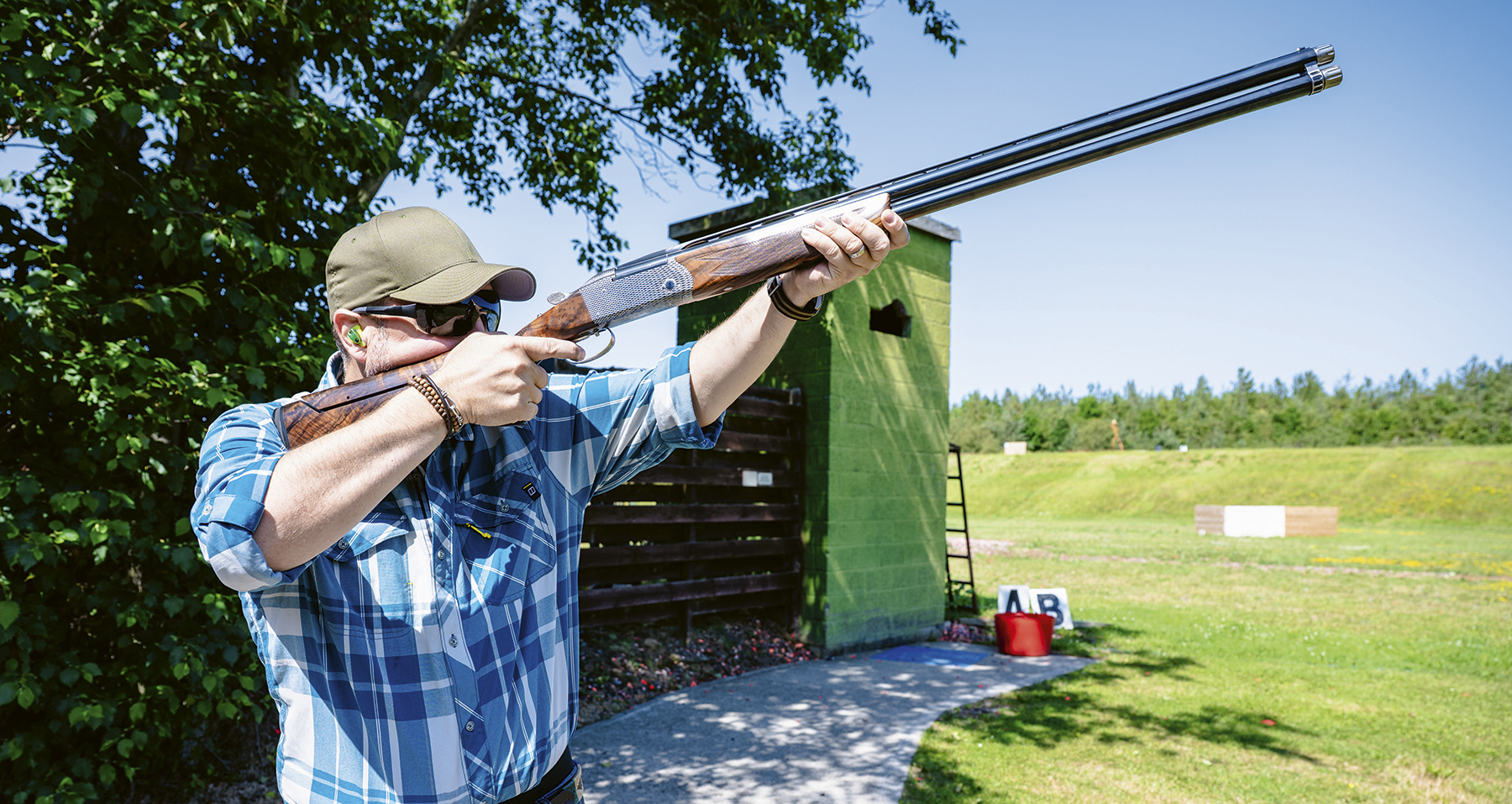
After waiting for the woodwork to be chequered, finished, fitted and shipped to the UK distributor I was reunited with my new gun and immediately took it out on the layouts at Bywell to give it a thorough testing.
The gun I selected is pretty typical for a Sporting shooter with the Sporter barrels, titanium hanger and choke. However, it was mated to Parcours-style woodwork, which is more graceful than the woodwork normally fitted if you choose a hybrid or Trap-style gun.
The three K-80 barrel styles: Sporter, Parcours and Parcours X
Krieghoff offers three barrel styles. The Sporter is the heaviest and can also be mated to the “pro” rib, which is an adjustable ramped rib. The Parcours has a game top rib, solid mid rib, flush thin-wall chokes and is the lightest in the range. The latest is the Parcours X, which sits in the middle and offers a more neutral feel for shooters who find the Sporter too heavy and the Parcours too whippy.
The Sporter barrels with no mid rib are held together at the muzzle end by a hanger that can be swapped for different sizes and weights, allowing the shooter to tune the point of impact for top and bottom barrels independently, which many Trap and Helice shooters value. As a Sporting shooter I selected the neutral POI for top and bottom barrels.
The titanium extended chokes have an unusual crenellated top that mates snugly into an exceedingly slick folding choke wrench that shows the level of over-engineering that goes into making a Krieghoff. It is, I can tell you, exceedingly satisfying to use.
The non-chrome-lined barrels are beautifully struck off and topped with an 11x7mm tapered top rib with tram line and centre bead, which I have removed. Krieghoff supplies a grub screw to fit the hole snugly and stop any dirt fouling. The barrels terminate in the monobloc with the hand-fitted ejectors, which sit flush with the block – no skinned knuckles when cleaning.
The tolerances mating the barrels to the long, low action are so tight that assembling a Krieghoff can require a bit of practice for a new user. But it is at this point that you will notice that the forend is stored separately in the Krieghoff case, making assembly and disassembly far more logical in a way that makes you wonder why all the other manufacturers force you to partially assemble the gun before putting it away.
The substantial forend iron hides multiple redundant springs for the ejectors and a very solid locking mechanism with the forend loop. Chequering throughout is all hand cut and beautifully finished.
How the Krieghoff K-80 action locks up
The lock-up is interesting. The long, low action of the Krieghoff is unique and relies on top-quality tool steel and the previously mentioned tight tolerances, with a small lump protruding into a cutout in the action floor just beneath the trunnions taking up most of the full width of the action. The monobloc has a pair of flats that are roughly where the wings would be on a normal action and are engaged by a sliding top latch that cams open by indexing off the top lever. This design famously debuted on the Remington Model 32, but Krieghoff subtly refined the design after acquiring the patents.
The trigger on Krieghoff shotguns is a marvel – crisp and light with no slop, and a distinct reset that is, I think, unique to this maker. The barrel selector is integrated with the trigger rather than the safety, which features a button to prevent accidental activation and can be locked off for shooters who prefer no ambiguity.


How the K-80 handles and shoots
On to the shooting. Obviously you can infer that, since this gun was made to fit me, the fit is pretty much bang on. However, I have lost 28kg (62lb) since getting the gun, so opting for the adjustable comb was definitely the right move, as otherwise I would have needed a new stock.
It’s my opinion that nothing moves or feels like a Krieghoff. I shot a Perazzi for five years before switching back to the German gun, having owned an old K-80 from the mid-1990s before being dazzled by a trip to Italy. Coming back to the Krieghoff felt like coming home, and shooting it is something that brings a smile to my face pretty much every single time.
The feel of the K-80 is special. It’s heavy but slimmer in the hand than most guns, and that makes for a unique experience. The palm swell is pronounced and perfect for my hand; the gun balances absolutely dead on the pin and swings with an authority and smoothness that is difficult to describe to someone who has never used one. I have heard them described as weird, ungainly or nose heavy and there are certainly guns out there that feel like that, but properly specced and fitted, a K-80 is an extension of your will. An artist’s brush dispensing clouds of dust when wielded well.
I’ve used mine to shoot all disciplines of clays and on game days. I have subsequently bought a second set of Parcours barrels for mine, and sold my game gun as I simply wasn’t taking it out of the cabinet.
With the Parcours barrels fitted the gun is transformed into a more elegant-looking package, and the handling is naturally transformed from the turret-like swing of the Super Sport to a whippy and much more reactive feel. It’s perfect for snap shooting on swift driven game and lighter overall, which is a boon for walked-up sport.
Verdict: is a Krieghoff K-80 worth £14,730?
There are a few guns in this price bracket that can be described as competition workhorses, but I can’t think of one that holds its money or wears its age better than a K-80. The action and barrels have a feeling of near invincibility and if you have the gun serviced regularly, the manufacturer’s warranty is 10 years.
Frequently asked questions
How much does a Krieghoff K-80 cost?
The K-80 Custom starts at £14,730, with the custom fitting a further £1,825. The gun reviewed here was specified with Sporter barrels, a titanium hanger and titanium extended chokes, mated to Parcours-style woodwork, and its final price is not disclosed. All figures are RRP at the time of publication.
Where can you buy a Krieghoff K-80 in the UK?
Krieghoff’s UK distributor is Alan Rhone, who can be reached at sales@alanrhone.com. A custom gun is built to the customer’s own dimensions at the factory in Ulm and shipped to the UK distributor once the woodwork has been chequered and finished.
What is the difference between Krieghoff’s Sporter, Parcours and Parcours X barrels?
The Sporter is the heaviest of the three and can be mated to the adjustable ramped “pro” rib. The Parcours is the lightest, with a game top rib, a solid mid rib and flush thin-wall chokes. The Parcours X sits between the two and offers a more neutral feel for shooters who find the Sporter too heavy and the Parcours too whippy.
What warranty does a Krieghoff K-80 carry?
The manufacturer’s warranty runs to 10 years, provided the gun is serviced regularly.
Who is the Krieghoff K-80 best suited to?
It suits the competition clay shooter who wants a gun built to their own dimensions and expects to keep it for years – the swappable muzzle hanger allows top and bottom point of impact to be tuned independently, which Trap and Helice shooters in particular value. With a second set of Parcours barrels fitted it becomes light and reactive enough for driven game and walked-up sport as well.

About the author
Lloyd Pattison
A current contributor on clay shooting and shotgun reviews, Lloyd writes gun tests and clay features for ShootingUK.
 Closes 15 JanuaryWorth £129.90Win a pair of tickets to the British Shooting Show 2027Enter nowFree to enter
Related Articles

The lost art, reforged: the first British damascus gun barrel in 130 years
Graham Downing meets Toby Smith, the young Hertfordshire blacksmith who has forged the first damascus gun barrel made in Britain for around 130 years
By Graham Downing | 24 September 2026

Post-lead partridges: choosing the right non-lead cartridge
Martin Puddifer investigates choke, pellet size and shot type – and why the right non-lead partridge load is not the biggest one available
By Martin Puddifer | 4 September 2026
Get the latest news delivered direct to your door
Subscribe to Shooting Times & Country
Discover the ultimate companion for fieldsports enthusiasts with Shooting Times & Country Magazine, the UK’s leading weekly publication that has been at the forefront of shooting culture since 1882. Subscribers gain access to expert tips, comprehensive gear reviews, seasonal advice and a vibrant community of like-minded shooters.
Save on shop price when you subscribe with weekly issues featuring in-depth articles on gundog training, exclusive member offers and access to the digital back issue library. A Shooting Times & Country subscription is more than a magazine, don’t just read about the countryside; immerse yourself in its most authoritative and engaging publication.
 New competitionWin a pair of tickets to the British Shooting Show 2027Worth £129.90Closes 15 JanuaryEnter now ›