

Drawn to the saltings: punt-gunning and goose flights with the artist Frank Southgate
Fowling guide Pat Cringle recalls a lifelong friendship with artist Frank Southgate, who punted for geese, wigeon and knots on the Norfolk coast


The years before World War I produced glorious wildfowling outings at Wells-next-the-Sea.
A few gentlemen gunners who visited the town in those days were certainly not so trigger-happy as many who came later. The reason no doubt was that the few who came in the early days hired a local guide who was an experienced fowler.
The guide would stay beside the inexperienced gunner throughout the flight and advise whether or not the geese were within range. Later, when the trigger-happy goose shooters became numerous, those early gunners were as disgusted with them as were the local wildfowlers.
During those early years, I was a professional. One day when I was preparing my punt for a wigeon hunt in the evening, a stranger, dressed for fowling, complete with gamebag and 12-bore, bid me ‘good afternoon’ and introduced himself as Frank Southgate. That was the beginning of a close friendship between Frank and me, which lasted till his death in 1916.
A sketchbook in the gamebag
Wildfowling was Frank’s great joy and he derived much of his inspiration from the experiences encountered during our goose hunts and forced marches across the saltings to beat the tide, and exciting adventures of punting for geese and wigeon under a full moon.
Wherever we went wildfowling during daylight hours, his sketchbook would be in his gamebag. Many times I lay in a gun hole on the sand, with my gun up and body twisted into all shapes and contortions, shooting at imaginary geese passing over me. And from those rough sketches a picture was born, many of which were reproduced in the Illustrated Sporting and Dramatic News.
Punting for knots on the inner bink
Frank was very fond of punting and we used the double punt whenever I considered the chances of shots were good. And though I cannot claim to have ever made big shots with my single punt during the whole of my experience, we did have two or three outstanding successes with the double punt. The vast flocks of thousands of knots twisting and turning, sometimes looking like clouds of smoke, really fascinated Frank and often when watching them he would say: “If only we could get within range of that lot.”
One morning we did. There was still a frosty dawn on top of the spring tides. All the sands and most of the saltmarsh were underwater, but about a quarter of a mile outside the marsh is a high shingle ridge, about 100 yards long by 10 yards wide, that was still above water. This was the morning we had been waiting for.
The weather was still, a big tide and high water when it was just coming to daylight. Huge bunches of knots were twisting and turning about as I worked the pump slowly towards the shingle ridge, which was known to local fowlers as the ‘inner bink’.
As we drew nearer in the growing light, we could see that one huge flock was trying to settle. There was only room for about half the number on the ridge and, as half of them flew off, the half that had settled jumped and joined up again. Several times this happened, but eventually the flock broke up and about 2,000 settled. This was our chance. We were in about 3ft of water and I could still get the bottom with my stalking pedal. I used every ounce of strength in my right arm to force the punt forward.
It was getting light and I was afraid the knots would jump out of range. But when we were within 100 yards, I knew we were in for a shot and I warned Frank to be ready to pull, but we were within 80 yards before they began to rise. As they lifted off the ridge, 1lb of BB shot played havoc. The total number from that shot was 203.
We spent many hours during moonlit nights punting the ducks, but we never made a really good shot as far as numbers were concerned. But numbers did not matter. The excitement of sighting and approaching them and bringing a couple or two into the bag pleased us as much as if we had shot a boatload.
The wild music of the geese
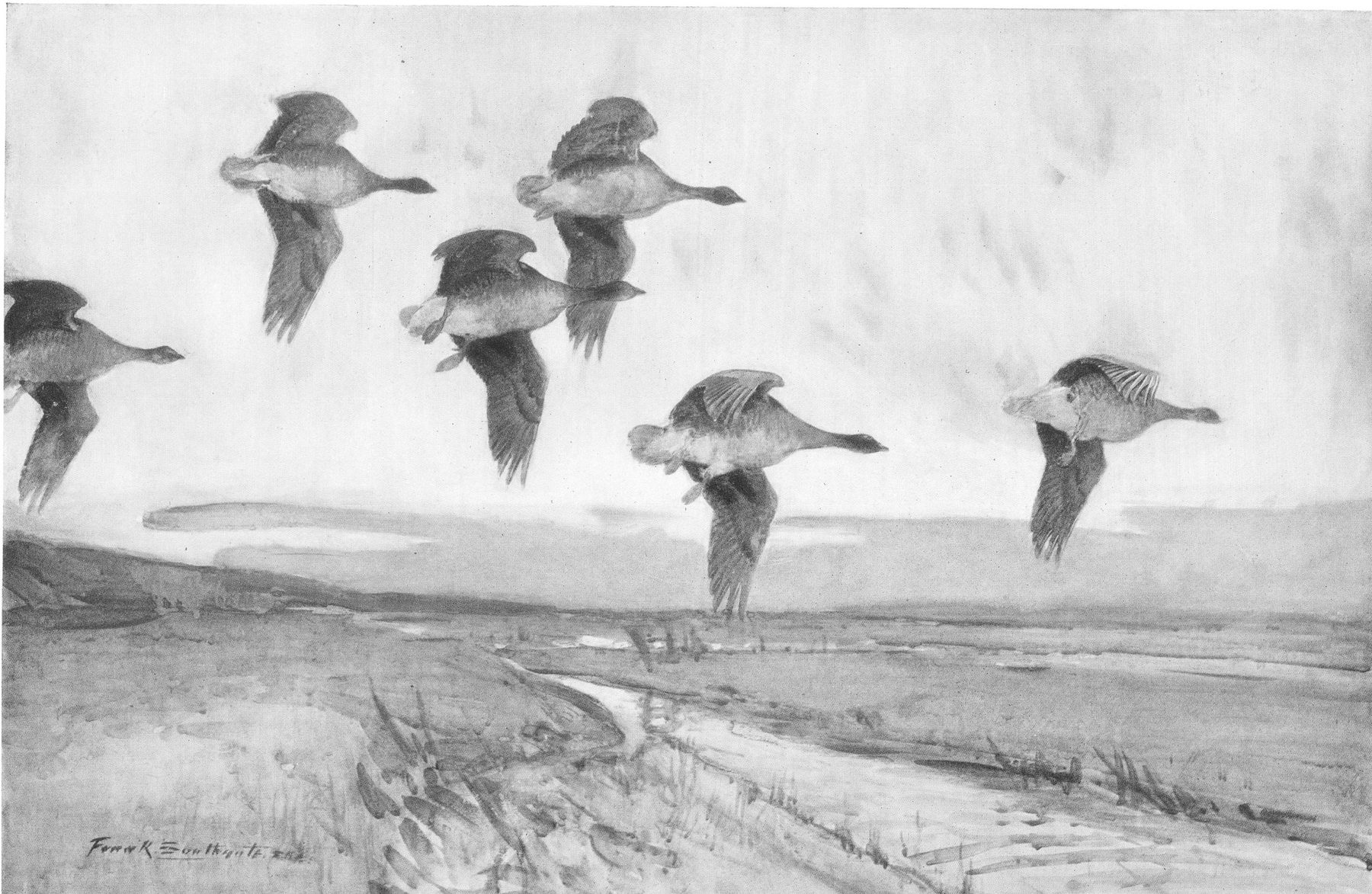
Though Frank was very fond of punting for fowl, he also thoroughly enjoyed flighting by moonlight. Geese seemed to fascinate him. I’ve known him to turn out on a very still morning when he knew the geese would be flying high simply to watch them passing over the sea wall and to listen to the noise they made as they approached their feeding grounds. On moonlit nights, he loved to sit and wait for them coming in on the moon.
We were sitting in the dunes one night when the wind had dropped and all was quiet except for the roar of the breakers on the shore. Suddenly, the geese began to move in big parties, passing over us out of range and making an awful lot of noise. He stood looking up at them for some time then turned to me with a beaming smile and said: “When I die, I wish to be buried here in the sand dunes where the wild music of the geese would be with me night and morning from September to February.”
When the war came Frank volunteered for service in France and I had to admire his determination to carry on and keep up with men half his age. But eventually the strain told on him and the candle suddenly snuffed out in a derelict building a few hundred yards away from the German line, after a two-mile run in an emergency.
This article was first published in the 25 November 1965 issue of Shooting Times. Knots are now a protected species.
 Closes 15 JanuaryWorth £129.90Win a pair of tickets to the British Shooting Show 2027Enter nowFree to enter
Related Articles

Down from the heavens: a young peregrine flown at partridges on the Hampshire downs
A young peregrine falls short of a partridge on the Hampshire downs, but a cock pheasant proves another matter entirely, says GA Pollard
By Shooting Times | 18 November 2026

Music of the pack: foxhounds in the mist and otterhounds on the Great Ouse
J Ivester Lloyd hears the Whaddon Chase through the morning mists, then joins two otterhound packs on the Great Ouse for a day to remember, in this piece from the Shooting Times archive, first publish...
By Shooting Times | 11 November 2026
Get the latest news delivered direct to your door
Subscribe to Shooting Times & Country
Discover the ultimate companion for fieldsports enthusiasts with Shooting Times & Country Magazine, the UK’s leading weekly publication that has been at the forefront of shooting culture since 1882. Subscribers gain access to expert tips, comprehensive gear reviews, seasonal advice and a vibrant community of like-minded shooters.
Save on shop price when you subscribe with weekly issues featuring in-depth articles on gundog training, exclusive member offers and access to the digital back issue library. A Shooting Times & Country subscription is more than a magazine, don’t just read about the countryside; immerse yourself in its most authoritative and engaging publication.

