★ Win four pegs on a Kent simulated game day with JBD Sporting worth £1,000! Click to enter ★

Grouse shooting explained: every question answered
From the Glorious Twelfth to burning licences, cartridges to cooking – straight answers to the questions people actually ask about Britain's most demanding fieldsport
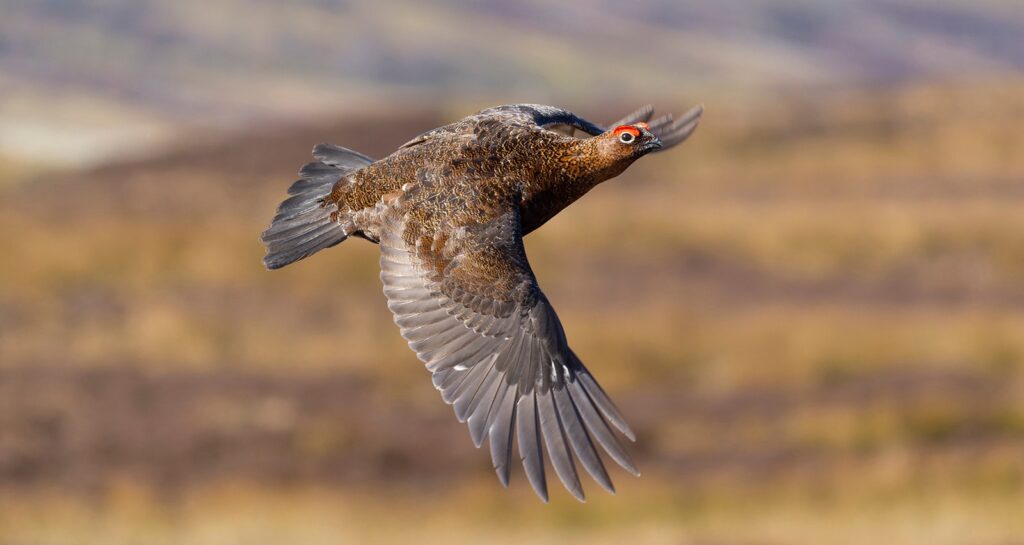
 Low, fast and head-on over the heather – the reason nothing in British shooting asks quite as much of a Gun. Credit: Alan Ward

What is grouse shooting?
Grouse shooting is the pursuit of wild red grouse across managed heather moorland in the uplands of England, Scotland and Wales. The distinction that matters is this: nothing is reared and nothing is released. Every grouse shot in Britain hatched on the hill from a wild nest, and that single fact shapes everything else about the sport – the price, the uncertainty, and the years when moors do not shoot at all.
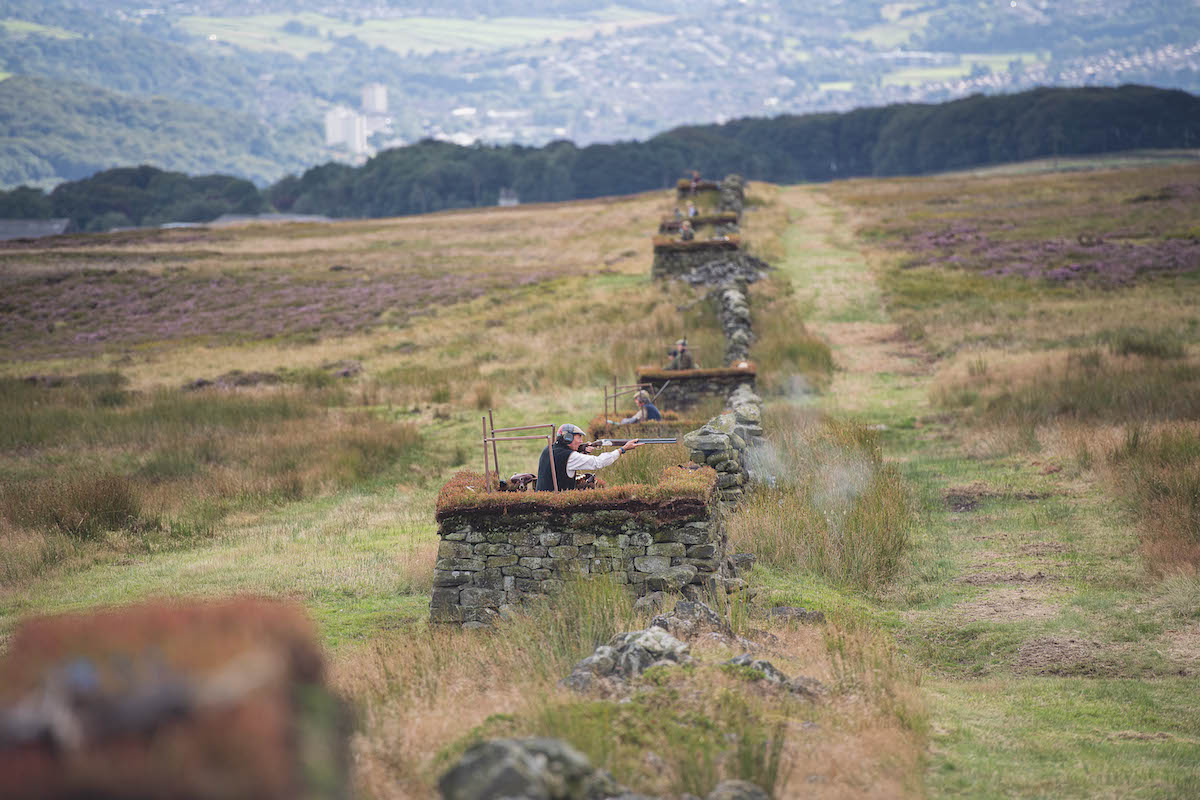
There are two main forms. Driven grouse shooting places a team of eight or nine Guns in a line of butts – low stone or turf hides sunk into the hillside – while a line of beaters works a large block of moor towards them, moving the birds forward with flags. Grouse fly fast and low, contouring the ground, and they arrive without warning. Walked-up shooting reverses the arrangement: the Guns advance in a line and flush the birds themselves, covering miles of ground for a far smaller bag. Shooting over pointers and setters is the oldest method, in which the dog quarters the moor, finds grouse by scent and holds them on point until the Guns walk in.
Beating is honest and sociable work, and on most moors it is how a good many people – including plenty of future Guns – first come to the hill.
When is the grouse season, and why is it called the Glorious Twelfth?
The season opens on 12 August and closes on 10 December in England, Scotland and Wales; in Northern Ireland it ends on 30 November.
The Twelfth is called Glorious because it opens the sporting year – the first day of the new season, fixed in law since the 19th century. Whether individual moors actually shoot on the day is another matter. Grouse are counted in July, and only moors with a genuine harvestable surplus will shoot; in poor years many estates cancel entirely, because the birds are wild and there is no topping up from a release pen.
Warm weather is the other constraint. As gamekeeping columnist Lindsay Waddell has written, trying to move birds that are not designed to withstand high temperatures is close to impossible, if not immoral – grouse on hot days will sit panting in the heather, and they are far better sport left for a cooler spell.
As for the best time of day: early. Grouse feed and move in the cool of the morning – on hot August days keepers counting birds are out with their dogs from 4am, because by mid-morning the birds have tucked into shady banks and stream edges and will barely lift.
Where do grouse live in the UK, and are they native?
Red grouse are not merely native. They are endemic – a subspecies of the willow grouse found nowhere else on earth, which is why this shooting exists nowhere else on earth. Ling heather forms over 90 per cent of their diet, so grouse country is heather country: the North Pennines, the Yorkshire Dales, the North York Moors, the Peak District, the Bowland Fells, the Scottish Borders, Perthshire, Angus, Deeside and the eastern Highlands, with pockets in Wales and on the south-west moors.
The Moorland Association’s members care for some 860,000 acres of heather moorland in England and Wales, and grouse moor management covers roughly 423,000 hectares of the English uplands – one of the three dominant upland land uses alongside livestock farming and forestry. Britain holds around 75 per cent of the world’s remaining heather moorland, a habitat rarer globally than rainforest.
Black grouse – the lekking blackcock of the moorland fringe – are a separate and much scarcer species, subject to voluntary restraint across most of Britain.
Are red grouse rare? Not in the threatened sense, but they are volatile. Numbers in Scotland have declined and occasionally collapsed since around 2015, and England has seen several crashes over the same period. The 2024 crash produced the lowest young-to-old ratio in Scotland and the second lowest in England since records began in 1990, after cold, sodden weather in early June killed chicks in huge numbers. The 2026 picture is markedly better: sporting agent Mark Osborne reports brood averages on many northern English and southern Scottish moors running at seven, eight and nine young – very good figures – with the Pennines strong, the Peak District and North York Moors patchier, and the Highlands still lean.
Is grouse shooting legal, and do you need a licence?
Yes, it is legal – but the paperwork depends on where you stand. Everywhere in Britain you need a shotgun certificate, issued by your local police force, and permission to shoot over the land.
In Scotland the bar is now higher. Since the Wildlife Management and Muirburn (Scotland) Act 2024, any land used to kill or take red grouse must hold a section 16AA licence from NatureScot, whether the shooting is driven or walked-up, and shooting on unlicensed ground is an offence. Licence holders must have regard to the statutory Code of Practice for Grouse Moor Management, and NatureScot can suspend or revoke a licence where wildlife crime is established on the balance of probabilities, with a right of appeal to the sheriff. The regime was introduced explicitly to tackle raptor persecution, and its scope was tightened further by the Natural Environment (Scotland) Act 2026.
England and Wales have no equivalent shooting licence. Parliamentary petitions to ban driven grouse shooting have been debated at Westminster more than once and not enacted; the government response, under administrations of both colours, has consistently favoured regulation over prohibition. Where Westminster has acted is on burning – which brings us to the question everyone asks.
Why do gamekeepers burn heather?
Controlled burning – muirburn in Scotland – happens in winter and early spring, never in the shooting season. Short, cool fires take the top off old, leggy heather without touching the peat beneath, producing fresh, nutritious shoots for grouse and sheep while leaving taller stands nearby for nesting cover. The patchwork mosaic you see from the road is the point: different heather ages within yards of each other, giving birds food and shelter side by side.
The second purpose is wildfire prevention. Burning in rotation removes the standing fuel load that feeds a summer wildfire and creates the firebreaks that stop one running. After a summer in which keepers across the Peak District and the Cairngorms spent days and nights volunteering alongside fire crews, that argument has sharpened. The CLA contends that England’s 2025 amendment regulations – which extended burning licences to all upland peat deeper than 30cm and swept nearly 700,000 hectares into the system – amount to a de facto ban on the most effective prevention tool available, and has asked the Environment Secretary to rescind them. Conservation bodies take the opposite view: that burning on deep peat damages a carbon store that would be better rewetted. The Commons EFRA committee is currently testing both cases, and long-term research, including York University’s 20-year Peatland-ES-UK study, suggests the science is considerably less settled than either side likes to claim.
What gun and cartridge should you use for grouse?
Nothing exotic. A 12-bore or 20-bore game gun in good order is right for the moor, and the traditional choice remains a light side-by-side, because it comes to the shoulder fast and swings cleanly between two birds that appear from nowhere. Over-and-unders are entirely acceptable; what matters is fit and familiarity, not configuration.
Chokes should be open – improved cylinder and quarter, or skeet and improved cylinder – because grouse are shot close and a tight pattern at 20 yards ruins birds for the table. For shot size, 6 or 7 in a 28g or 30g load covers the season, with some Guns moving to a heavier 5 late on. There is no need for magnum loads: grouse are not armour-plated, merely fast.
The lead question is now settled in law. Under the REACH (Amendment) Regulations 2026, in force since 1 April, the use and sale of lead shot for live-quarry shooting becomes unlawful across England, Scotland and Wales from 1 April 2029. Buy cartridges with that date in mind – the steel and bismuth game loads now on the market are well up to grouse.
How much does grouse shooting cost?
More than any other driven shooting in Britain. Days are sold at a price per brace – a brace being two birds – and £190 to £220 plus VAT per brace is representative of the driven market in 2026. A team taking a 100-brace day is therefore looking at £20,000 or more before gratuities, cartridges, accommodation and travel, divided between eight or nine Guns. Walked-up days are a fraction of that, often a few hundred pounds a Gun, and shooting over dogs can be cheaper still.
The reason is economics, not exclusivity for its own sake. A moor carries keepering, predator control, heather management, medicated grit, disease control and vehicles all year round – Moorland Association members alone spend a combined £52.5 million annually, 90 per cent of it private money – then has a handful of weeks in which to recover it from a wild bird nobody can guarantee. In a bad year the moor spends the money and shoots nothing. It is worth adding that most moors are not commercial at all: across the Peak District, almost every moor is a private family or syndicate shoot that rarely lets a day.
What is a grouse shooting party actually like?
Guns meet mid-morning, draw for their butts, and shoot four or five drives with a break for lunch on the hill – or shoot through and eat afterwards as the days shorten. Each drive lasts 20 to 40 minutes, and safety discipline is absolute, because grouse fly low between the butts and no bird is worth a swing through the line. Pickers-up and their dogs gather the bag after each drive, the keeper announces the total at the day’s end, and each Gun goes home with a brace. Etiquette is old-fashioned in the best sense: sombre clothing – grouse have exceptional eyesight – punctuality, and proper thanks to the beaters and keepers whose year made the day.
Why do people shoot grouse – and what are the benefits?
Ask a Gun and the answer is the sport itself: grouse are the fastest and most demanding quarry in British shooting, and an August moor is the finest office in the world. Ask an ecologist and the answer is different. Because the shooting depends entirely on wild birds, the management that supports it also supports everything else that nests on a keepered moor. A GWCT paper published this year in the BTO journal Bird Study found high and stable curlew numbers on moorland managed for red grouse in northern England, and Natural England’s evaluation of its six-year hen harrier brood management trial concluded that harrier numbers rose fastest on the grouse moors taking part – while stressing that illegal killing remains the principal block on the bird’s recovery.
That last point deserves stating plainly: raptor persecution on a minority of moors does more damage to the case for grouse shooting than any campaign group has ever managed. The sport’s future depends on it stopping.
How should you eat grouse – and is it better than chicken?
Roast, if the bird is young. Young grouse have soft, slightly translucent claw tips and a skull that gives under the thumb; they are best eaten fresh rather than hung. Twenty minutes in a hot oven, rested, served pink with bread sauce, game chips and something sharp – blackberries or rowan jelly. Old birds need hanging and slow cooking: chef Tim Maddams rates them for pâté, stews and curry, and lightly cures young breasts before pan-frying them with chanterelles and blackberries.
Better than chicken? Not comparable. Grouse is dark, dense and faintly bitter from a lifetime of heather shoots – the most emphatically wild thing you can put on a British plate.
Grouse trivia: the slang, the whisky and the name
Is “grouse” slang for something? Yes, but not here – in Australian slang, grouse means excellent, which seems fitting. To grouse, in British English, is to grumble; the two words are unrelated, though a blank day can produce both. And no, The Famous Grouse whisky is not named after a particular bird: the blend simply borrowed the most recognisable emblem in Scottish sport, right down to the red grouse on the label. That a whisky, a rugby mascot and a national argument all trade on one small brown bird tells you how deep it runs in the national furniture.
Frequently Asked Questions
Can you shoot grouse on a Sunday?
Not in England and Wales. The Game Act 1831 prohibits the killing or taking of game on a Sunday or Christmas Day, and red grouse are game under that Act. The 1831 Act does not extend to Scotland, so there is no statutory Sunday ban north of the border, though Sunday shooting is not customary and most estates do not offer it. In Northern Ireland, shooting any wild bird or game bird on a Sunday is prohibited.
What is the difference between red grouse and black grouse?
They are separate species. Red grouse are the endemic moorland bird that driven and walked-up shooting is built around, and their season runs from 12 August to 10 December. Black grouse are larger, gather at communal display grounds called leks, and favour the moorland fringe where heather meets rough grazing and woodland edge. Their season is shorter, opening on 20 August in England, Scotland and Wales, and on 1 September in Somerset, Devon and the New Forest. Numbers are low enough that most of Britain observes a voluntary restraint and blackgame are rarely shot deliberately.
Where can you buy grouse to eat if you do not shoot?
Grouse reaches the public through licensed game dealers, good butchers and online game suppliers from mid-August, and appears on restaurant menus within a day or two of the Twelfth. Supply is short and entirely weather-dependent, so the season on the plate can be brief and prices reflect it. Ask for young birds if you intend to roast them, and older ones if you are making a stew, a curry or a pâté.
Related Articles
Grouse counts 2026 point to recovery on English and Scottish moors
Mark Osborne of sporting agent JM Osborne reports a very welcome rise in the number of grouse counted on most moors in northern England and southern Scotland this July. Brood averages of eight and nin...
By Mark Osborne

Come driven partridge shooting in Morocco
El Koudia’s finest season yet has drawn teams from eight countries into Morocco’s Jbilet hills – and only three two-days trips remain for 2026/27
By Shooting Times
Get the latest news delivered direct to your door
Subscribe to Shooting Times & Country
Discover the ultimate companion for fieldsports enthusiasts with Shooting Times & Country Magazine, the UK’s leading weekly publication that has been at the forefront of shooting culture since 1882. Subscribers gain access to expert tips, comprehensive gear reviews, seasonal advice and a vibrant community of like-minded shooters.
Save on shop price when you subscribe with weekly issues featuring in-depth articles on gundog training, exclusive member offers and access to the digital back issue library. A Shooting Times & Country subscription is more than a magazine, don’t just read about the countryside; immerse yourself in its most authoritative and engaging publication.