

Weihrauch HW30S: the light air rifle that earns its keep in the barn, round the pens and as a first gun
A scaled-down break-barrel running well under the 12ft/lb limit has impressed Airgun World’s Pete Evans. For keepers, farmers and families with a youngster starting out, the lower power is the point, not the compromise

A scaled-down break-barrel air rifle running at barely two-thirds of the legal power limit has drawn an unusually warm verdict in Airgun World, and the reasons matter well beyond the target range. Writing in Airgun World, Pete Evans put the Weihrauch HW30S through the chronograph and out to 30m and concluded that a gun sold as a starter is, in his words, “a true all-rounder which can be enjoyed by families of all ages”.
For the working countryside reader, that is not a specialist’s footnote. A light rifle that a keeper can carry round the release pens, that will deal with rats along the feed line or feral pigeons in the barn without punching through a roof sheet, and that a youngster can cock and hold without strain, answers three different needs on one estate. The specification is simple: a spring-piston, single-shot break-barrel in .177 or .22, 98.5cm long with a 39.9cm barrel, 2.6kg with its supplied 4×32 scope, and 7.2 – 8.1ft/lb on test depending on pellet.
Why does a sub-8ft/lb air rifle suit the barn and the release pen?
Evans is direct about where this gun belongs. “Various roles for this gun would involve shorter-range (20m) pest control, which would include gardens or inside barns, where the lower power is a distinct bonus,” he wrote. Anyone who has shot rats among stacked bales or under a Dutch barn roof knows the argument: at close range, a pellet that has already given up most of its energy on the target is a pellet that does less damage to whatever sits behind it.
He also noted a change in attitude that many older keepers will recognise. “It’s strange to think that back in the 1980s many at this point would tune out, as anything below 11.99ft/lb would not deserve further consideration. Thankfully we live in enlightened times, where consistency and accuracy are prized over raw power.”
The accuracy figures back that up. With 7.33gr JSB Exact RS pellets the rifle put five shots into 15mm at 20m in still conditions, opening to 18mm at 25m, and it went on to ring 1in spinners at 30m. Those are groups tight enough for a clean head shot on a rat at feed-hopper distances, with power in hand for the job but not much beyond it. In England and Wales an air rifle of this output needs no firearm certificate; feral pigeons in a barn remain a general licence matter, so the usual conditions apply before a shot is taken.
What did Pete Evans make of the trigger and the firing cycle?
Much of Evans’s praise rests on two things: the Rekord trigger and how little the gun moves when it fires. He described the two-stage adjustable Rekord unit as “the benchmark for all spring gun triggers and has been for the last 60-plus years”, and warned that the currently imported HW30 carries it while some used examples have the simpler, non-adjustable Perfekt trigger instead.
On the firing behaviour he wrote: “I use the word benign because this rifle doesn’t react in a way that you would expect a spring gun to. There is very little movement on discharge, save for some mechanical noise; there really isn’t much to let you know the shot has been taken.” For a keeper shooting from awkward positions in a pen or off a gatepost, a springer that does not kick and twist is a real working advantage, not a nicety.
He was equally clear on why this matters for the next generation. “The component that seems to suffer most is the trigger, which is a huge shame because as we all know trigger control is one of the most important skills to master. A poorly performing trigger is not a good introduction and can leave ingrained poor technique which is difficult to address down the line.”
Is the HW30S a sensible first rifle for a youngster?
Evans set out his test in the context of a sport that struggles to draw in the young. He noted that past Airgun World surveys put most readers in the middle-age bracket, and argued that a youngster’s gun “should be a scaled version of the adult design, where possible incorporating the same standard of parts”. Too many starter guns, he said, save money on exactly the components a beginner needs most.
The HW30S, in his judgement, does not. “This HW30 is a rare thing, inasmuch as it’s marketed as a starter gun, but its build quality and performance match that of its full-size peers.” The stock is an ambidextrous walnut-stained beech design from Minelli of Italy, slimmer and shorter than a full-size Weihrauch but, he wrote, comfortable “for all but the largest builds”. Weihrauch also offers a junior version 8.9cm shorter and running at around 5ft/lb, and an HW30SF fitted with open sights for those who would rather teach the basics before adding glass.
The rules for a family are straightforward under BASC’s guidance for England and Wales: a 14 to 17-year-old may use an air rifle unsupervised on private premises where they have permission, while under-14s must be supervised by someone aged 21 or over. Scotland requires an Air Weapon Certificate for any air rifle. Either way, the parent or keeper doing the teaching will want a gun they can shoot well themselves, and Evans’s point is that this one passes that test: “What’s also rare is that this ‘starter’ gun would be equally suitable in the hands of a seasoned Shot, a fact supported by the number of people I know who are buying these and pressing them into service in various roles.”
What happens next
Evans plans to take his HW30 to a social evening in a large enclosed garden to put it in front of a wide age group, and then to service the gun and try measures to sharpen its performance for a follow-up feature in Airgun World. For the keeper or farmer weighing up a light rifle for the yard, the pens and the youngsters, his tested figures and verdict stand as the most recent published assessment of a design that has been earning its keep for decades.
Frequently asked questions
Is the Weihrauch HW30S powerful enough for rats and feral pigeons?
On test in Airgun World it produced 7.2 – 8.1ft/lb depending on pellet and grouped five shots into 15mm at 20m. Pete Evans judged it suited to shorter-range pest control at around 20m, in gardens and inside barns, where the lower power is an advantage.
Does the HW30S need a firearm certificate?
No. At well under 12ft/lb it falls below the threshold at which an air rifle needs a firearm certificate in England and Wales. Scotland requires an Air Weapon Certificate for any air rifle.
Can a child use the HW30S on the farm?
Under BASC’s guidance for England and Wales, 14 to 17-year-olds may use an air rifle unsupervised on private premises with permission, and under-14s may use one under the supervision of someone aged 21 or over. Weihrauch also makes a shorter junior version at around 5ft/lb.
How heavy is the Weihrauch HW30S?
It weighs 2.6kg (5.7lb) with its supplied 4×32 scope fitted, measures 98.5cm overall and has a 39.9cm barrel.

 Closes 15 JanuaryWorth £129.90Win a pair of tickets to the British Shooting Show 2027Enter nowFree to enter
Related Articles

Fit for a hero: the Webley Junior air pistol inherited from a wartime uncle
John Milewski relives his lifelong connection with a treasured Webley Junior air pistol, inherited from the Monte Cassino veteran who first introduced him to a real Webley
By John Milewski | 11 November 2026
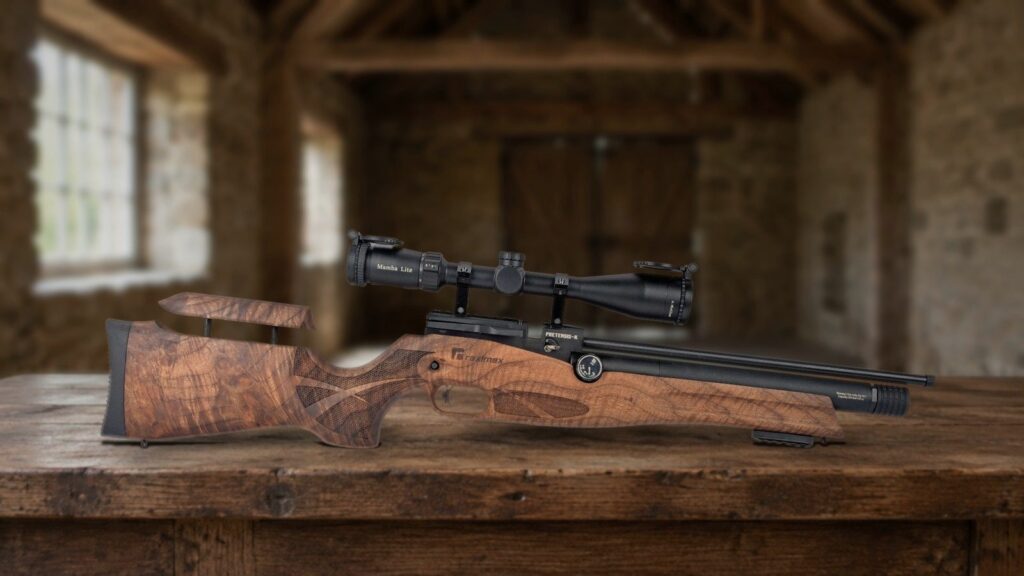
Reximex Pretensis-K review: a walnut-stocked PCP carbine that gives more rifle than its £615 price
Dave Barham tests the .22 Reximex Pretensis-K, the carbine version of the Turkish maker’s well-regarded Pretensis, on the chronograph and the bench – and finds it every bit as good as its big brother,...
By Dave Barham | 4 November 2026
Get the latest news delivered direct to your door
Subscribe to Shooting Times & Country
Discover the ultimate companion for fieldsports enthusiasts with Shooting Times & Country Magazine, the UK’s leading weekly publication that has been at the forefront of shooting culture since 1882. Subscribers gain access to expert tips, comprehensive gear reviews, seasonal advice and a vibrant community of like-minded shooters.
Save on shop price when you subscribe with weekly issues featuring in-depth articles on gundog training, exclusive member offers and access to the digital back issue library. A Shooting Times & Country subscription is more than a magazine, don’t just read about the countryside; immerse yourself in its most authoritative and engaging publication.

