★ Your magazine. Your say. Complete our reader survey with a chance to win Jack Pyke kit worth £500! ★


The copper revolution: what lead-free bullets really do at stalking ranges
Game processors want lead-free venison and the law now has a deadline. Selena Barr asks what copper really does at stalking ranges


The pressure to drop lead did not start in Westminster. Forestry England says its rangers use lead-free ammunition and that it was one of the first UK organisations to do so, and it markets the venison it sells through Highland Game as 100% wild and lead-free. Forestry and Land Scotland’s policy says every deer and feral pig culled by its rangers has been shot lead-free since 1 April 2019, with contract renewals requiring the same of contractors, and it put around 850,000kg of venison into the food chain in 2017/18.
In 2021 National Game Dealers Association members voted to source venison and wild boar from lead-free supply chains from 1 July 2022, and the British Deer Society (BDS) warned that some approved game handling establishments would stop buying lead-shot venison that August. If your deer go anywhere but your own freezer, the buyer decided this for you long ago.
When does the lead ban apply to rifle bullets?
The law has now caught up. The REACH (Amendment) Regulations 2026 came into force on 1 April 2026 and apply in England, Wales and Scotland. From 1 April 2029 a bullet containing 3% or more lead by weight cannot be used or sold for live quarry shooting in any calibre of 6.17mm or above, which catches the .243 Winchester and everything larger; smaller centrefires used on live quarry, and airgun pellets, are exempt. Outdoor ranges are restricted a year earlier, from 1 April 2028, unless they have notified risk-management measures.
Minimum bullet weights and the Deer Act
Scotland moved first on deer: the Deer (Firearms etc.) (Scotland) Amendment Order 2023 cut the minimum bullet weight for deer other than roe from 100gr to 80gr, roe staying at 50gr, and its explanatory note says plainly that the change was made to permit copper. In England and Wales, the Deer Act 1991 still requires a soft-nosed or hollow-nosed bullet, at least .240in and 1,700ft/lb (.220in, 1,000ft/lb and a 50gr bullet for muntjac and Chinese water deer); the tipped monolithics below are hollow-points with a polymer plug to start expansion.
Copper is less dense than lead, so a bullet of the same weight is longer and one of the same length is lighter. Makers therefore load lighter-for-calibre bullets faster, because a monolithic needs impact velocity to open: Rifle Shooter’s testing works to roughly 2,000fps at the target as the floor for reliable expansion. Once open, copper holds together. Hornady claims 95% weight retention for the CX, Federal and RWS 99%, Norma almost 100%.
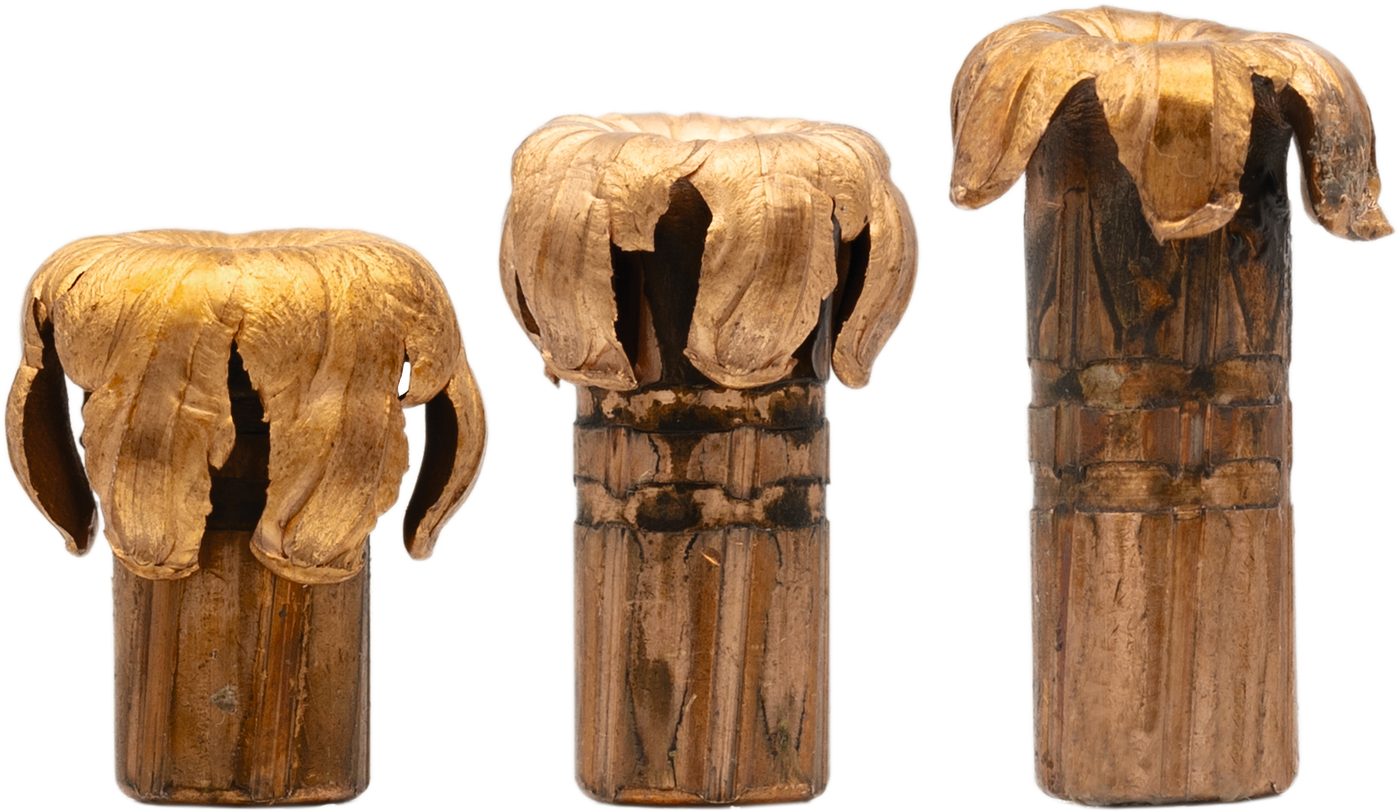
NatureScot Research Report 1312, published in 2022, fired seven factory .243 copper loads and three lead loads into ballistic soap and gelatine at 100m. The copper bullets retained almost all of their mass; the 100gr lead loads came back at 38gr to 68gr. The copper bullets travelled around 30mm into the soap before expanding, against about 10mm for lead, then opened to roughly twice calibre.
A cleaner carcass for the larder
Their permanent wound cavities averaged 216ml against 270ml for 100gr lead, and the report concluded that, with velocity and energy minimums met, there would be no detrimental effect on deer welfare. The larder finding matters too: copper produces a cleaner carcass because there are no lead fragments and none of the bruising their wound tracks cause.
How does copper perform on deer at 100 to 250 yards?
What does that mean on a fallow or a sika between 100 and 250 yards? The best UK field data is Tim Pilbeam’s study for Rifle Shooter, which followed 15 stalkers for five months across six calibres and more than 20 lead-free loads, taking over 325 deer including fallow, red, roe, muntjac and Chinese water deer. The average run-off for body-shot deer was 18m. No pencilling was witnessed, one roe was lost, two ricochets were seen, and beyond 250m there was no evidence that copper was failing to expand.
Tim’s caveats matter: the copper wound channel is narrower and deeper than a fragmenting lead one, the reaction is sometimes less dramatic, the beast standing a second or two before it goes down, and placement matters more because you are not relying on fragmentation to do the work. Head and neck shots, all 170 of them, produced no runners.
Distance is a velocity question, and the tipped designs exist to keep ballistic coefficient up so that impact speed stays inside the expansion window. Hornady’s published figures for the 6.5 Creedmoor 120gr CX give 2,925fps at the muzzle, 2,501fps at 200 yards and 2,303fps at 300, so a 250-yard sika is well inside the window. An 80gr to 85gr copper .243 left NatureScot’s test rifle at between 2,900fps and 3,250fps but sheds speed faster.
Know your own figure: almost every factory load measured below its catalogue velocity in that 21¾in barrel, because factory data assumes something nearer 24in, so a short stalking barrel gives up margin at the far end.
The lead-free loads on the market
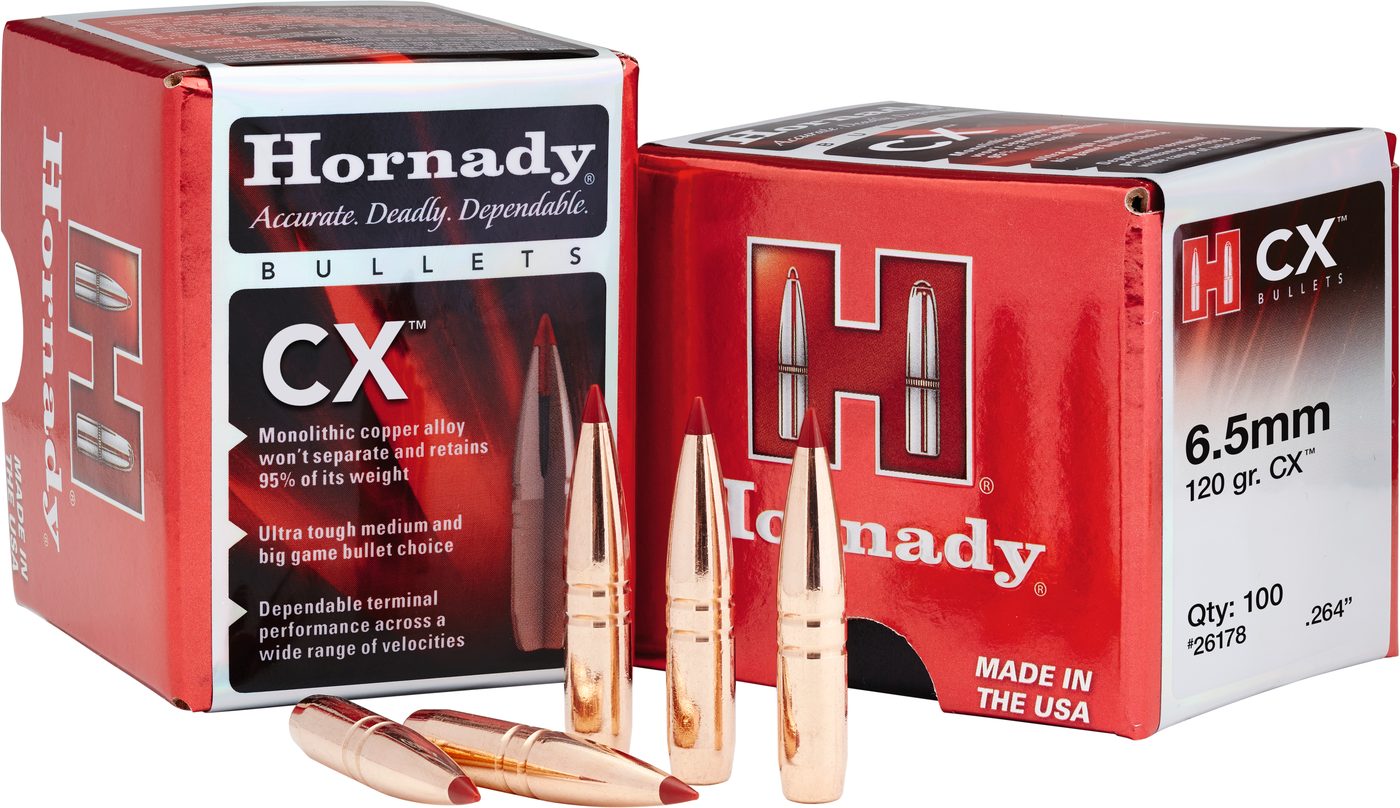
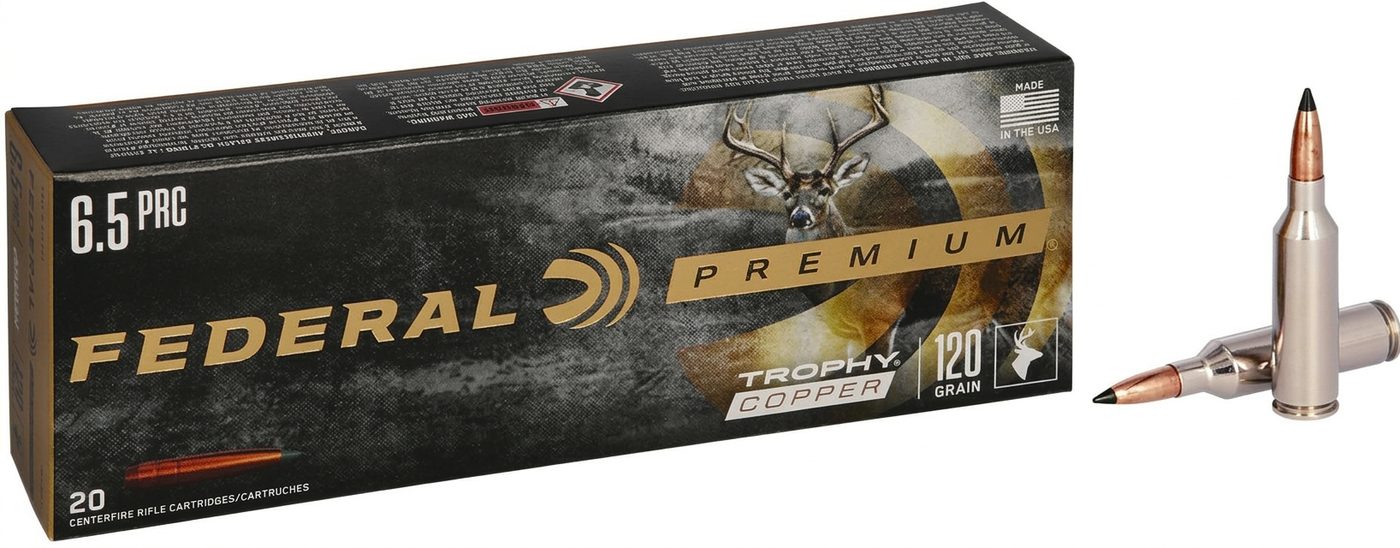
Hornady’s CX replaced the GMX and sits in the Outfitter line with sealed, nickel-plated cases; it is a copper alloy with a Heat Shield tip and grooves that Hornady says reduce bearing surface and fouling. Edgar Brothers imports it. Federal’s Trophy Copper pairs a tipped cavity, which Federal says opens across a broad velocity range, with a grooved shank and a nickel-plated case. RWS offers two routes: HIT is a monolithic copper bullet with a twin-compression tip that RWS says opens to about twice calibre and retains 99%, while Evolution Green is not a monolithic at all but a double tin-core partial fragmenter with a nickel-plated jacket, built to react fast at low velocity on light and medium game; in Tim’s study its front core produced violent entry wounds and, at times, meat damage.
Sako’s Powerhead Blade is 100% copper with a tri-blade tip and a reaction chamber that Sako says drives expansion even at the lowest impact velocities while resisting bone; 25 deer fell to the 162gr .308 version in Tim’s study. Fox Classic Hunter is made in Slovenia from a copper-zinc alloy with a thermo-stable tip and grooves that Fox says reduce pressure; Edinburgh Rifles imports and factory-loads it in the UK, says its short profile meets the Deer Act while stabilising in slow-twist factory barrels, and that it is in volume use with UK forestry organisations.
NatureScot’s test found the 80gr Fox shed its petals, retaining 53.5gr, yet produced one of the two largest copper wound cavities at 270ml. Norma’s Ecostrike is a nickel-coated copper bullet that Norma says expands at both low and high velocity and was designed to exceed its Oryx.
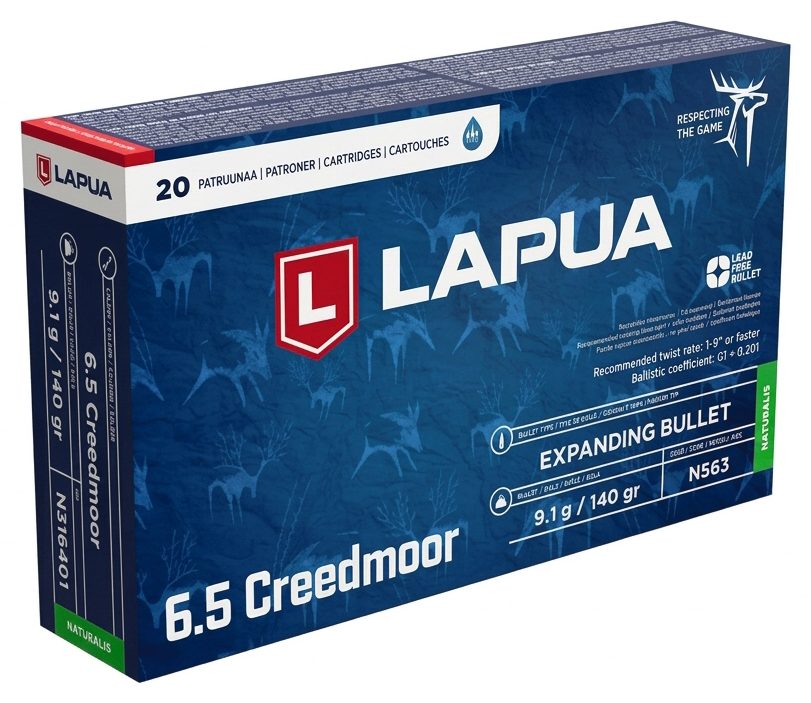
Viking Arms, which was championing copper long before legislation brought the subject into sharper focus, brings in Lapua’s Naturalis, a solid copper bullet designed for controlled expansion and high weight retention, and Sellier & Bellot’s eXergy Blue, which pairs a monolithic copper bullet with a polymer tip. “These products demonstrate why innovation is so important,” says commercial director Andy Norris, “it ensures the move away from lead delivers not only environmental benefits and cleaner venison, but also the accuracy, consistency and humane performance that responsible deer management demands.”
Twist rate and rifles for copper bullets
The rifle question is mostly twist rate. Longer copper bullets need faster twists, which is why NatureScot could not source a 100gr copper .243 load and why GMK, Sako’s UK distributor, says the 90 series barrels were retwisted for modern bullets, with UK dealers listing the .243 at 1-in-8in. The 90 Adventure has a carbon-reinforced fibreglass stock, adjustable comb and Cerakoted stainless action; the 90 Peak is a 2.6kg carbon-stocked hill rifle. Tikka’s T3x Lite Stainless remains the affordable default.
Switch-barrel rifles: a calibre change becomes a barrel change
Switch-barrel platforms turn a calibre change into a barrel change: Blaser’s R8, in adjustable-stocked Ultimate or walnut Jaeger form, and Sauer’s 404 Synchro XT, now succeeded by the 505, let a .243 owner move to a 6.5 or .308 barrel, where copper choice is widest; Sauer’s 101 covers the conventional end. Bergara’s B-14 range, including the Cerakoted Extreme Hunter, sits on a Remington 700 footprint with a sub-MOA guarantee.
Rigby’s Highland Stalker, a Mauser 98 in .275 Rigby, reminds us that heritage calibres are caught too: 7mm sits above the 6.17mm line, and its express sights are regulated to 250 yards for a bullet that will now be lighter and faster than the one they were cut for.
Copper fouling, cleaning and moderators
Copper fouling is the cleaning worry, and makers have engineered for it: Hornady says the CX grooves cut bearing surface and fouling, Fox says its grooves cut contact and pressure, and Norma and RWS plate their bullets in nickel. ShootingUK’s tester noticed none after a box of Fox in a 7mm-08. The sensible regime is a copper solvent after zeroing, a bore check before the season and a full re-zero whenever the load changes, because a lighter, faster bullet will not print where the old one did.
None of this changes the moderator’s job, but a calibre change might, and modular designs follow it. A-TEC’s Optima 45 swaps front modules across .224 to .375, weighs 335g and is rated at 29dB(C), while its H2 has just been succeeded by the H3. Schultz & Larsen’s Superdome takes an add-on baffle module and the Venom is its lighter sibling.
Wildcat’s Evolution, from UK Custom Shop, is a 446g modular reflex design that swaps calibres and threads with new parts and sits between the Predator 8 and 12. Hausken’s JAKT series, led by the JD224, is pitched as the all-rounder.
Finding the right lead-free load for your rifle
Finding the right load is the hard part, and importers are trying to shorten the search. Edgar Brothers has drawn on UK and overseas testing, including Tim’s, and its own in-house research to chart the most popular calibres and lead bullet weights against the most suitable lead-free alternative, a starting point for stalkers making the switch; the charts will be available as a leaflet in gunshops.
“We’re not guaranteeing that our suggestion will be perfect for their rifle – there are many factors, as we all know – but hopefully it gives someone a starting point in what can be quite a daunting and even stressful process,” says Graham Turner of Edgar Brothers.
The revolution, then, is less about the bullet than the discipline around it: a load your barrel stabilises, a chronograph figure you trust, a velocity floor you respect at your longest shot, and a clean carcass at the end of it.
Frequently asked questions
Which calibres does the lead bullet ban cover?
From 1 April 2029, bullets containing 3% or more lead by weight cannot be used or sold for live quarry shooting in calibres of 6.17mm or above, which includes the .243 Winchester. Smaller centrefires used on live quarry, and airgun pellets, are exempt.
What impact velocity does a copper bullet need to expand?
Rifle Shooter’s testing works to roughly 2,000fps at the target as the floor for reliable expansion of a monolithic copper bullet.
Do I need a faster twist barrel for copper bullets?
Often, yes. Copper is less dense than lead, so bullets of a given weight are longer and need a faster twist to stabilise. Check your barrel’s twist rate before choosing a lead-free load.

About the author
Selena Barr
Originally cutting her teeth as Shooting Times news editor two decades ago, her career in sporting journalism has taken her all over the world turning field adventures into reports that focus on conservation and sustainability.
 Closes 15 JanuaryWorth £129.90Win a pair of tickets to the British Shooting Show 2027Enter nowFree to enter
Related Articles

Stalking diary: a week of Highland stags and a partridge day in Perthshire
A week on the open hill in the Highlands tests every skill for Chris Rogers – but it is a partridge day in Perthshire that provides the real challenge
By Chris Rogers | 15 October 2026

Gamekeeper: why head shots are the wrong answer, and how to process venison at home
Falling carcass prices are encouraging risky head shots, says David Whitby, but there is a better way – and it ends with a freezer full of venison
By David Whitby | 15 October 2026
Get the latest news delivered direct to your door
Subscribe to Shooting Times & Country
Discover the ultimate companion for fieldsports enthusiasts with Shooting Times & Country Magazine, the UK’s leading weekly publication that has been at the forefront of shooting culture since 1882. Subscribers gain access to expert tips, comprehensive gear reviews, seasonal advice and a vibrant community of like-minded shooters.
Save on shop price when you subscribe with weekly issues featuring in-depth articles on gundog training, exclusive member offers and access to the digital back issue library. A Shooting Times & Country subscription is more than a magazine, don’t just read about the countryside; immerse yourself in its most authoritative and engaging publication.

