★ Your magazine. Your say. Complete our reader survey with a chance to win Jack Pyke kit worth £500! ★

Jottings for wildfowlers: opening-day greylags and picking the right spot on the saltings
Opening day brings greylags off the estuary in their hundreds, and Graham Downing learns that it pays to pick the right spot on the saltings

Geese seem to have been everywhere over the past few weeks. There are greylags on our local farm reservoirs and trout lakes, there have been big numbers of Canadas flighting out onto the stubbles from old flooded gravel workings in the river valley and the other day I even saw a skein of barnacles flying over the farm. It’s the same out on the coastal marshes, which prompted me to think in terms of a trip down to the foreshore for a goose on 1 September rather than driving over to the Ouse Washes in search of an early mallard.
There’s not too much preparation needed for a simple morning flight at this time of year. The night-time temperature is so mild that I barely need a fowling jacket, and a pair of wellies is quite sufficient to tramp out onto the saltings – there’s no real need for waders. I had got my gun and a full belt of Eley bismuth ready the previous evening, so it was just a matter of boiling the kettle for a quick cup of tea before the half-hour drive to the club car park, then walking out to the foreshore.
A thermal imager for the walk out in the dark
It’s about a 40-minute hike across the grazing marshes to get to the sea wall, and it’s got to be done in full darkness. For this reason, I had slipped my Pulsar Accolade thermal imager into my fowling bag. Given the amount of time that is spent in darkness or near darkness during the fowling season, it makes a good deal of sense to carry the thermal. A head torch will light up the ground for several metres around, but with a thermal imager you can see the entire landscape to the horizon. Not only that, but you can check out where wildfowl are settling at night, and you can even watch airborne packs of ducks or skeins of geese in complete darkness as they move around the marsh. I have recently upgraded the thermal device I use for deerstalking, so my old Accolade has now been relegated to wildfowling duties.
There was barely a glow in the eastern sky as I climbed the steps to the top of the sea wall and drank in that magical burst of salt air scented with a cocktail of seaweed and estuarine mud. High water had only just been and gone, so the tide was right up to the edge of the saltings, with a light onshore breeze making ideal conditions for a morning flight. Having first scanned the grazing marsh with the thermal to check for geese, I rounded the bay and dropped down onto the saltings with Holly trotting along beside me. I had hoped that resident birds might be flighting out across the marsh to the opposite side of the estuary, but the thermal picked out nothing apart from crowds of waders.
Careful positioning on the saltings
And at the first crack of dawn, that was what came over me. Shrieking redshank rushing low over the marsh, bar-tailed godwits and an army of curlews just visible against the dawn sky. I had chosen my position carefully. The closest point of the saltings is normally a good spot and served me well last season. Moreover, I had first choice, since nobody else was out on the marsh. Or so I thought.
The light was already coming up when I spotted another person and a dog hurrying along the sea wall. An early-morning dog walker or another fowler? I soon clocked the gun slip on his back, and after a brief conversation, he made his way halfway along the marsh, maybe 250 yards from where I crouched along the tideline.
As it turned out, he was right and I was wrong. Within half an hour I could hear goose talk. A low murmuring at first but rising to a mighty crescendo as a huge army of greylags appeared over the water, coming from the far side of the estuary. I tucked low into the marsh, but it was clear that their track was not going to be over me, and sure enough they poured over my new friend. I looked on as maybe 150 geese went over him, watched his gun go up, heard the shot and saw a single bird crash down onto the saltings.
Oh well, it may not have been my morning, but at least one of our club members scored a goose on the first day of the season. And the geese will remain here or hereabouts for a few more weeks to come. Perhaps next time I might select a different position for morning flight.
Graham Downing is a passionate wildfowler who has been shooting over innumerable estuaries and marshes with a dog at heel for more than 50 years.
Frequently asked questions
Why carry a thermal imager when wildfowling?
A head torch lights only a few metres around you, but a thermal imager shows the whole landscape to the horizon, so you can see where wildfowl are settling at night and watch packs of duck or skeins of geese moving in the dark.
What do you need for an early-season morning flight?
In early September Graham Downing finds a light jacket and wellies enough on the saltings, with no real need for waders, plus his gun, a belt of non-toxic cartridges such as bismuth and a thermal imager for the walk out in the dark.

About the author
Graham Downing
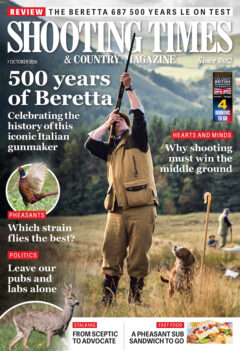
A Suffolk-based independent shooting consultant with 50 years' practical experience of shotguns and rifles across all areas of shooting sport, Graham has been a regular contributor to Shooting Times for more than 30 years. Appointed secretary of the British Shooting Sports Council in 2019, he co-ordinates political lobbying across Britain's major shooting associations on firearms control, and is a vice-president of BASC. He gave oral evidence to the Home Affairs Committee's 2009 inquiry into firearms controls. A keen deer stalker, wildfowler, game and rough shooter who has shot since the age of 13, Graham is the author of nine books, including The Deer Stalking Handbook, Practical Woodland Stalking, Stalking Muntjac, The Sporting Shooter's Handbook and A Sporting Century, the history of BASC.
 Closes 15 JanuaryWorth £129.90Win a pair of tickets to the British Shooting Show 2027Enter nowFree to enter
Related Articles

Jottings for wildfowlers: what should the fowler wear on the foreshore?
No camouflage pattern works everywhere, says Gethin Jones, so what should the wildfowler wear – and why do silhouette and movement give you away long before colour?
By Gethin Jones | 24 September 2026

Some places will never be too dry: wildfowling a drought
Drought has emptied most of the marsh ditches, but Alan Jarrett finds that the falling tide still leaves pools that hold a duck or two
By Alan Jarrett | 17 September 2026
Get the latest news delivered direct to your door
Subscribe to Shooting Times & Country
Discover the ultimate companion for fieldsports enthusiasts with Shooting Times & Country Magazine, the UK’s leading weekly publication that has been at the forefront of shooting culture since 1882. Subscribers gain access to expert tips, comprehensive gear reviews, seasonal advice and a vibrant community of like-minded shooters.
Save on shop price when you subscribe with weekly issues featuring in-depth articles on gundog training, exclusive member offers and access to the digital back issue library. A Shooting Times & Country subscription is more than a magazine, don’t just read about the countryside; immerse yourself in its most authoritative and engaging publication.
 New competitionWin a pair of tickets to the British Shooting Show 2027Worth £129.90Closes 15 JanuaryEnter now ›