★ Your magazine. Your say. Complete our reader survey with a chance to win Jack Pyke kit worth £500! ★

Jottings for wildfowlers: what should the fowler wear on the foreshore?
No camouflage pattern works everywhere, says Gethin Jones, so what should the wildfowler wear – and why do silhouette and movement give you away long before colour?


An essential consideration for the wildfowler, whether seasoned or novice, is the art of concealment. In a sport where you place yourself in an entirely natural environment – to wit, the foreshore – in the pursuit of wild birds possessing the sharpest eyesight, and where you usually employ tactics involving sitting and waiting for your quarry to come into the relatively short range of a shotgun, the ability to conceal yourself effectively in your surroundings is vital to success.
A standing line of Guns on a pheasant drive needn’t bother themselves too much about camouflage, although bright, gaudy colours should be shunned in any case to avoid frightening onlookers as much as the birds. Shooters in pursuit of wilder prey, however, do need to consider some sort of natural disguise.
Pigeon shooters use hides made of camouflage netting, and deerstalkers wear clothing of subdued colours to suit their environment – including tweed, a material long designed with camouflage very much in mind.
Choosing colours for foreshores that change with the light
So what should a wildfowler wear to best conceal himself or herself on foreshores that vary in colour from green marsh grasses and yellow sands to dark brown mud and in light conditions varying from bright sunlight to pitch darkness? Clearly, there can be no universally accepted shade or colour of clothing that can serve to disguise the fowler in such a wide range of environments, so you should seek some sort of compromise, based on the environment in which you do most of your fowling.
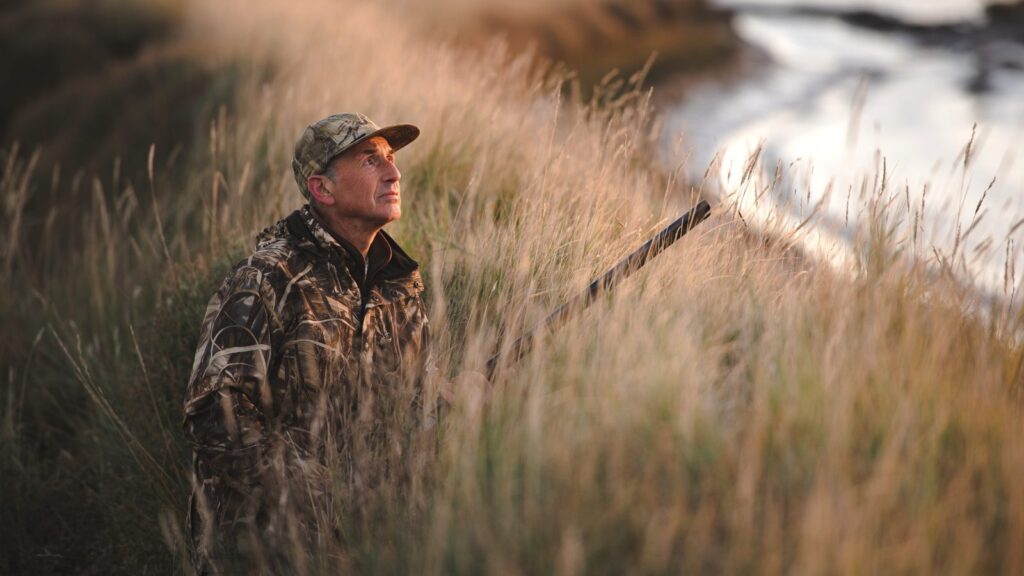
For many years, pretty well the only available choice of outerwear was the classic waxed cotton jacket, which I always thought appeared too dark for most foreshores, even in low-light conditions. Nowadays, there is a plethora of camouflage shades and designs available to wildfowlers who wish to kit themselves out in camouflage, from shooting jackets and chest waders through to matching gun camouflage.
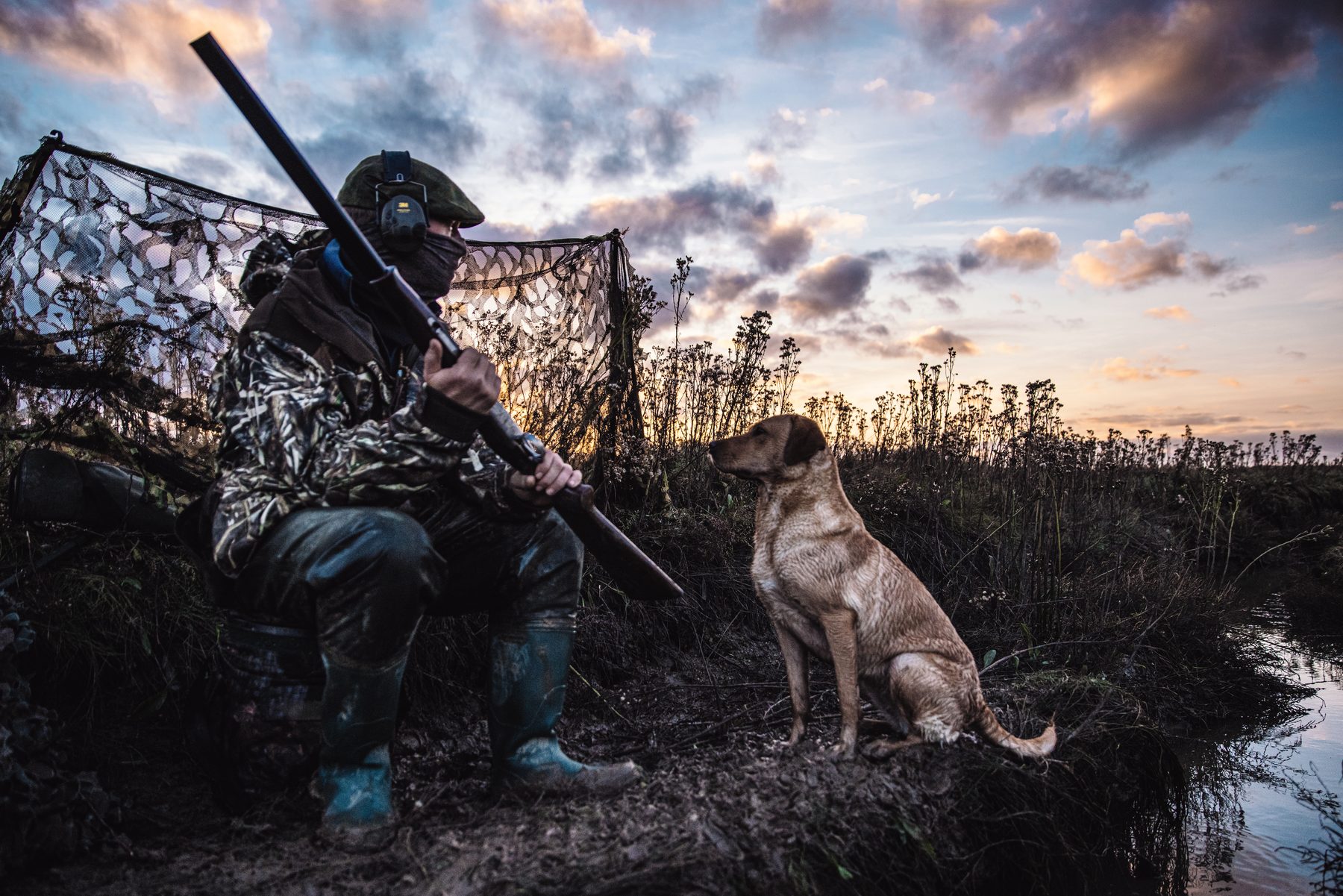
Black Labrador or yellow for the foreshore?
And what of the wildfowler’s dog? Regardless of breed, I’ve often pondered this very question on a quiet duck flight, as nobody has yet bred a retriever with a camouflage coat. As far as the ubiquitous Labrador is concerned, the recognised colours are black, yellow and chocolate, with the darker fox-red shades of yellow much more often seen nowadays.
Many fowlers swear by a yellow Lab, claiming that a black dog shows up too much to passing fowl, in daylight, half-light or even in the dark. I’ve always held the opposite view and prefer a jet-black Lab for my fowling in all light conditions.
Why silhouette and movement matter more than camouflage
As for my own attire, my preference is not to wear camo clothing but to stick to plain green, brown or khaki. This is because I’m convinced that no single camouflage pattern can be effective in all light conditions and all environments. Moreover, I suspect that advocates of camouflaged clothing may often convince themselves that they’re more hidden than they are. I also rarely take camouflage netting with me, although I do appreciate that this can be essential kit in certain settings.
When observing other wildfowlers in their natural habitat, the first things I notice are their silhouette and any movement they make, regardless of what they’re wearing. It’s a safe bet that this is what sharp-eyed wildfowl notice first, too. So when you are seeking to disguise yourself on the foreshore, my considered advice would be: use natural cover as much as possible.
Always keep below the skyline. Cover or shade your head, face and hands as best you can and last – but certainly not least – keep quiet and keep still.
Gethin Jones is a keen wildfowler and rough shooter. He joined BASC (then WAGBI) at the age of 16, the day after he shot his first mallard.
Frequently asked questions
Do you need camouflage clothing for wildfowling?
Not necessarily. Gethin Jones prefers plain green, brown or khaki, arguing that no single camouflage pattern works in every light and on every foreshore, and that silhouette and movement give a fowler away before colour does.
How do you stay hidden from wildfowl on the foreshore?
Use natural cover as much as possible, keep below the skyline, cover or shade your head, face and hands, and keep quiet and still.

About the author
Gethin Jones
A wildfowler who writes duck and goose shooting features for Shooting Times.
 Closes 15 JanuaryWorth £129.90Win a pair of tickets to the British Shooting Show 2027Enter nowFree to enter
Related Articles
Jottings for wildfowlers: opening-day greylags and picking the right spot on the saltings
Opening day brings greylags off the estuary in their hundreds, and Graham Downing learns that it pays to pick the right spot on the saltings
By Graham Downing | 7 October 2026

Cut from a different cloth: the outdoor clothing brand with country roots and a conscience
Pete Tyjas meets Hooké founder Fred Campbell, whose conservation-led outdoor clothing has just launched in the UK, to talk country roots, eating what you catch and looking after the places we love
By Pete Tyjas | 2 October 2026
Get the latest news delivered direct to your door
Subscribe to Shooting Times & Country
Discover the ultimate companion for fieldsports enthusiasts with Shooting Times & Country Magazine, the UK’s leading weekly publication that has been at the forefront of shooting culture since 1882. Subscribers gain access to expert tips, comprehensive gear reviews, seasonal advice and a vibrant community of like-minded shooters.
Save on shop price when you subscribe with weekly issues featuring in-depth articles on gundog training, exclusive member offers and access to the digital back issue library. A Shooting Times & Country subscription is more than a magazine, don’t just read about the countryside; immerse yourself in its most authoritative and engaging publication.
 New competitionWin a pair of tickets to the British Shooting Show 2027Worth £129.90Closes 15 JanuaryEnter now ›