★ Your magazine. Your say. Complete our reader survey with a chance to win Jack Pyke kit worth £500! ★


New season and new kit: the Pulsar Symbion DXT50 on a muntjac stalk
Graham Downing swaps two sets of binoculars for one multispectral device and puts Pulsar's Symbion DXT50 to work on a dark September morning in the woods
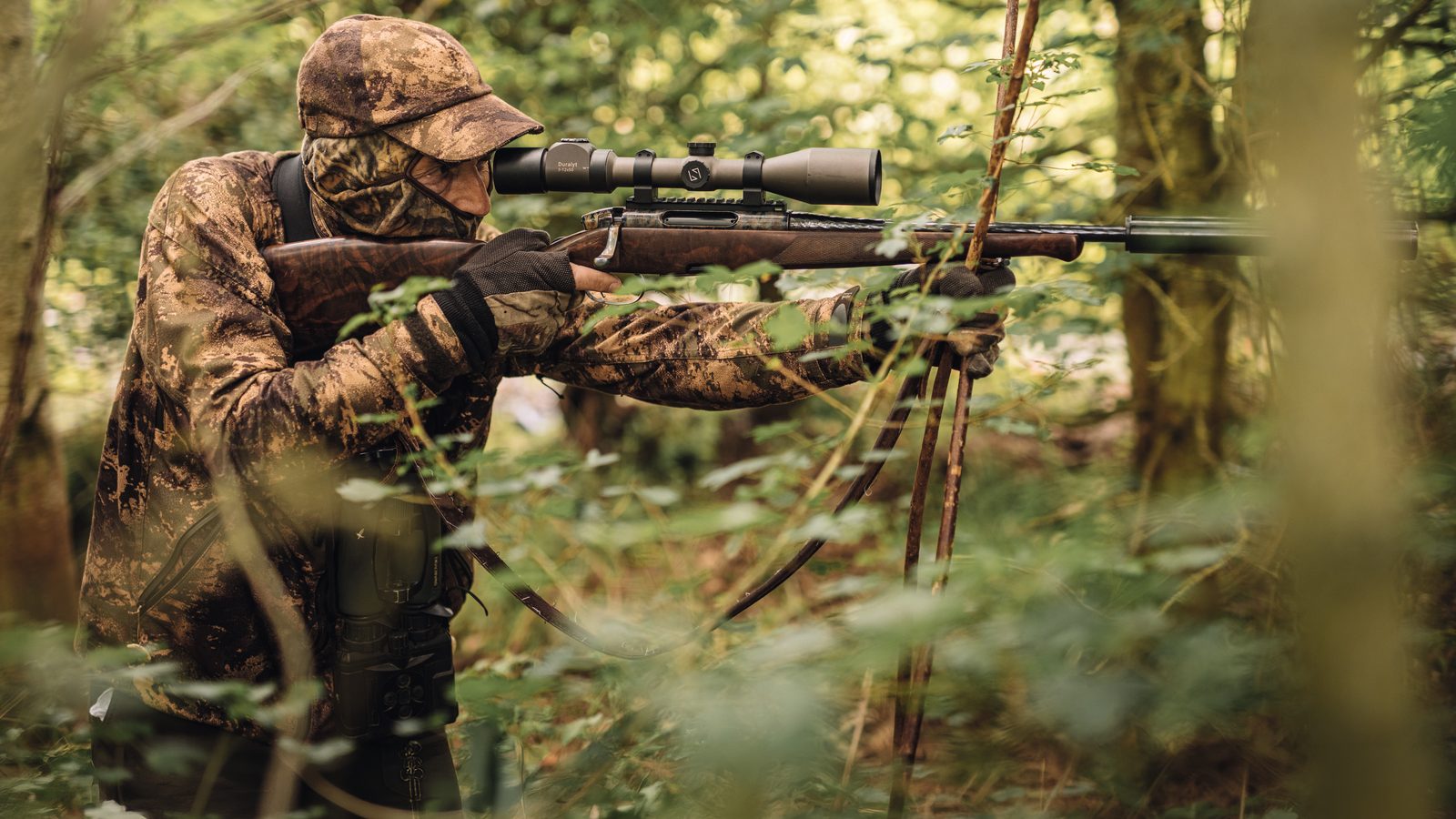
Back in July I wrote about how the march of technology has revolutionised the way I stalk and how the use of new kit, and in particular thermal imaging, has reduced the time it takes me to cull a deer – from an average of 6.6 stalking hours per cull in 2015 to just 48 minutes in 2025. I have never been a great one for new technology. My preference has always been to stick with the old ways and what you know, but there comes a moment when the benefits are so obvious that investment in technology becomes a no-brainer.
For the past seven years I have stalked with two devices dangling in front of me: my Pulsar Accolade thermal binoculars, which I have relied on as my primary means of detecting and spotting deer, and my Swarovski EL optical binoculars, with which I can confirm the identity of what I am looking at. In reality, as I have become more confident about identifying species and sex through the thermals, I have been using conventional binoculars less. But although the binoculars have remained an essential standby, the need to have two chunky devices hanging round my neck as I thread my way through the woods in the half-light is not exactly ideal.
Why a multispectral binocular made sense
I have often thought of replacing my lovely Swarovskis with a lighter, more compact pair of optical binos but never got around to doing so. However, at Nuremberg’s IWA shooting fair in February I took a really detailed look at Pulsar’s new Symbion multispectral binoculars, which offer both thermal and daylight digital channels through the same device.
There are now several multispectral devices on the market, but I have consistently been impressed by the quality of Pulsar’s products. They are superbly well built in a European factory rather than being imported from the Far East, and they are more than capable of taking the brutal treatment that is handed to them when being used, day after day, in the filthy conditions of a British winter.
I well remember a few years ago leaving my Accolades on the bonnet of my Land Rover before driving a couple of miles to the start of my stalk and then realising to my horror that they must have fallen off somewhere along a winding country road. Three-quarters of an hour later I found them. They had crashed into the verge, detaching one of the eyepieces in the process. I found the eyepiece a few feet away, screwed it back in, pressed the ‘on’ button, and the Accolades worked perfectly. This is not a product test I would recommend, but it demonstrated to me how rugged Pulsar’s kit really is.
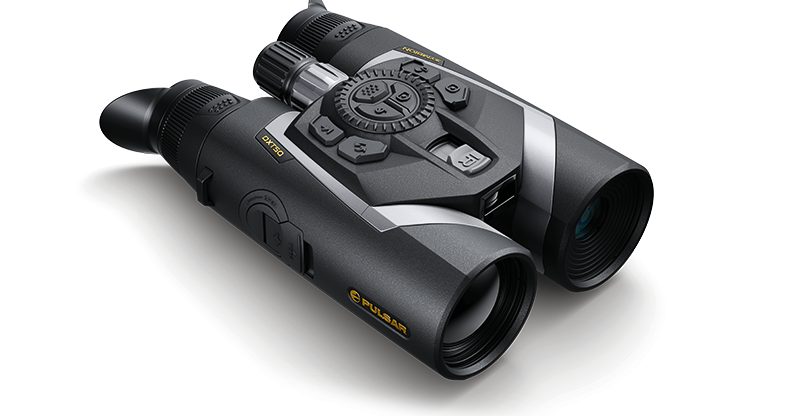
A show discount at the Game Fair sealed the deal, and I walked away with a pair of Pulsar’s top-of-the-range Symbion DXT50 multispectrals, which I have now been playing with for the past couple of months. It really is a hugely impressive device, enabling me to toggle instantly between thermal observation and a range of digital channels. The thermal display is superbly crisp and will magnify from 2x to 24x – though for spotting it’s always best to maintain a low setting.
Switch to digital and you have brilliant daylight binoculars that are as good as looking at your LED television screen, plus a twilight channel and a night-time infrared (IR) channel complete with an IR illuminator beam that you can quickly adjust from wide-angle to tight focus. All this, plus a laser rangefinder, image stabilisation, full image, video recording options and a Bluetooth capability that will send the display to your phone.
What’s more, instead of carrying two devices around my neck with an all-up weight of 1,855g, I now need only one pair of binoculars weighing 1,100g – a saving of more than three-quarters of a kilo. Of course, daylight digital will never replace the fabulous clarity and perfect colour rendition of good-quality optical glass, but for sheer practicality the DXT50 is seriously impressive.
A pitch-dark start in the woods
But how would the Symbion perform in the field? I parked up in a familiar spot for a first proper look around the woods. At 5am on a cloudy morning it was pitch dark, and in the first week of September the leaf was still heavy on the trees and the ground cover remained dense. The rides, however, had been trimmed, and where the brambles were not too thick the thermal channel enabled me to see well into the woods beside me. A thermal imager, however, is not an X-ray machine, and there is a limit to the amount of cover that it will penetrate. There may well have been muntjac in the undergrowth as I made my way through the wood, but for the first half-hour I saw none.
Checking down each ride and carefully scanning a young plantation, I could see little apart from the odd rabbit, a few hares and the occasional grey squirrel. And while the forester would be only too delighted for me to deal with those little critters, I have had to remind him gently that my .243 is not exactly the most appropriate tool for squirrel shooting.
Then, some 40 yards ahead of me in a bramble bush I spotted a substantial thermal signature. Carefully observing it for a few moments I could see that there were two animals, almost certainly muntjac, moving around together in the dense cover. I set up the rifle and observed them through my Krypton clip-on. Eventually one of the animals showed itself more fully and I immediately confirmed the profile of a muntjac buck. A bullet was quickly on its way and through the Krypton I watched a second muntjac rapidly depart the scene while the buck kicked its last.
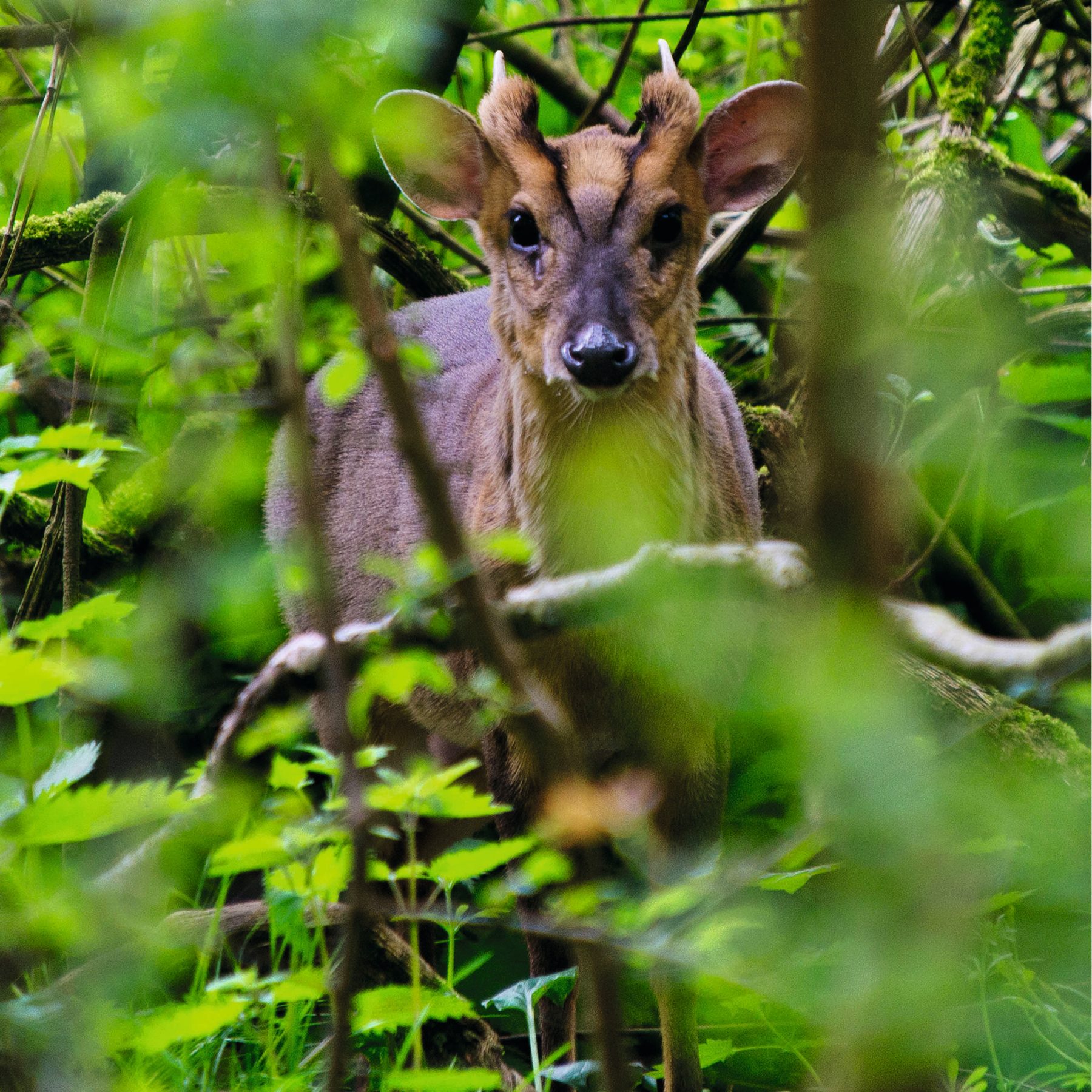
It was nearly sunrise now, and the woods were looking gorgeous at the start of their autumnal colour change, the yellow, brown and gold having come particularly early this year as a result of the prolonged drought. The forestry team had also been busy over the summer, and there was plenty of evidence to show where some of the older, more mature oaks had been taken out for the timber merchant, the paths that had been cut for their extraction offering new ways into the heart of the wood.
Leaves as crispy as cornflakes and a fallow pricket
I took the opportunity to explore one of these new extraction paths, taking care to do so as quietly as I could while stepping over twigs and branches and weaving my way across a carpet of dead, dry leaves that were as crispy as cornflakes. Then, scanning with the thermals, I spotted a small deer emerging onto the path some 70 yards ahead of me. It was a muntjac doe, and although I was in plain sight she had not seen me and was busy nosing around some fallen branches. Quietly and carefully I set up the quad sticks and picked up the doe in the Krypton, waited for her to pause for a moment and squeezed off a round. The doe immediately slumped to the ground.
Dragging the carcass to one of the main rides, I thought about what I might do for the final part of my outing, and as I did so a much larger deer stepped out some 90 yards ahead of me. A fallow certainly, but was it a buck or a doe? The thermal image was not offering any clues, so I toggled instantly to the digital channel and was able to admire the handsome chestnut-red coat with rows of white spots, along with a modest set of headgear. A very shootable pricket.
Steadying myself off the sticks, I took a chest shot, heard a satisfying thump as the 90-gr bullet struck home and watched through the Krypton as the buck stumbled slightly before dashing across the ride and disappearing into the trees on the other side. I walked forward to the point of the strike and noted the splashes of bright red blood on the ride. But while I was confident that he was down, I also knew that he could well have run another 100 yards through heavy cover before collapsing. It would be quickest to head back to the Land Rover and fetch Holly, my Labrador.
Holly was, of course, thrilled to be given a run. I showed her the strike and the point at which the buck had crossed the ride, and she was off like a bullet, quartering and questing before getting her nose down and speeding through the wood ahead of me. She took maybe a minute and a half to do what might easily have taken me an hour, finding the fallow slumped dead in a clearing.
It was a delighted dog that gratefully accepted the little titbits of lung that I offered her at the gralloch, and an equally delighted owner who brought three deer back to the larder that morning, the pricket turning the scales at 43.65kg in the chiller.
Of course it might all have been done with my old familiar kit, but the Pulsar Symbion definitely helped.
Graham’s kitbag
What Graham took on the stalk
- Steyr Mannlicher rifle in .243 Winchester
- Zeiss Duralyt 3-12×50 riflescope
- Lapua Naturalis 90-gr non-lead ammunition
- Pulsar Symbion DXT50 multispectral binoculars
- Pulsar Krypton clip-on thermal sighting device
- Blaser quad sticks
- Musto stalking jacket
- Lowa boots
Frequently asked questions
What is a multispectral binocular?
A single device that combines a thermal imaging channel with daylight digital channels. The Pulsar Symbion DXT50 lets the user toggle between thermal observation, daylight, twilight and night-time infrared channels, and adds a laser rangefinder, image stabilisation, video recording and Bluetooth.
How much weight does the Symbion DXT50 save?
In Graham Downing’s case, replacing a pair of thermal binoculars and a pair of optical binoculars (1,855g together) with the 1,100g Symbion DXT50 saved more than three-quarters of a kilo.
Is there a close season for muntjac?
No. Muntjac have no close season, which is why they can be stalked in early September when other species are out of season or the leaf is still heavy on the trees.

About the author
Graham Downing
A Suffolk-based independent shooting consultant with 50 years' practical experience of shotguns and rifles across all areas of shooting sport, Graham has been a regular contributor to Shooting Times for more than 30 years. Appointed secretary of the British Shooting Sports Council in 2019, he co-ordinates political lobbying across Britain's major shooting associations on firearms control, and is a vice-president of BASC. He gave oral evidence to the Home Affairs Committee's 2009 inquiry into firearms controls. A keen deer stalker, wildfowler, game and rough shooter who has shot since the age of 13, Graham is the author of nine books, including The Deer Stalking Handbook, Practical Woodland Stalking, Stalking Muntjac, The Sporting Shooter's Handbook and A Sporting Century, the history of BASC.
Related Articles
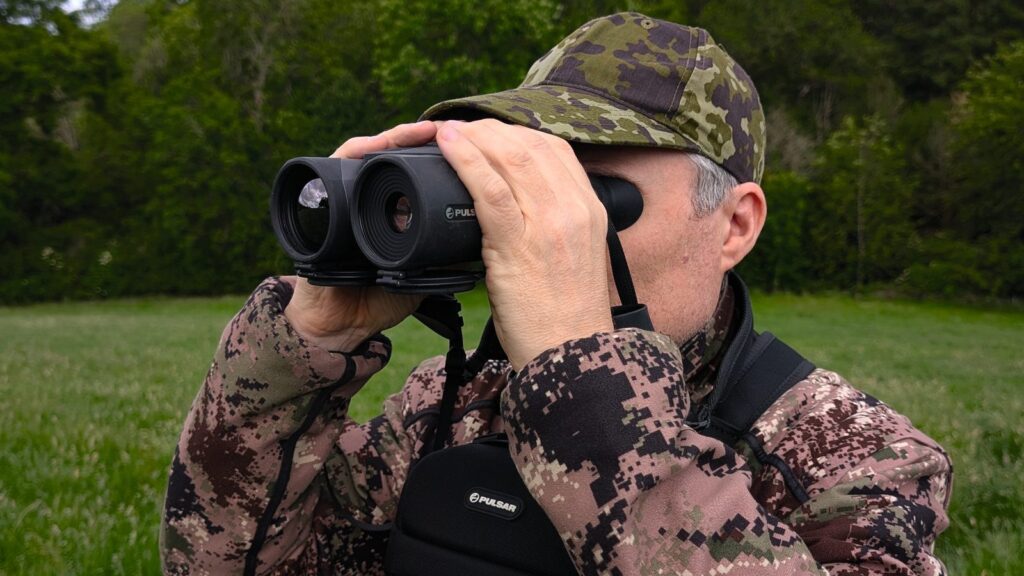
Pulsar Symbion LRF DXR50 multispectral binoculars review
These multispectral binoculars are not cheap by any means, but the thermal channel and the handling win the day, says Jules Whicker, who rates them the best he has used
By Jules Whicker | 23 September 2026
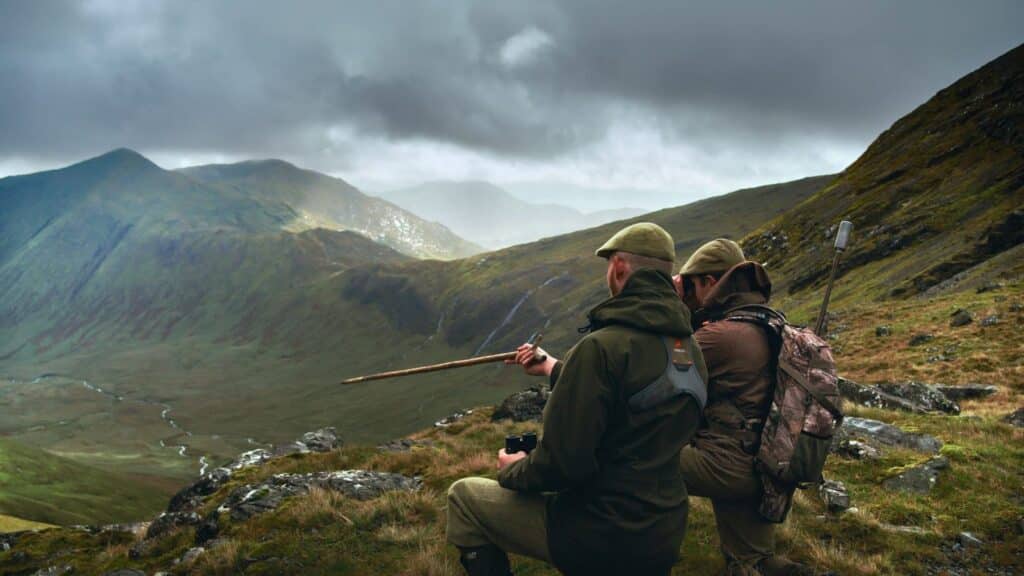
It isn’t meant to be easy: stalking and fishing at Benmore Estate on Mull
Kirk Norbury heads for Benmore Estate on the Isle of Mull, where sideways rain and cloud-covered hills are half the attraction and make it unforgettable
By Kirk Norbury | 18 September 2026
Get the latest news delivered direct to your door
Subscribe to Shooting Times & Country
Discover the ultimate companion for fieldsports enthusiasts with Shooting Times & Country Magazine, the UK’s leading weekly publication that has been at the forefront of shooting culture since 1882. Subscribers gain access to expert tips, comprehensive gear reviews, seasonal advice and a vibrant community of like-minded shooters.
Save on shop price when you subscribe with weekly issues featuring in-depth articles on gundog training, exclusive member offers and access to the digital back issue library. A Shooting Times & Country subscription is more than a magazine, don’t just read about the countryside; immerse yourself in its most authoritative and engaging publication.