★ Your magazine. Your say. Complete our reader survey with a chance to win Jack Pyke kit worth £500! ★

Stalking Diary: a woodland double in the roe rut
A young buck falls during a productive cull on the North York Moors, and the master of the wood comes swiftly in, looking for his rival, writes Al Gabriel


The roe rut was in full swing across the North York Moors, and despite a relentless midsummer heatwave the cull was proving remarkably productive. High temperatures invariably force these secretive woodland deer into the deepest shade, turning traditional stalking into an exercise in sheer, exhausting frustration. Consequently I found myself relying on a high seat tucked neatly into the middle of the wood, overlooking a dense carpet of undergrowth and the rolling hills beyond. I was struck by the resilience of the young broadleaves, thriving despite weeks of baking sun. During this frantic phase of the rut territorial tempers reach fever pitch, and on one mercifully overcast evening the drama finally unfolded.
I had been waiting less than half an hour when a promising young six-pointer stepped cautiously into the clearing, framed by the soft, golden light an hour before dusk. A single, well-placed copper round from the .270 brought a swift end to his season, dropping the buck cleanly. Given I still had an hour until last light, I opted to stay put and see if Lady Luck might smile on me again. Shortly after, a heavy-set, mature six-pointer emerged from the treeline some 300 yards off, testing the breeze aggressively as he made his way towards his fallen rival. Closing to within 40 yards, undeterred by the shot that had rung out earlier, he held his head high, drawing in a heavy lungful of air like an adder sampling the wind, utterly fixated on the intruder.
The ultimate bait
It dawned on me then that the youngster had inadvertently played the role of the ultimate bait, coaxing the true master of the woods straight out of hiding. Driven by seasonal madness, the old buck marched directly towards the carcass, blissfully unaware of my position high above his line of sight. A second precise shot brought a memorable woodland double to a tidy close.
The formidable scenting machinery of the roe deer
What proved most fascinating was how unerringly the old buck had navigated straight to the mark, fuelled by hormonal momentum and completely unable to comprehend why an interloper lay silent on his beat. He was utterly locked on to the scent trail, blind to any other hidden danger lurking nearby.
This extraordinary display of biological GPS relied entirely on the roe deer’s formidable scenting machinery. Every stalker knows a deer’s primary defence is its nose, yet the physiological gulf between us remains extraordinary. To put our human shortcomings into perspective, if the olfactory tissue inside a human nasal cavity were the size of a 2p coin, a roe deer’s membrane would easily cover an adult’s palm, and it is packed with upwards of 250 million specialised scent receptors. What is more, the olfactory bulb, the dedicated engine room of the brain tasked with decoding these complex airborne messages, is roughly four times larger in a deer than in a human.
Pheromones and Jacobson’s organ
Deep within the roof of the mouth lies Jacobson’s organ, operating as a high-powered chemical processor. Through air-sampling, a rutting buck channels airborne pheromones directly into this secondary neural pathway. When that master buck caught a rival’s hormone signature, his brain registered it not as a mere smell, but as an intolerable, direct challenge to his authority.
After the dust had settled, extracting a pair of heavy roebucks through a pitch-black, suffocating tangle of gorse, tall grass and bramble proved a punishing physical ordeal, but the real blow to my ego arrived five days later at the larder table, when I discovered a pair of tick nymphs anchored firmly in my forearm. It seems that while I was busy admiring the sensory sophistication of the noble roebuck, I had inadvertently become the prey.
Al Gabriel is a molecular biologist and keen deerstalker with a strong interest in promoting diversity and public understanding of fieldsports.
Frequently asked questions
How good is a roe deer’s sense of smell?
Extraordinary. If the olfactory tissue in a human nasal cavity were the size of a 2p coin, a roe deer’s membrane would cover an adult’s palm, carrying upwards of 250 million scent receptors, and the olfactory bulb in a deer’s brain is roughly four times larger than a human’s.
What is Jacobson’s organ?
A chemical processor deep in the roof of the deer’s mouth. Through air-sampling, a rutting buck channels airborne pheromones directly into this secondary neural pathway, so a rival’s hormone signature registers not as a mere smell but as a direct challenge to his authority.
Why use a high seat in hot weather?
High temperatures force roe into the deepest shade, making traditional stalking exhausting and often fruitless. A high seat overlooking undergrowth lets the stalker wait above the deer’s line of sight, with the added safety and visibility the elevated position brings.
Related Articles

From dawn stalk to burger night: muntjac from the ride to the pub menu
Keith Edmunds sets off down a Suffolk lane under sheet lightning, with insect repellent on and a thermal in his pocket, for a morning after muntjac on the Nedging Hall estate. What follows is a ruined...
By Keith Edmunds | 1 September 2026
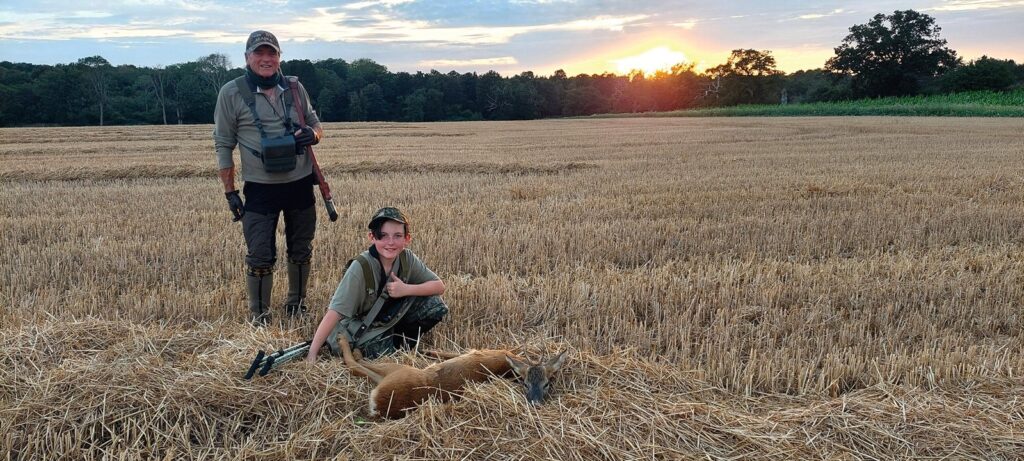
Stalking diary: a slow roe rut and a young guest's first buck
Chris Rogers finds the roe rut slow to start at Euston, but a tactical stalk gives a young guest an invaluable insight into ethical deer management
By Chris Rogers | 21 August 2026
Get the latest news delivered direct to your door
Subscribe to Shooting Times & Country
Discover the ultimate companion for fieldsports enthusiasts with Shooting Times & Country Magazine, the UK’s leading weekly publication that has been at the forefront of shooting culture since 1882. Subscribers gain access to expert tips, comprehensive gear reviews, seasonal advice and a vibrant community of like-minded shooters.
Save on shop price when you subscribe with weekly issues featuring in-depth articles on gundog training, exclusive member offers and access to the digital back issue library. A Shooting Times & Country subscription is more than a magazine, don’t just read about the countryside; immerse yourself in its most authoritative and engaging publication.